Heritage Analysis: Isfandiyar’s Third Course – The Dragon Slain
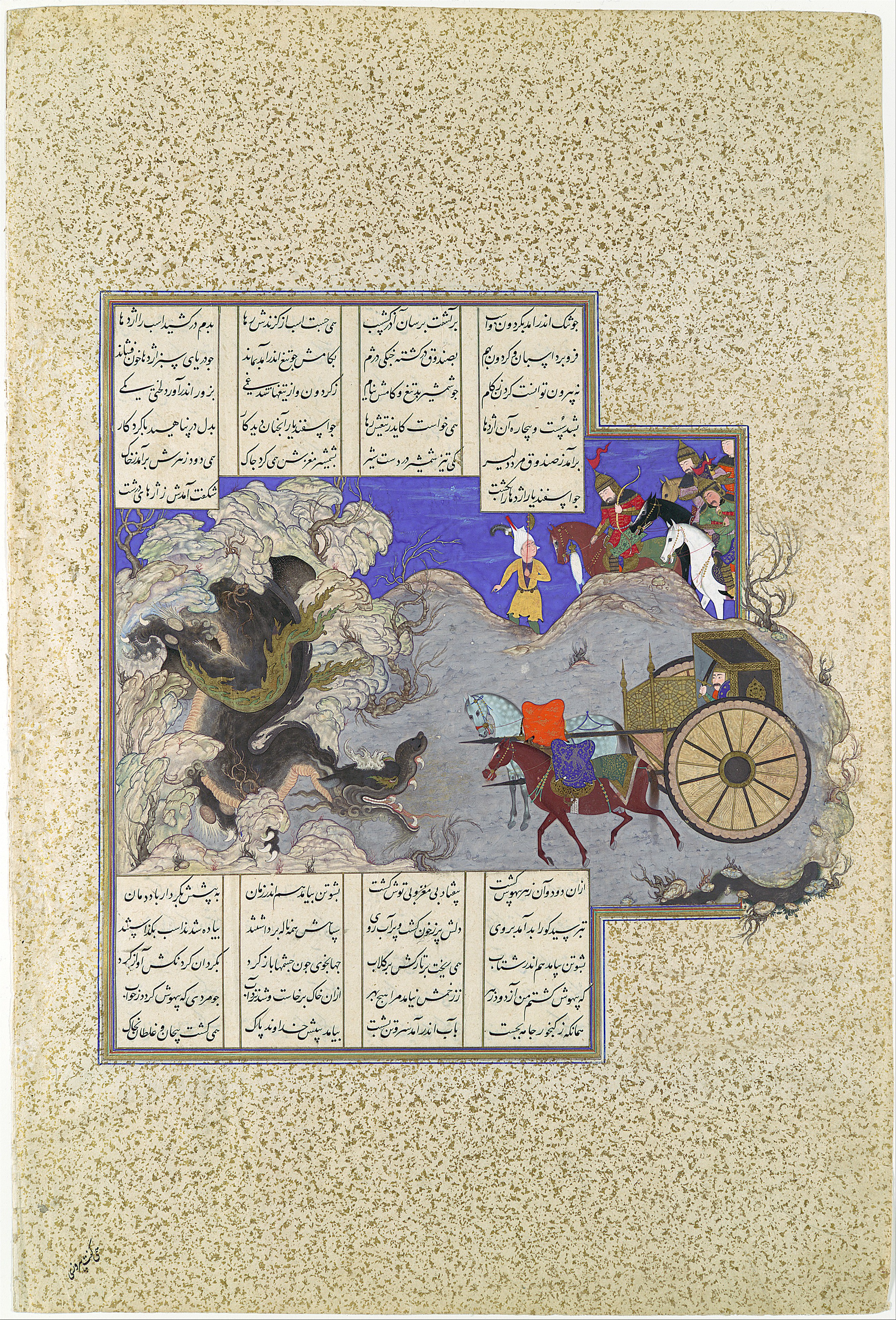
Katherine Fashion Lab presents this strategic heritage analysis of Folio 434v from the Shahnama (Book of Kings) of Shah Tahmasp, specifically depicting Isfandiyar’s Third Course: He Slays a Dragon. This masterpiece, executed in opaque watercolor, ink, silver, and gold on paper, originates from the Safavid dynasty—a civilization renowned for its synthesis of spiritual devotion, martial prowess, and artistic opulence. For the 2026 luxury landscape, this folio is not merely an artifact; it is a blueprint for symbolic power, historical adornment, and spiritual resonance that can be translated into a high-end brand narrative of invincibility and enlightenment.
Symbolic Power: The Architecture of Triumph
The iconographic weight of this folio rests on the representation of Isfandiyar as the divinely sanctioned hero. In Persian epic tradition, Isfandiyar’s seven courses are not physical battles alone; they are metaphysical trials that prove his legitimacy to rule. The dragon, rendered with serpentine coils and fiery breath, symbolizes chaos, untamed nature, and the internal demons of the soul. The hero’s victory is a codified statement of order over anarchy—a concept luxury brands can leverage as a narrative of controlled excellence.
For Katherine Fashion Lab’s 2026 strategy, this translates into a design language of precision and dominance. The dragon’s scales, each meticulously painted, suggest a texture of impenetrable armor. A luxury collection can reinterpret this through scaled leatherwork, laser-cut metal appliqués, and structural tailoring that mimics the hero’s cuirass. The silver and gold pigments, now oxidized, speak to the patina of time—a reminder that true power is not ephemeral but accrues value through age. The strategic takeaway is to position the brand as the slayer of mediocrity, using sharp silhouettes and metallic finishes to convey a decisive, victorious aesthetic.
Historical Adornment: The Regalia of the Warrior-King
Examine the adornment of Isfandiyar: his helm, his jeweled belt, and the intricate patterns on his horse’s trappings. These are not decorative flourishes but functional signifiers of rank. The Safavid court understood that adornment is a form of communication—it broadcasts social standing, military capability, and divine favor before a single word is spoken. The folio’s use of gold leaf for the hero’s crown and the dragon’s eye is a deliberate choice to draw the viewer’s gaze to points of power.
In a 2026 high-end context, historical adornment becomes a tool for personal branding. Katherine Fashion Lab can develop a line of statement accessories—cuffs, brooches, and headpieces—that echo the folio’s geometry. The dragon’s eye, a singular orb of gold, can be abstracted into a monocle pendant or a ring with a cabochon stone, symbolizing the wearer’s ability to see through deception. The hero’s belt, adorned with plaques, can inspire a corset belt or a waist-cinching accessory that emphasizes the warrior’s core—both physical and metaphorical. This is not nostalgic reproduction but adaptive reuse of iconography for the modern power dresser.
Spiritual Meaning: The Alchemy of the Seven Courses
The spiritual dimension of this folio is profound. Isfandiyar’s third course occurs after he has survived the wolf and the lion, signifying the progressive purification of the soul. The dragon, often associated with the baser instincts, must be conquered to achieve spiritual illumination. The artists used opaque watercolor to create a luminous, otherworldly glow, suggesting that the battle occurs in a liminal space between the mortal and the divine. The silver, now tarnished, once shimmered to represent the hero’s farr—the divine glory that legitimizes kingship.
For luxury consumers in 2026, spiritual meaning is a premium commodity. The market is saturated with material goods; what remains scarce is meaning and transcendence. Katherine Fashion Lab can position its 2026 collection as a “Seven Courses” series, where each garment or accessory corresponds to a trial. The dragon piece would be the centerpiece—a sculptural gown or a dramatic outerwear silhouette in deep greens and burnished golds, representing the moment of catharsis. The spiritual narrative is not religious but existential: the brand sells the idea of overcoming personal dragons. Marketing collateral should emphasize the ritual of dressing as a preparatory act for one’s own battles, drawing a direct line from the Safavid hero to the contemporary client.
2026 High-End Luxury Strategy: From Folio to Fashion House
To translate this heritage analysis into a viable 2026 strategy, Katherine Fashion Lab must adopt a curatorial approach to product development. The folio offers three strategic pillars:
Pillar One: The “Victory” Silhouette
Design pieces that feature sharp shoulders, cinched waists, and floor-sweeping lengths—echoing the hero’s stance over the dragon. Use jacquard weaves with metallic threads to mimic the folio’s gold and silver. The color palette should be drawn from the original: lapis blue, cinnabar red, and verdigris green, offset by the stark white of the hero’s horse. These are not seasonal colors but timeless pigments that convey regality.
Pillar Two: The “Armor” Accessory
Develop a capsule of hardware-forward accessories—belt buckles shaped like dragon scales, earrings that cascade like the hero’s chainmail, and a signature “Isfandiyar” clutch with a gold clasp resembling the dragon’s maw. These pieces are designed to be heirlooms, not disposable trends. The materials should be heavy: brass, enamel, and semi-precious stones, ensuring the tactile weight of power.
Pillar Three: The “Legacy” Narrative
Luxury in 2026 is defined by storytelling and provenance. Katherine Fashion Lab should produce a limited-edition folio booklet accompanying the collection, featuring high-resolution details of Folio 434v and an essay on Safavid symbolism. This transforms the purchase from a transaction into an acquisition of cultural capital. The brand can also host a private viewing event in partnership with a museum, positioning the collection as a bridge between ancient craft and modern design. This strategy leverages scarcity and intellectual depth—two pillars of sustained luxury value.
Conclusion: The Dragon as Brand Metaphor
Folio 434v is not a static image; it is a dynamic manifesto on the nature of power. For Katherine Fashion Lab, the dragon represents the challenges of a saturated market, and Isfandiyar represents the brand’s resolve to conquer through heritage, artistry, and spiritual resonance. By integrating the folio’s symbolic power, historical adornment, and spiritual meaning into a cohesive 2026 strategy, the fashion house can offer more than clothing—it can offer a wearable myth. The client who wears this collection is not merely dressed; they are invested with the farr of a legendary king, ready to face their own seven courses with grace and invincibility. This is the ultimate luxury: the purchase of a story that empowers the wearer to write their own victory.