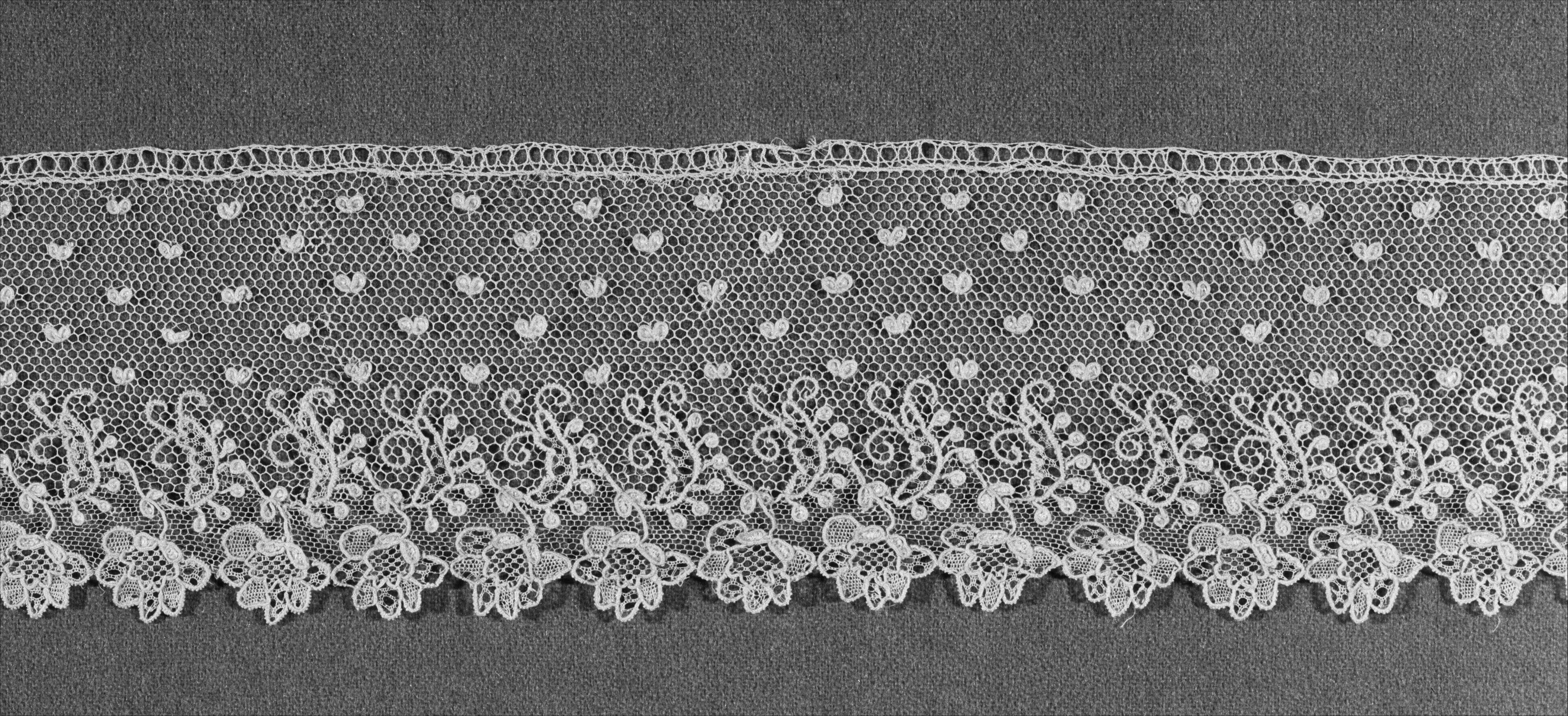
The Cartography of Absence: Needle Lace and the Border in Katherine Fashion Lab’s Global Heritage Study
In the rarefied echelons of contemporary couture, where fabric is often reduced to mere spectacle, Katherine Fashion Lab’s standalone study on the subject of Border emerges as a profound meditation on geopolitical and existential demarcation. Drawing from a lineage of Global Heritage, the study eschews the literal—no barbed wire, no passport stamps—in favor of a far more subversive material lexicon. The chosen medium, needle lace in the specific tradition of point d’Alençon, is not an ornament but an argument. It posits that the border is not a line of exclusion but a porous membrane of negotiation, a thesis executed with the precision of a surgeon and the vision of a poet.
Deconstructing the Line: Point d’Alençon as Territorial Syntax
To understand the gravity of this study, one must first appreciate the technical ontology of point d’Alençon. Originating in the 17th century in Normandy, this needle lace is distinguished by its fine network of cordonnet—a twisted, horsehair-reinforced outline that defines each motif. Historically, this cordonnet served as a rigid boundary, a structural necessity that separated floral patterns from the transparent ground. In Katherine Fashion Lab’s hands, this historical rigidity is deliberately destabilized. The cordonnet is no longer a hard edge; it is rendered in irregular, hand-knotted loops that mimic the organic, contested lines of natural frontiers—rivers that shift course, mountain passes that erode.
The study presents a series of garment sculptures, each a cartographic exercise. The primary piece, a sleeveless architectural tunic, deploys point d’Alençon not as a decorative overlay but as the primary structural skin. The lace is worked in panels that do not meet at conventional seams. Instead, they overlap in a state of perpetual negotiation, with the cordonnet acting as a visible, tactile treaty. This is a deliberate inversion of couture’s usual obsession with seamless perfection. Here, the seam is celebrated as the site of contact, the place where two distinct territories—two pieces of lace—must reconcile their differences. The result is a garment that breathes with the tension of diplomacy.
Material Memory: The Global Heritage of the Porous Ground
The choice of point d’Alençon is also a strategic act of cultural reclamation. While the technique is quintessentially French, Katherine Fashion Lab’s Global Heritage context reframes it as a diasporic language. The lace’s transparent réseau (the netted background) is read as a metaphor for the migrant’s gaze—a view through a filter that is both obstructive and revealing. The study draws parallels between the hand movements of the lace maker—the repetitive, almost ritualistic twisting of thread—and the labor of generations who have crossed borders, carrying their craft as their only portable homeland.
In one poignant ensemble, a floor-length gown, the point d’Alençon is left unbleached, retaining a faint, ecru tint that recalls aged parchment or the patina of a well-worn map. The motifs are not the classic rosettes or lily-of-the-valley but abstracted topographical forms: concentric circles suggesting elevation, broken arcs implying coastlines. This is a cartography of memory, where the border is not a political imposition but a palimpsest of human movement. The gown’s hem is left intentionally raw, with loose threads that trail like the frayed edges of a disputed territory, suggesting that the story is not yet concluded.
The Alchemy of Negative Space: Absence as Presence
Perhaps the most intellectually rigorous aspect of this study is its treatment of negative space. In traditional point d’Alençon, the ground is a necessary void, a backdrop that gives the pattern its relief. Katherine Fashion Lab elevates this void to a protagonist. In a striking bolero jacket, the lace is so densely worked on the shoulders that it forms a near-solid carapace, only to dissolve into almost pure transparency at the nape of the neck. This gradient from opacity to absence is a direct commentary on the selective permeability of borders. The garment asks: Who is allowed to be solid, and who is rendered invisible?
The construction technique itself is a feat of engineering. Each piece required over 400 hours of handwork, with artisans using a single needle and thread to build the lace from scratch on a parchment pattern. There is no machine intervention; the border is literally hand-drawn in thread. This labor intensity is not a fetishization of craft but a political statement. In an era of fast fashion and algorithmic design, the study insists on the irreducible value of human time as the ultimate luxury. The border, in this context, is also a temporal boundary—a demarcation between the instantaneous and the enduring.
Wearable Dialectics: The Body as Contested Territory
The silhouette of the collection is deliberately ascetic—columnar, with minimal darts, allowing the lace to dictate the form. This is a wise curatorial decision. The body beneath becomes the terrain upon which the border is drawn. When the garment moves, the lace shifts, and the cordonnet lines appear to migrate across the skin. This kinetic effect subverts the static nature of cartography. The border is no longer a fixed point on a map but a living, breathing negotiation that changes with every gesture.
One accessory, a pair of elbow-length gloves, is particularly evocative. The fingers are fully enclosed in dense, opaque lace, while the palm is left almost bare, save for a few floating threads. This inversion of protection and exposure speaks to the dual nature of borders: they shield and they isolate. The gloves are a study in ambivalence, refusing to offer a comfortable moral position. The wearer is neither victim nor oppressor, but a participant in the ongoing construction of their own boundaries.
Conclusion: A New Lexicon for the Line
Katherine Fashion Lab’s Border study is a masterclass in conceptual couture, one that refuses to be reduced to a mere garment. It is a philosophical treatise executed in thread, a geopolitical critique articulated through the most delicate of materials. By employing point d’Alençon, a technique historically associated with aristocratic courts and rigid social hierarchies, the lab subverts its legacy to interrogate contemporary migration, identity, and sovereignty. The Global Heritage framing is not a tokenistic nod to diversity but a rigorous acknowledgment that borders are not natural phenomena—they are human inventions, and as such, they can be re-imagined.
This is couture at its most intellectually potent: a standalone study that does not simply dress the body but challenges the very lines we draw around it. The border, here, is not a wall. It is a stitch. A loop. A thread that connects even as it separates. In an industry often accused of superficiality, Katherine Fashion Lab has produced a work of profound material intelligence, one that will linger in the mind long after the lace is stored away, a haunting reminder that the most important frontiers are not on maps, but in the spaces we create between ourselves and others.