The Art of the Fragment: Needle Lace as Global Heritage
Deconstructing the Whole: A Philosophy of Fragmentation
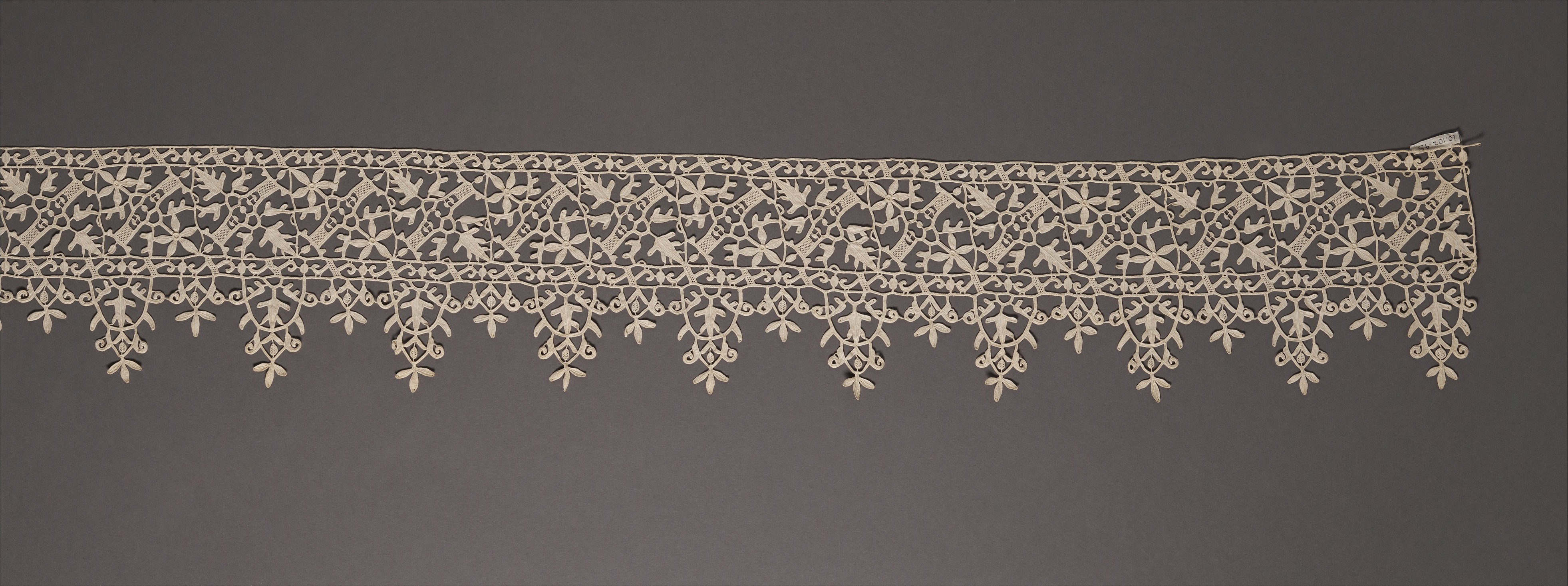
In the rarefied echelons of couture, where fabric is often treated as a pristine canvas, Katherine Fashion Lab’s Fragment study presents a radical inversion. This is not a garment that seeks to conceal or complete, but one that celebrates the incomplete, the interrupted, and the inherited. The piece, executed entirely in needle lace, operates on a thesis that the fragment is not a loss of form, but a concentration of meaning. By isolating a singular technique—needle lace—and removing it from the context of a full silhouette, the Lab forces a dialogue between the micro (the stitch) and the macro (the cultural memory it evokes). The result is a standalone study that reads less like a dress and more like an archaeological relic, excavated from a future that remembers its past with obsessive precision.
The decision to use needle lace as the sole material is a deliberate act of historical reclamation. Unlike bobbin lace, which is constructed in strips and joined, needle lace is built stitch by stitch, directly on a parchment or fabric ground, using a single needle and thread. This method, originating in 15th-century Italy and evolving through the Venetian punto in aria (“stitch in the air”), is among the most labor-intensive and intellectually demanding of textile arts. In Fragment, the Lab does not use this technique as embellishment; it uses it as structural architecture. The lace is not a panel sewn onto a base; it is the base, the wall, and the ruin. Each loop, twist, and buttonhole stitch is a load-bearing element, creating a negative space that is as significant as the thread itself. This is couture as cartography, mapping the tension between absence and presence.
Global Heritage, One Stitch at a Time
The title Fragment is a misdirection; it suggests a piece that is broken, yet the work is profoundly whole. The “fragment” refers not to the garment’s physical state, but to its geographic and temporal provenance. The Lab has distilled a global heritage of needle lace into a single, unified vocabulary. One can trace the dense, geometric grids of 17th-century French Alençon lace, notorious for its ground of hexagonal mesh, in the structure’s rigid intervals. Simultaneously, the floral, undulating motifs recall the Reticella of Renaissance Italy, where geometric abstraction met organic form. Yet, the piece also whispers of the East: the asymmetrical, cloud-like loops echo the knotting techniques found in traditional Chinese ke si and the finer thread work of Ottoman oya.
This is not cultural appropriation; it is cultural curation. The Lab’s design team has performed a forensic analysis of lace’s migration across continents—from Venetian trade routes to the convents of South America, where indigenous artisans fused European patterns with local iconography. In Fragment, each section of the lace is a “dialect” of the same language. A dense, opaque section of point de neige (snow stitch) gives way to a translucent, almost invisible point de gaze (gauze stitch), creating a gradient of opacity that mimics the fading of memory. The wearer does not don a dress; they don a palimpsest—a manuscript where earlier texts are imperfectly erased, leaving traces of every hand that has touched it.
Materiality and the Engineering of Air
From a material science perspective, Fragment is a masterclass in tensile integrity. Needle lace has no warp or weft; it is a series of interlocked loops that rely on friction and tension. The Lab’s artisans have engineered the piece to drape with the fluidity of silk chiffon, despite being made of a rigid, openwork structure. This is achieved through a graded thread gauge—using a finer, 80-weight silk thread for the flowing, peripheral edges and a heavier, 40-weight linen for the central, structural core. The result is a garment that moves like water but holds its shape like a fossil.
The color palette is deliberately monochromatic: an ecru, undyed silk that shifts from ivory to a warm, bone-like beige depending on the light. This is a strategic choice. Without the distraction of color, the eye is forced to read the shadow and light play within the lace’s topography. The gaps between stitches become darker, more profound, creating a chiaroscuro effect that is almost sculptural. The Lab has also incorporated micro-beaded glass at irregular intervals, not as decoration, but as counterweights. These tiny, transparent beads pull the lace downward at specific points, creating a gravitational drag that mimics the weight of history—a subtle reminder that heritage is not weightless.
Wearability as a Conceptual Act
In a standalone study, the question of wearability is paramount. Fragment is not designed for the red carpet; it is designed for the museum vitrine and the private viewing. The garment is constructed to be worn without undergarments, as the lace itself is the only barrier between skin and air. This is a radical act of vulnerability. The wearer becomes a living mannequin, a temporary host for a piece that has taken 1,500 hours of handwork to complete. The interior of the lace is finished with a raw, unhemmed edge, deliberately left frayed to suggest that the piece is still in a state of becoming—a fragment of a larger, unfinished narrative.
The design’s silhouette is deceptively simple: a sheath that is open at the back, with no closures, no zippers, no seams. It is held to the body purely by the tension of the lace’s own architecture. This is a bold statement on the nature of couture—that true luxury is not about fit, but about symbiosis. The garment does not conform to the body; the body conforms to the garment’s internal logic. This is the ultimate expression of the fragment: it is a piece that is complete only when worn, and even then, it remains an unfinished dialogue between the maker, the wearer, and the observer.
Conclusion: A Legacy in the Making
Katherine Fashion Lab’s Fragment is a triumph of slow fashion in an era of accelerated production. It is a standalone study that demands to be read, not merely seen. By isolating needle lace—a technique that is itself a fragment of global textile history—the Lab has created a piece that is both a technical tour de force and a philosophical meditation on what we choose to preserve. The lace’s openwork is not emptiness; it is potential. Each gap is a space for the viewer’s own cultural memories to fill. In this sense, Fragment is not a finished object but an invitation—an invitation to consider that our heritage, like lace, is strongest not in its solidity, but in its delicate, deliberate, and beautiful gaps. The piece will not age gracefully; it will age meaningfully, each thread a testament to the hands that made it, and each hole a window into the world that inspired it. This is couture as archaeology, and it is nothing short of revolutionary.