The Collar as Cartography: A Study in Global Heritage and Crochet Artistry
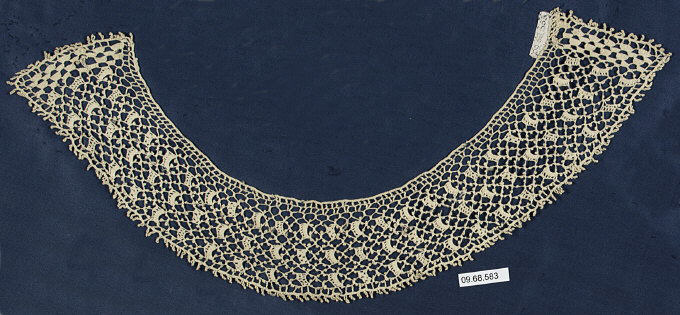
In the rarefied echelons of haute couture, the collar is seldom afforded the gravitas of a standalone thesis. It is typically relegated to the role of a supporting actor—a finishing flourish that frames the face but rarely commands the narrative. Katherine Fashion Lab’s latest offering, however, dismantles this hierarchical assumption with surgical precision. By isolating the collar as a singular object of study, the Lab elevates this humble appendage to a sovereign piece of wearable sculpture. The subject is not merely a collar; it is a cartographic rendering of global textile heritage, executed exclusively in the intricate, laborious language of crochet.
This analysis dissects the piece through three interlocking lenses: the architectural redefinition of the collar as a standalone object, the material intelligence of crochet as a vehicle for cultural memory, and the curatorial decision to present it devoid of a garment—a radical act of decontextualization that forces a re-evaluation of value, utility, and adornment.
Deconstructing the Silhouette: Architecture Without a Body
The first point of departure is the collar’s structural autonomy. In traditional couture, the collar derives its meaning from its relationship to the neckline, the shoulder slope, and the drape of the fabric beneath it. Katherine Fashion Lab’s piece rejects this dependency. Here, the collar is engineered as a freestanding architectural form—a stiffened, three-dimensional torus that holds its shape with the confidence of a sculptural bust. The absence of a garment is not a void; it is a deliberate negative space that invites the viewer to project a body, a posture, and a context onto the object.
The silhouette is a masterclass in controlled asymmetry. The back rises in a dramatic, almost ecclesiastical peak, reminiscent of the ornate ruff collars of 17th-century Spanish nobility, while the front dips into a soft, scalloped crescent that traces the clavicle’s natural line. This duality—the severe and the supple—creates a dynamic tension. The piece does not simply rest on shoulders; it commands the space around them, functioning as a portable architecture that redefines the wearer’s personal aura. In this standalone study, the collar becomes a prosthetic for presence, amplifying the wearer’s gesture into a performative act.
The Global Lexicon of Stitch
Where the silhouette announces its authority, the surface texture delivers its intellectual depth. The crochet technique employed is not a singular, monolithic approach. Instead, Katherine Fashion Lab has curated a polyglot vocabulary of stitches, each one a quotation from a distinct geographical and historical tradition. This is where the “Global Heritage” origin becomes tangible, not as a vague inspiration, but as a precise, stitch-by-stitch citation.
- Irish Crochet Lace: The foundational base is a dense, continuous net of Irish rose motifs and leaf clusters. This 19th-century technique, born of famine-era necessity and refined into aristocratic luxury, provides a dense, textural bedrock. The raised, padded cord work here is executed with a precision that would humble the most accomplished convent workshop.
- Filet Crochet from the Mediterranean: Interspersed within the Irish base are panels of filet crochet—a grid of open and filled mesh that forms geometric, almost Islamic-inspired star patterns. This nod to the Moorish influence on Spanish and Sicilian textile traditions introduces a rhythmic, mathematical counterpoint to the organic Irish florals.
- Bavarian and Nordic Motifs: The scalloped edge is not a simple trim but a series of interlocking, fan-shaped shells, echoing the Bavarian Häkelspitze and the more geometric Nordic virkning. These are executed in a contrasting, matte cotton thread, creating a subtle tonal shift that catches light differently, delineating the border without the need for color contrast.
- Japanese Amigurumi Density: The most surprising inclusion is the use of tight, single-crochet loops to form small, three-dimensional beads and nodules that are strategically placed along the front closure. This technique, borrowed from the Japanese art of amigurumi (stuffed toy crochet), adds a tactile, almost pearl-like dimension, disrupting the flatness of the lace and inviting a closer, more intimate inspection.
This deliberate juxtaposition of regional techniques is not mere pastiche. It is a form of textile diplomacy, a negotiation between disparate cultural aesthetics that resolves into a cohesive, singular voice. The collar becomes a wearable atlas, where the Irish famine, the Spanish Inquisition, the Bavarian courts, and the Japanese post-war craft revival all converge within a 40-centimeter circumference.
Material Intelligence: The Politics of Crochet
To understand the material choice is to understand the political and economic subtext of the piece. Crochet is historically a craft of the margins—of domesticity, of poverty, of women’s unpaid labor. It was the language of the Irish cottage, the Brazilian favela, and the Victorian drawing room alike. By selecting crochet for a high-couture standalone statement, Katherine Fashion Lab engages in a deliberate act of reclamation. The material is not elevated despite its humble origins; it is elevated because of them.
The thread itself is a hand-dyed, mercerized Egyptian cotton, chosen for its tensile strength and its subtle, lustrous sheen. The dyeing process is a slow, artisanal operation that yields a gradient of ivory to warm ecru, avoiding the sterile uniformity of industrial white. This tonal variation mimics the natural patina of aged linen, lending the piece an archaeological quality—as if it were unearthed from a forgotten trousseau, yet rendered with contemporary precision. The absence of any metallic thread or synthetic shimmer is a deliberate austerity. The luxury here is not in opulence but in the sheer, obsessive density of the handwork.
Furthermore, the structural integrity of the collar is achieved through a hidden internal armature of fine-gauge wire, crocheted directly into the fabric. This is a technical tour de force. The wire allows the collar to be manipulated by the wearer—bent, shaped, and sculpted to suit a particular neckline or mood. The piece is therefore not static; it is a kinetic object, responsive to the human hand. This interactivity transforms the wearer from a passive mannequin into a co-creator, completing the artistic act through physical manipulation.
The Curatorial Act: Isolation as Amplification
The decision to present this collar as a standalone study—mounted on a minimalist, ghost-like bust or perhaps suspended in a glass case—is the most radical curatorial choice. By severing it from the garment, the Lab forces a confrontation with the object’s intrinsic worth. Without a dress to distract, the observer must engage with the collar as pure form, pure texture, and pure technique.
This isolation also speaks to the contemporary zeitgeist of modular fashion. In an era of sustainability and capsule wardrobes, the standalone collar functions as a chameleonic accessory—a statement piece that can transform a simple sheath dress, a crisp white shirt, or even a minimalist knit into a couture-level ensemble. It is a democratization of high fashion, offering the transformative power of a red-carpet moment without the need for a full gown. The collar becomes a talisman, a wearable heirloom that carries the weight of global history on its delicate, yet formidable, shoulders.
In conclusion, Katherine Fashion Lab’s crochet collar is not an accessory. It is a manifesto. It argues that the most intimate and overlooked part of the garment can be the most profound. It demonstrates that craft, far from being obsolete, is the ultimate frontier of luxury. And it proves that a single, well-executed idea—the collar, the stitch, the heritage—can speak louder than a thousand yards of silk. This is not merely a study of a collar; it is a study of the power of focused, deliberate, and culturally literate artistry.