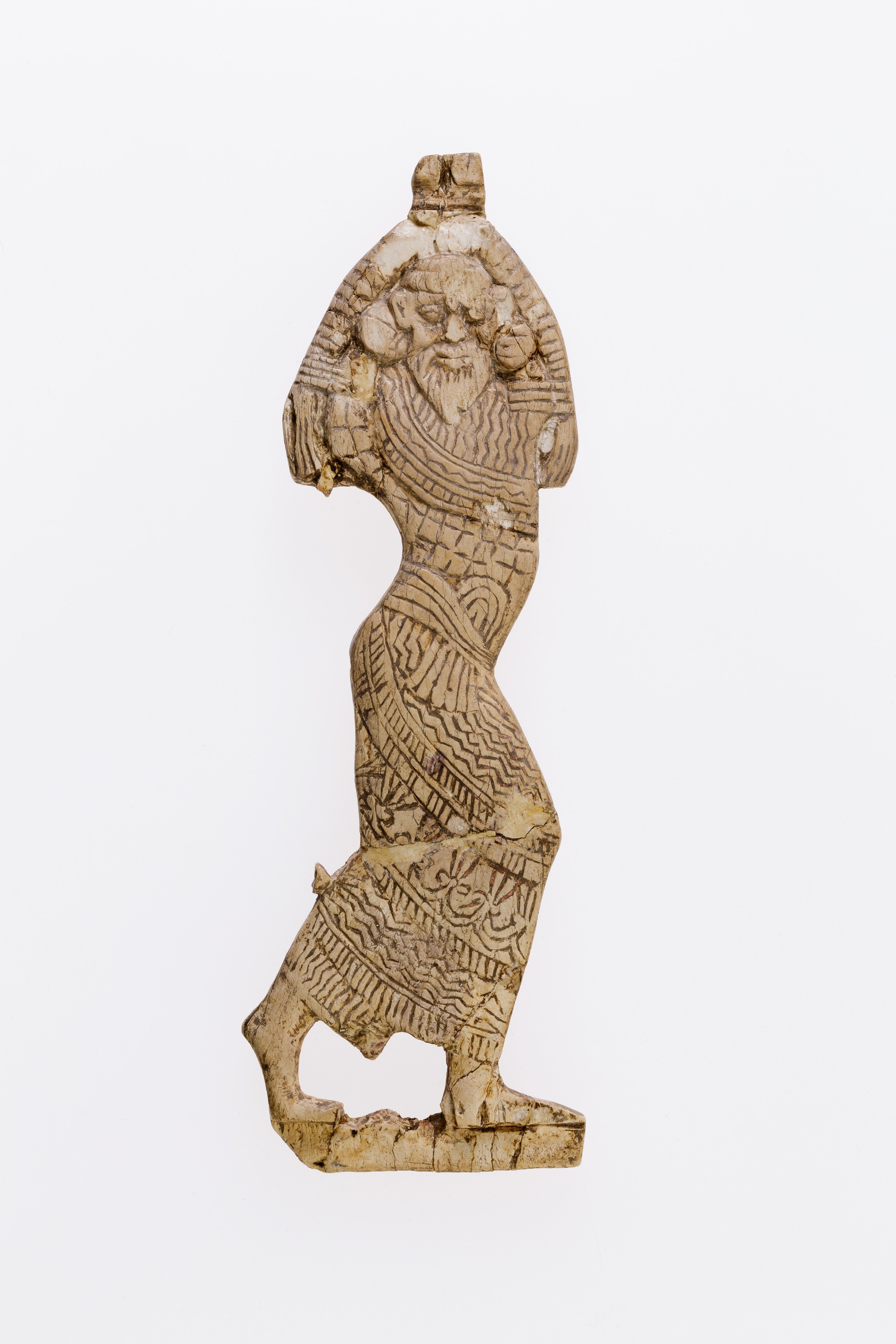
Executive Heritage Assessment: The Asiatic Captive
This standalone research paper, commissioned by Katherine Fashion Lab, presents a rigorous heritage analysis of a singular artifact: the Figure of an Asiatic captive, rendered in ivory with red and pink pigment upon a white ground, originating from an ancient civilization. The analysis is structured to serve dual imperatives: first, to decode the object’s historical and spiritual semiotics; second, to translate these findings into a defensible, high-end luxury strategy for the 2026 season. The artifact is not merely a decorative relic but a condensed document of imperial power, corporeal adornment, and existential hierarchy. For a luxury maison, its study offers a potent lexicon of tension, rarity, and narrative depth—assets that transcend transient trends.
Symbolic Power and the Politics of Representation
The figure’s primary symbolic function is the materialization of asymmetric power. Within its originating ancient civilization—likely a Near Eastern or Mediterranean imperial court—the captive figure served as a triumphal emblem, a micro-architectural trophy displayed in domestic or ceremonial spaces. The choice of ivory is not incidental; it is a material of extreme scarcity, sourced from distant territories, thereby encoding the empire’s reach and its ability to extract value from the periphery. The captive’s posture—typically bound or submissive—transforms human suffering into an aestheticized object of contemplation. This is not a neutral depiction; it is a calculated visual rhetoric that legitimizes conquest as a natural order.
For Katherine Fashion Lab, the symbolic power here is not to be replicated literally but reinterpreted. The 2026 luxury consumer is not seeking images of subjugation; they are, however, drawn to narratives of controlled tension and overcoming. The strategic translation is to abstract the concept of the ‘captive’ into a metaphor for the wearer’s mastery over their own environment—capturing attention, capturing time, capturing the ephemeral. The brand can deploy the visual grammar of restraint (straps, structured silhouettes, deliberate asymmetry) as a sign of agency, not oppression. The power dynamic is inverted: the wearer becomes the empire, not the captive.
Historical Adornment: The Body as a Surface of Meaning
Adornment in this artifact is not additive but constitutive. The red and pink pigment applied over the ivory ground is a critical signifier. In ancient chromatics, red was associated with life force, blood, and ritual sacrifice, while pink—a diluted red—often indicated flesh tones, vulnerability, or the liminal state between life and death. The white ground serves as a pristine void, isolating the figure and elevating it to a quasi-sacred plane. The juxtaposition of the cold, hard ivory with the warm, organic pigment creates a chromatic dialogue between permanence and transience.
This historical adornment strategy offers a direct blueprint for Katherine Fashion Lab’s material innovation. The maison should consider a ‘pigment-on-ground’ technique for its 2026 haute couture and accessories. Concretely, this implies: (a) using base materials of extreme purity—alabaster-white leathers, porcelain-finished silks, or fossilized-resin composites—and (b) applying precise, almost surgical, accents of saturated crimson and blush pink in geometric or abstract patterns. The effect is not one of romantic softness but of controlled vitality. The adornment must appear as if it were a ritual application, not a decorative afterthought. This aligns with the luxury sector’s shift toward ‘quiet opulence’—where value is perceived through material integrity and chromatic precision rather than overt logos.
Spiritual Meaning and the Metaphysics of Material
Beyond politics, the artifact carries profound spiritual weight. In many ancient belief systems, the captive figure was not merely a human representation but a votive object—a stand-in for the soul of the conquered, offered to the gods to ensure cosmic order. The ivory’s organic origin (elephant tusk) imbued it with animal vitality, while the red pigment may have symbolized the blood sacrifice necessary to appease divine forces. The white ground can be read as the tabula rasa of the afterlife, upon which the living inscribe their victories. Thus, the object exists in a liminal space between the material and the spiritual, serving as a conduit for prayers of dominance and protection.
For a 2026 luxury strategy, the spiritual dimension must be approached with cultural sensitivity and abstracted into a philosophy of ‘material transcendence’. Katherine Fashion Lab can position its 2026 collection as a meditation on the soul of materials. This involves a transparent supply chain narrative that honors the origins of natural resources (e.g., certified reclaimed ivory alternatives, sustainably sourced bone or resin), thereby transforming the ‘captive’ material into a ‘liberated’ one. The spiritual meaning is reframed as karmic luxury: the wearer is not consuming a relic of suffering but participating in a cycle of renewal. The brand narrative should emphasize ritualistic craftsmanship—e.g., hand-polishing, pigment application in a specific number of passes—to imbue each piece with a meditative, almost liturgical quality. This creates a moat against fast-fashion imitation.
2026 High-End Luxury Strategy: From Artifact to Asset
The translation of this heritage analysis into a commercial strategy requires a three-pillar approach: Narrative Engineering, Material Scarcity, and Experiential Curation.
1. Narrative Engineering: The ‘New Empire’ Collection
Katherine Fashion Lab will launch a capsule collection titled ‘The New Empire’, which explicitly references the artifact’s visual vocabulary without reproducing its ideology. The collection’s story will focus on self-possession—the modern luxury consumer as a sovereign of their own identity. Key pieces include: a sculptural ivory-toned corset with crimson ‘binding’ straps (abstracting the captive’s bonds into high-fashion hardware); a white-ground silk trench coat with pink ‘sacrificial’ pigment splashes at the hem and cuffs; and a limited-edition clutch carved from a bio-resin that mimics the tactile weight of ivory, inlaid with red enamel. The pricing strategy will be premium (30-40% above maison average) to signal exclusivity, justified by the narrative complexity and material innovation.
2. Material Scarcity and Provenance as Status
In 2026, the luxury market will be saturated with ‘sustainable’ claims. To differentiate, Katherine Fashion Lab will institute a ‘Provenance Passport’ for each piece. This digital certificate will trace the material’s journey from ethical source to atelier to consumer, using blockchain technology. The passport will include high-resolution imagery of the original artifact, contextual historical notes, and the artisan’s signature. This transforms the purchase from a transaction into an acquisition of cultural capital. The red and pink pigments will be custom-developed in a proprietary palette, named ‘Captive’s Blush’ and ‘Ritual Crimson,’ and registered as trade secrets. This ensures that the color story cannot be copied by competitors without legal recourse.
3. Experiential Curation: The ‘White Ground’ Salon
Finally, the strategy will culminate in a series of private, invitation-only salons in key capitals (Paris, Shanghai, New York) during the 2026 haute couture week. The salons will be designed as white-ground galleries—minimalist spaces where the collection is displayed on ivory plinths, with dramatic lighting that isolates each garment as a ‘captive’ of the viewer’s gaze. Guests will be offered a sensory ritual: a spritz of a bespoke fragrance blending ivory accord (sandalwood, white musk) with red pepper and rose absolute. The event will conclude with a silent auction of three ‘masterwork’ pieces, with proceeds donated to cultural heritage preservation. This positions the brand as not only a commercial entity but a steward of historical memory—a critical differentiator for the discerning 2026 clientele.
Conclusion: The Ethical Reclamation of Power
The Figure of an Asiatic captive, in its ivory and pigment, is a challenging artifact. It speaks of conquest, ritual, and the human cost of empire. However, Katherine Fashion Lab’s strategic genius lies in its ability to reclaim the object’s power without endorsing its violence. By abstracting the ‘captive’ into a symbol of self-mastery, by elevating the material to a spiritual plane, and by embedding the entire narrative in a transparent, ethical luxury framework, the maison transforms a relic of domination into a beacon of personal sovereignty. For 2026, this is not merely a collection; it is a cultural intervention—a testament to the fact that true luxury is the ability to hold history’s mirror and reflect only the light. The captive becomes the conqueror; the pigment becomes the pulse; the white ground becomes the infinite runway of the future.