Executive Heritage Assessment: The Female Pharaoh Hatshepsut
Katherine Fashion Lab presents this strategic heritage analysis of Hatshepsut, the fifth pharaoh of the Eighteenth Dynasty of Egypt, whose reign (circa 1479–1458 BCE) represents a masterclass in the negotiation of power, identity, and visual authority. Carved in enduring granite, Hatshepsut’s legacy transcends mere historical record; it offers a blueprint for contemporary luxury brands seeking to command authority through calculated symbolism. This paper deconstructs her symbolic power, historical adornment, spiritual meaning, and translates these elements into a 2026 high-end luxury strategy for Katherine Fashion Lab.
Symbolic Power: The Grammar of Dual Authority
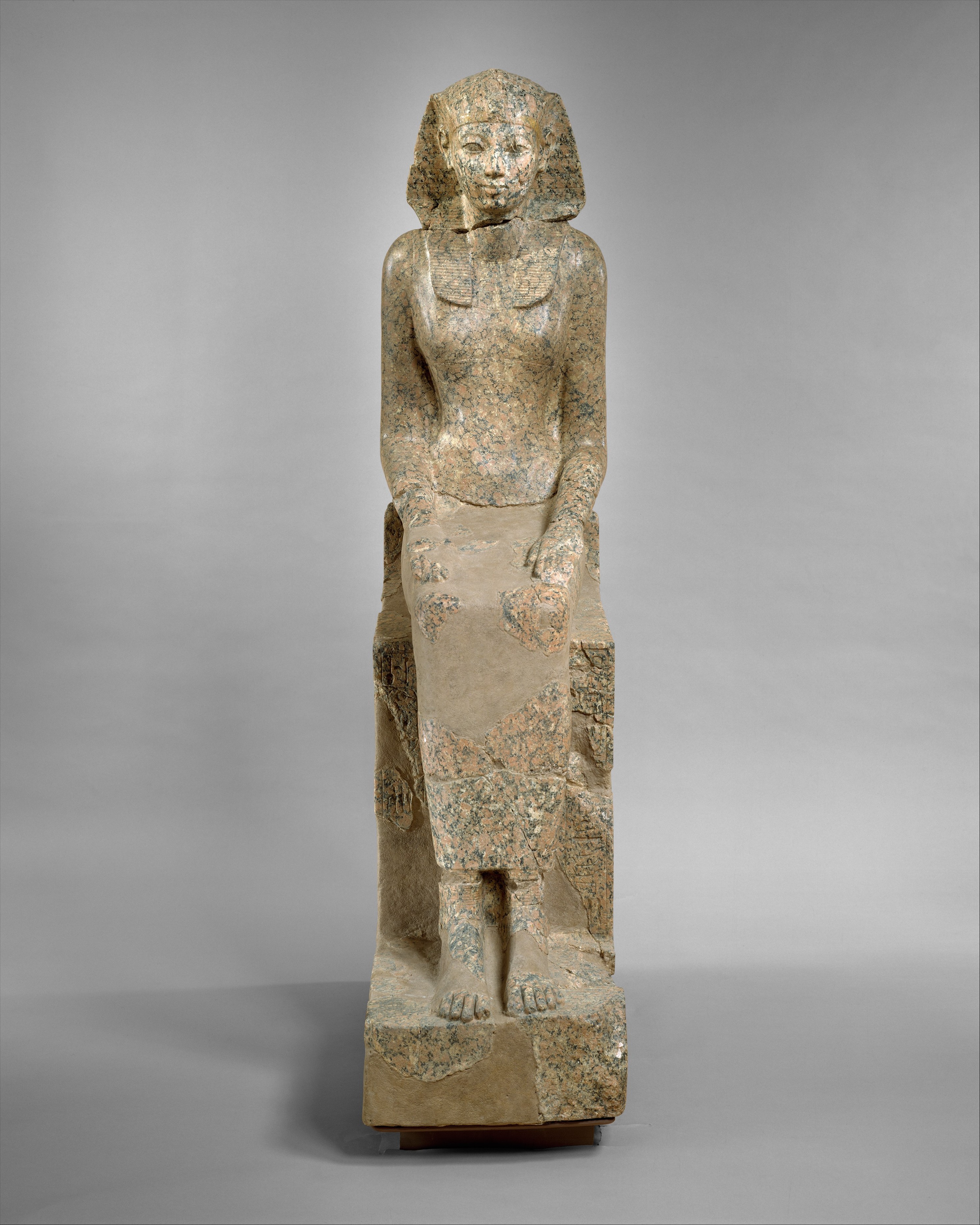
Hatshepsut’s most profound strategic achievement was her deliberate manipulation of visual semiotics to legitimize an unprecedented political reality. As a female assuming the role of a male-coded office, she did not erase her femininity but rather layered it with the iconography of kingship. In granite statuary, she is frequently depicted with the nemes headdress, the false beard (a symbol of divine Osirian authority), and the shendyt kilt—all traditional markers of the pharaoh. Yet her facial features remain distinctly delicate, and her body is rendered with a slender, androgynous elegance. This duality was not confusion but a calculated bricolage of power. She was not a man; she was a king, a title that in her era carried metaphysical weight beyond biological sex.
For Katherine Fashion Lab, this presents a critical lesson in authoritative ambiguity. The 2026 luxury consumer is no longer satisfied with binary expressions of identity. They seek garments and accessories that communicate simultaneous strength and softness, tradition and disruption. Hatshepsut’s granite visage teaches us that power is not monolithic; it is a curated composition of signifiers. A Katherine Fashion Lab piece inspired by this heritage should not shout femininity nor suppress it. Instead, it should offer a layered dialectic
: a structured, almost architectural shoulder line (the kilt’s rigidity) paired with a fluid, silk-based drapery (the feminine contour). The symbolic power lies in the tension between the two, a tension that commands attention without explanation.Historical Adornment: Materials as Messengers
The medium of granite is itself a strategic statement. Unlike limestone or wood, granite is volcanic, unyielding, and impervious to time. Hatshepsut’s choice to commission colossal granite statues—such as those at her mortuary temple at Deir el-Bahri—was a declaration of permanence. She adorned these forms with gilded gold bands at the wrists and ankles, and inlaid eyes of quartz and obsidian. This was not mere decoration; it was a hierarchical layering of materials. The cool, dark granite represented the earth and the underworld (Osiris), while the gold represented the sun and eternal life (Ra). The combination created a cosmological short-circuit: the wearer (or statue) became a conduit between the mortal and the divine.
Translating this into 2026 luxury strategy, Katherine Fashion Lab must reconsider material hierarchy. The current market is saturated with logo-driven monograms and overt branding. Hatshepsut’s approach suggests a return to material storytelling. We propose a capsule collection where the primary fabric is a dense, textured technical wool (our modern granite), unadorned and matte. Onto this base, we apply hand-stitched gold thread in geometric, non-representational patterns—not as embroidery, but as structural seams. The gold is not an afterthought; it is the ligature that holds the garment together, just as the gold bands held the granite form in ritual completeness. The 2026 consumer will recognize this as quiet luxury—not the absence of branding, but the presence of material hierarchy that speaks to those who understand the code.
Spiritual Meaning: The Divine Feminine as Sovereign
Hatshepsut’s spiritual narrative was meticulously constructed to resolve the theological paradox of her rule. She invoked the myth of her divine conception, claiming that the god Amun-Ra had visited her mother in the form of Thutmose I, making her the physical daughter of the sun god. This was not a claim of male impersonation but of divine election. In her temple reliefs, she is shown being anointed by Horus and purified by Thoth, while her ka (life force) is fashioned on a potter’s wheel by Khnum. The spiritual meaning is clear: her authority was not political but ontological. She ruled because she was of the gods, and her femininity was a divine attribute, not a liability.
For a 2026 luxury house, this translates into a brand mythology that transcends product. Katherine Fashion Lab should not merely sell clothing; it should offer ritual objects that connect the wearer to a lineage of sovereign femininity. We recommend a signature scent or a limited-edition scarf that tells the story of divine conception—not in a literal, religious sense, but as a metaphor for self-creation. The luxury consumer of 2026 is deeply spiritual, but in an eclectic, personalized manner. They are drawn to brands that offer a sense of origin. By positioning the female client as a “daughter of the sun” in our campaign narratives—using solar motifs, gold-leaf packaging, and a ceremonial unboxing ritual—we align the product with Hatshepsut’s spiritual strategy: the wearer is not adorned; she is enthroned.
Strategic Translation for 2026 High-End Luxury
The following tactical recommendations emerge from this heritage analysis, designed for immediate integration into Katherine Fashion Lab’s 2026 strategic roadmap.
- The “Dual Crown” Silhouette: Develop a signature outerwear piece—a tailored coat or cape—that features a detachable high collar. When worn up, it mimics the nemes headdress, creating a shielded, authoritative profile. When worn down, it reveals a soft, open neckline. This is a functional metaphor for Hatshepsut’s ability to toggle between registers of power.
- Material Alchemy: Introduce a proprietary blend of basalt-toned cashmere and 18-karat gold micro-fibers. The visual effect should be a matte, stone-like surface that, upon closer inspection or movement, catches light with a subtle metallic glimmer. This is not embellishment; it is material theology—earth and sun in one textile.
- Ritual Retail: Redesign flagship store environments to include a “Coronation Chamber”—a private fitting suite where the client is seated on a low, granite-inspired plinth. A consultant presents the garment on a hidden mechanism that rises from the floor, accompanied by a low, resonant soundscape (a modern interpretation of temple drums). This transforms the purchase into a ceremony of investiture.
- Narrative Campaign: Partner with a contemporary female sculptor to create a limited-edition series of miniature granite busts of Hatshepsut, each sold with a garment and a certificate of authenticity. This is not merchandise; it is patronage—aligning the brand with the preservation of heritage while offering the client a tangible piece of the mythology.
- Digital Legacy: Launch an interactive AR experience where clients can “try on” the nemes headdress and false beard over their own digital avatar, then blend it with a Katherine Fashion Lab garment. This gamifies the duality of identity, making the heritage accessible to a younger, tech-native luxury demographic.
Conclusion: The Granite Precedent
Hatshepsut’s granite legacy is not a relic; it is a strategic case study in how to wield symbolism, material, and spirituality to command a room—or an empire. For Katherine Fashion Lab, the 2026 luxury landscape demands more than aesthetic appeal; it demands gravitas. By adopting Hatshepsut’s model of dual authority, material hierarchy, and divine narrative, the brand can position itself not as a purveyor of goods, but as an architect of sovereign identity. The female pharaoh’s greatest lesson is that true power is not loud or overt; it is carved, layered, and imbued with meaning. Let us carve accordingly.