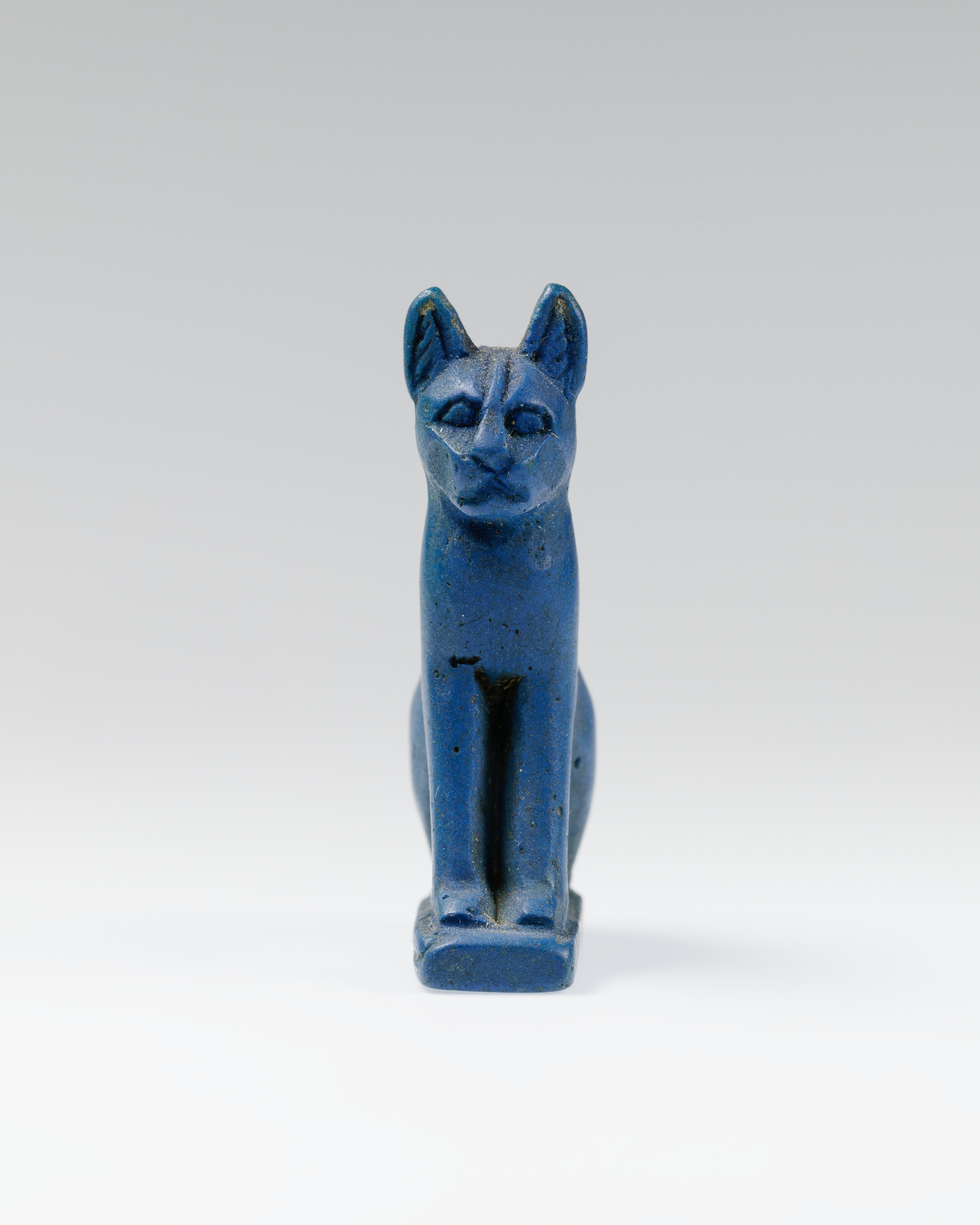
Heritage Analysis: The Cat Amulet in Dark Blue Faience
Within the pantheon of ancient protective symbols, few artifacts carry the combined weight of domestic reverence, cosmic authority, and aesthetic refinement as the cat amulet rendered in dark blue faience. For Katherine Fashion Lab, this object is not merely a historical curiosity but a strategic blueprint for a 2026 luxury narrative that fuses spiritual heritage with contemporary desirability. This analysis deconstructs the amulet’s symbolic power, its role in historical adornment, its spiritual architecture, and translates these elements into a high-end market strategy that speaks to the modern connoisseur of meaning-driven luxury.
Symbolic Power: From Domestic Companion to Cosmic Guardian
The cat, in the ancient Egyptian context—the most prolific source of such faience amulets—was a creature of profound duality. On one level, it represented the grace and fertility of the household, a protector of grain and hearth. On a more esoteric level, the cat was the living embodiment of the goddess Bastet, a deity who transitioned from a lioness warrior to a benevolent, feline-headed guardian of joy, music, and maternal protection. The dark blue faience, often referred to as tjehenet, was not a passive color choice. The deep, lapis-like hue was deliberately engineered to mimic the night sky and the primordial waters of Nun, the source of all life. In this material, the amulet’s symbolic power is amplified: it is not merely a representation of a cat, but a microcosm of the universe’s protective order. For the wearer, the amulet was a condensed source of ma'at—cosmic balance—that could be carried against the skin, warding off chaos, illness, and the evil eye.
The Material Alchemy of Dark Blue Faience
Strategically, the choice of dark blue faience is a masterclass in material semiotics. Faience is a self-glazing composite, a technology that predates glass, and its production was a closely guarded priestly craft. The dark blue variant, achieved through copper and cobalt compounds, was more than decorative; it was a simulacrum of lapis lazuli, a stone more precious than gold, imported from distant Afghanistan. This deliberate imitation was not deception but a democratization of divine power—a way to make celestial protection accessible to a wider elite. For a modern luxury house, this material history offers a powerful lesson: true luxury is not always about rarity of source, but rarity of meaning and mastery of craft. The amulet’s power lies in its ability to transmit a complex spiritual code through a single, saturated color and a refined silhouette.
Historical Adornment: The Amulet as Wearable Architecture
In the ancient world, adornment was never purely aesthetic; it was a functional interface between the human and the divine. Cat amulets were placed in mummy wrappings, strung on necklaces, and woven into girdles. Their placement on the body was deliberate—often at the throat or over the heart—to align the wearer’s vital energy with the goddess’s protective gaze. The amulet’s form, typically a seated cat with a straight, regal posture, was a study in controlled elegance. The ears were upright, the tail wrapped neatly around the paws, and the eyes inlaid or incised to catch light. This is a design language of quiet authority, not aggressive display. In historical adornment, the amulet functioned as a personal talisman and a social signal. To wear it was to declare one’s access to divine favor, one’s refined taste, and one’s understanding of the esoteric codes of the elite.
The Aesthetic of the ‘Regal Pause’
Analyzing the amulet’s design reveals a principle Katherine Fashion Lab can codify as the ‘Regal Pause’. The cat is depicted in stillness, yet that stillness is charged with latent energy. This is the antithesis of modern fast-fashion’s noisy logos. The amulet’s power is in its restraint—a single, perfect curve of the back, a precise angle of the head. For a 2026 luxury strategy, this translates into a product philosophy where silhouette and material do the talking, not overt branding. The amulet teaches that the most potent adornment is one that feels inevitable, as if it has always existed in that perfect form, waiting to be rediscovered.
Spiritual Meaning: A Protective Code for the Modern Psyche
The spiritual function of the cat amulet extends beyond mere superstition. It was a psychological anchor, a physical manifestation of the wearer’s intent for safety, prosperity, and joy. The cat goddess Bastet was also associated with the protection of the home and the secrets of women, making the amulet a deeply personal object. In the context of modern spirituality, there is a growing consumer desire for objects that provide a sense of grounding and intentionality in an increasingly chaotic world. The cat amulet’s spiritual meaning—protection of one’s inner sanctuary—resonates strongly with the 2026 luxury consumer who seeks not just status, but emotional resilience. The amulet offers a tangible connection to a lineage of human belief, a portable piece of sacred history that counters the ephemerality of digital life.
2026 High-End Luxury Strategy: The ‘Katherine Bastet’ Collection
Translating this heritage into a 2026 strategy requires a three-pronged approach: Artisan Provenance, Sensory Narrative, and Limited-Edition Scarcity. First, Katherine Fashion Lab should partner with master ceramicists to recreate the faience process, not as a museum replica, but as a modern interpretation using advanced glazing techniques. The dark blue must be uncompromisingly deep, with a subtle, luminous sheen that mimics the ancient self-glazing effect. This is not a costume jewelry piece; it is a sculptural object.
Strategic Positioning: The ‘Inner Sanctuary’ Campaign
The marketing narrative for 2026 should pivot away from ‘ancient Egypt’ as a theme park aesthetic and toward a concept of ‘Inner Sanctuary’. The campaign will position the cat amulet as a modern talisman for the high-achieving individual—the CEO, the artist, the cultural influencer—who requires a private shield against public scrutiny. The amulet will be presented in a bespoke, hand-finished case, accompanied by a digital certificate of authenticity that traces the faience recipe to ancient texts. The price point will be set at a premium tier, justified not by carat weight but by cultural weight and the mastery of a nearly lost craft. This is the ultimate luxury: owning a piece of human spiritual history, reimagined for a new era of conscious consumption.
Collaborative and Experiential Dimensions
To deepen engagement, Katherine Fashion Lab will offer a private commissioning service, allowing clients to have their amulet inscribed with a personal hieroglyphic or modern monogram, echoing the ancient practice of personalizing protective spells. Additionally, a limited series of ‘Bastet Evenings’ will be hosted in partnership with major museums, offering private viewings of original faience artifacts, followed by a preview of the collection. This positions the brand not as a seller of jewelry, but as a curator of protective heritage. The 2026 strategy is thus not a launch; it is a consecration. The cat amulet, in dark blue faience, becomes the brand’s signature emblem of quiet power, historical depth, and spiritual intelligence—a timeless artifact that proves the most enduring luxury is meaning itself.