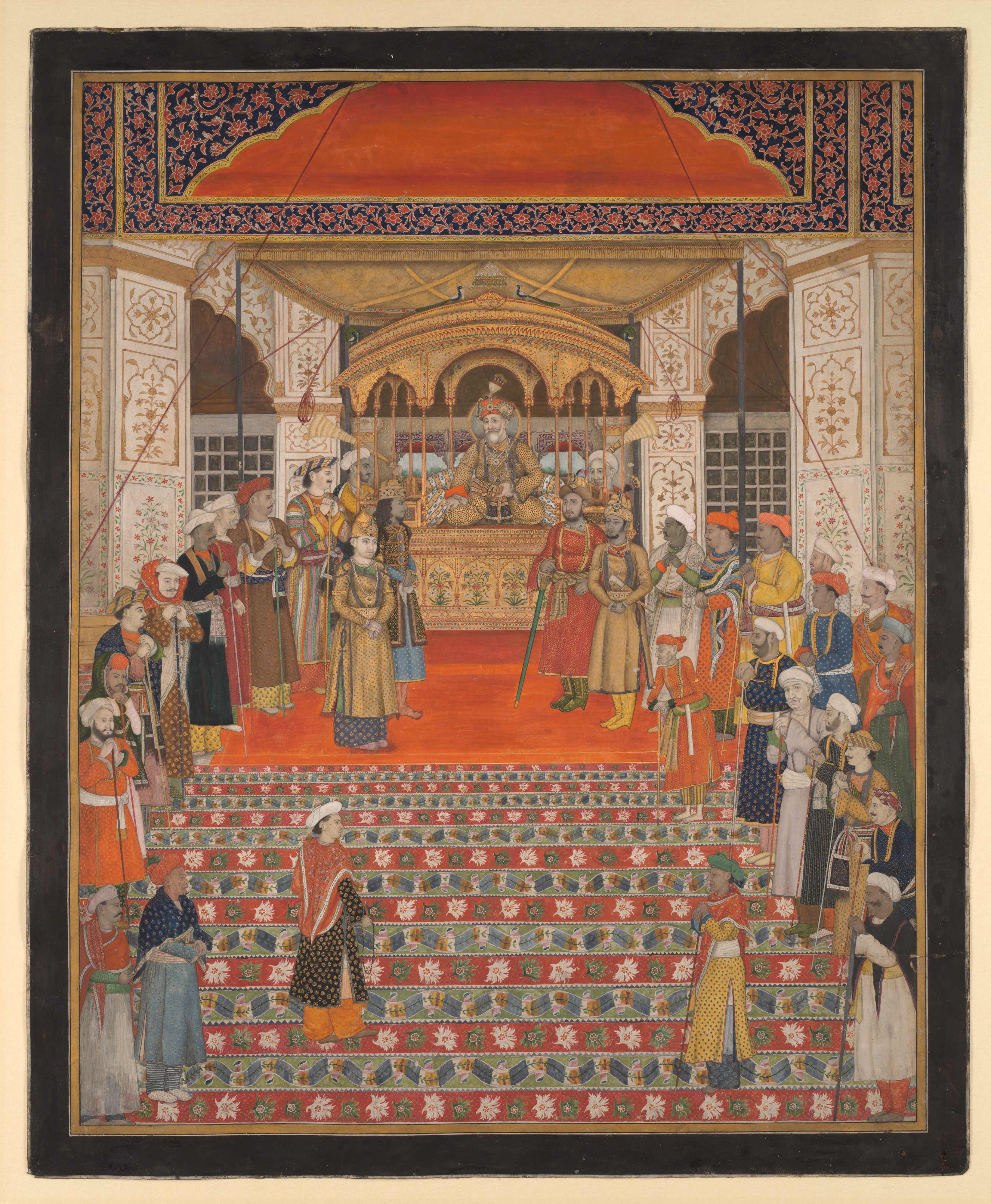
Executive Heritage Assessment: The Durbar of Emperor Akbar Shah II
This strategic standalone research paper examines the Durbar of Emperor Akbar Shah II as a masterclass in the codification of sovereign authority through material culture. Executed in opaque color and gold on paper, this artwork from the twilight of the Mughal Empire serves as a critical lens for Katherine Fashion Lab’s 2026 high-end luxury strategy. The analysis decodes three interlocking dimensions—symbolic power, historical adornment, and spiritual meaning—and translates them into actionable brand imperatives for the discerning global elite.
Symbolic Power: The Architecture of Imperial Legitimacy
The durbar, or formal court assembly, was not merely a social gathering; it was a technological apparatus of political theology. Akbar Shah II (r. 1806–1837) presided over a diminished empire, yet the visual rhetoric of this painting asserts an unbroken continuity with the cosmic order. The emperor’s elevated position on the throne, his profile rendered in strict hierarchical proportion, and the concentric arrangement of nobles and attendants create a spatial grammar of subordination. Every figure is positioned relative to the sovereign’s gaze, transforming physical distance into political rank.
For Katherine Fashion Lab, this translates into a 2026 strategy of “curated proximity.” Just as the durbar’s composition directs the eye toward the apex, luxury collections must establish a visual hierarchy where the primary garment—the “throne piece”—anchors the narrative. The use of opaque color (typically gouache with a matte finish) versus the luminescent gold is a deliberate binary: the opaque grounds represent the earthly, mutable realm of courtiers, while the gold signifies the immutable, divine essence of the ruler. In practice, this suggests a 2026 palette of deep, absorbent jewel tones (emerald, indigo, oxblood) paired with high-carat gold leaf applications on structural seams—not as embellishment, but as a declaration of unassailable status.
Historical Adornment: Garments as Cartography of Power
The sartorial details in the Durbar of Akbar Shah II are a cartography of political alliance and cultural syncretism. The emperor wears a jama (long coat) of fine muslin, overlaid with a patka (sash) woven with gold thread, and a turban adorned with a sarpech (turban ornament) featuring a plume of heron feathers—a symbol of royalty reserved exclusively for the sovereign. The nobles, in contrast, wear simpler chogas and smaller turbans, their jewelry limited to pearls and emeralds, signifying their rank as “jewels of the court” rather than sources of light themselves.
Critically, the painting reveals a hybrid aesthetic: Persian motifs intermingle with Rajput and European elements, reflecting Akbar Shah II’s diplomatic balancing act under the shadow of the British East India Company. For a 2026 luxury house, this is a mandate for cultural fluency without dilution. The strategy should involve adornment as information—each garment, clasp, or embroidery motif must carry a specific, legible meaning to the initiated. Katherine Fashion Lab can adopt a “code system” where, for instance, a gold thread count indicates client tier, and a specific gemstone cut signals membership in a private patronage circle. This transforms clothing from mere fashion into a wearable intelligence network.
Spiritual Meaning: The Sovereign as Cosmic Pivot
Beneath the political surface lies a profound spiritual dimension. Akbar Shah II, as a Mughal emperor, was considered the “Shadow of God on Earth” (Zill-i-Ilahi). The durbar scene is thus a terrestrial mirror of the celestial court of the divine. The golden halo—often depicted as a radiant disc behind the emperor’s head—is not decorative; it is a metaphysical assertion that the ruler’s authority flows directly from the divine source. The act of nazar (formal audience) was equivalent to a devotional act, where subjects received barakah (spiritual blessing) through the emperor’s gaze.
The medium itself—opaque watercolor on paper—carries spiritual resonance. Unlike oil paintings that emulate flesh, the flat, non-naturalistic application of color in Mughal miniatures suggests a transcendence of the material world. The paper is a finite, humble support, yet the gold overlay elevates it to the status of a relic. For Katherine Fashion Lab, this informs a 2026 strategy of “material meditation.” The brand should position its garments as conduits for personal transformation, not mere objects. Consider a limited “Durbar Series” where each piece is numbered and accompanied by a handwritten provenance card, echoing the manuscript tradition. The fabric should be treated with a matte, matte finish (like the opaque gouache) to absorb light, with strategic, almost sacred, placements of gold thread—on the cuffs, collar, and hem—to create a halo effect around the wearer. This elevates the wearer from a consumer to a contemporary sovereign of their own domain.
2026 High-End Luxury Strategy: The “Neo-Durbar” Framework
Synthesizing the above, Katherine Fashion Lab should implement a three-pillar strategy for 2026, codenamed “Neo-Durbar.” The first pillar is Exclusivity via Ritual. The durbar’s power lay in its inaccessibility. Therefore, the brand will launch a private, invitation-only “Durbar Council” for top-tier clients, offering bespoke fittings conducted with ceremonial precision—including a hand-holding of the fabric, a recitation of the garment’s symbolic code, and a final sealing with a wax emblem. This transforms a purchase into an initiation.
The second pillar is Material Sovereignty. Leveraging the gold-on-paper medium, the brand will introduce a signature textile: a “Shah’s Canvas”—a dense silk blend with a matte, chalky texture, woven with 24-karat gold thread in patterns derived directly from the painting’s border motifs. This fabric will be produced in a limited annual run of 100 meters, ensuring scarcity that mirrors the finite nature of the original artwork.
The third pillar is Narrative Ownership. Each collection will be accompanied by a digital “durbar dossier” using augmented reality. When a client points their device at the garment’s label, a 3D reconstruction of the original painting appears, with hotspots explaining the specific motif’s spiritual and political meaning. This deepens client engagement, positioning Katherine Fashion Lab not as a seller of clothes, but as a custodian of imperial heritage.
Conclusion: From Artifact to Asset
The Durbar of Emperor Akbar Shah II is more than a historical document; it is a strategic blueprint for luxury in an era of information overload. By decoding its symbolic power, historical adornment, and spiritual meaning, Katherine Fashion Lab can offer clients what the digital age cannot: grounded authority, tangible legacy, and transcendent identity. The 2026 strategy is not about replicating the past, but about re-engineering its principles of hierarchy, material value, and metaphysical resonance for the modern connoisseur. In doing so, the brand will not merely dress its clients—it will crown them.