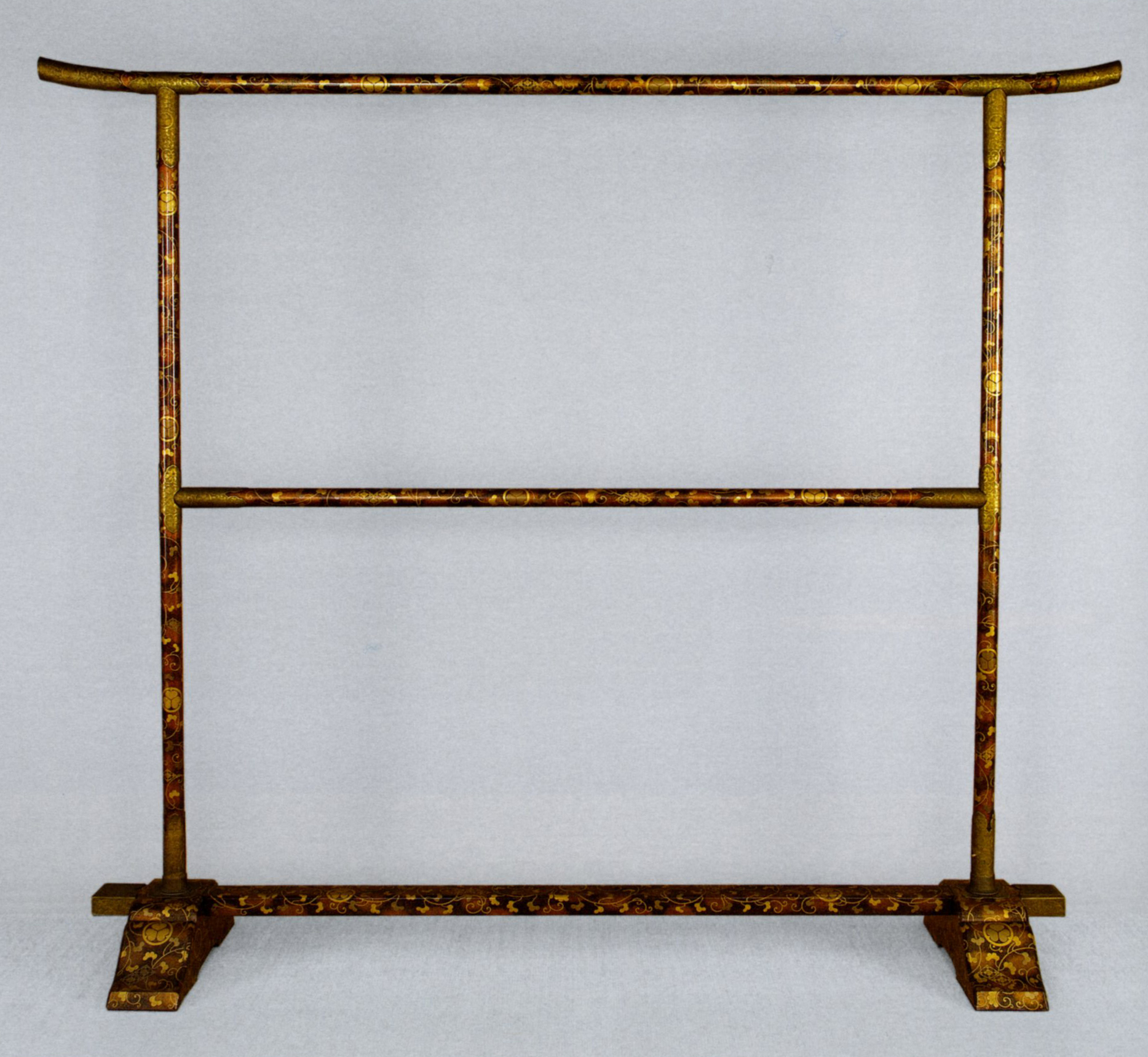
Executive Heritage Assessment: The Ikō as an Instrument of Sovereign Authority
The kimono rack (ikō) bearing scrolling foliage and the Tokugawa family crest is not merely a utilitarian object for garment display; it is a codified instrument of political theology, a micro-architectural statement of clan hegemony, and a precursor to modern luxury’s obsession with invisible provenance. For Katherine Fashion Lab, this artifact offers a strategic blueprint for 2026: the translation of *spiritual containment* into *material exclusivity*. Executed in lacquered wood with gold hiramaki-e on a nashiji ground, the rack operates less as furniture and more as a portable shrine to the wearer’s social cosmology.
This analysis deconstructs the ikō across four vectors—symbolic power, historical adornment, spiritual meaning, and 2026 luxury strategy—to extract actionable heritage assets for the Lab’s upcoming collection and brand narrative.
I. Symbolic Power: The Crest as a Cartography of Loyalty
The Tokugawa family crest—a triple hollyhock leaf (Mitsuba-aoi)—is the primary semiotic load of this object. During the Edo period (1603–1868), the display of this crest was not decorative but jurisdictional. The ikō, placed within the private chambers of a daimyo’s wife or a high-ranking courtesan, functioned as a spatial declaration: the garments it held were not merely cloth but extensions of the shogunate’s authority. To drape a kimono over this rack was to submit the fabric—and, by extension, the body—to a visual pledge of fealty.
For Katherine Fashion Lab, the strategic extraction is the concept of “crest-as-contract.” In 2026, the Lab can move beyond monogram prints toward a system of embedded insignia—laser-etched, heat-pressed, or woven into the interior seams of garments. The crest becomes a private mark of allegiance visible only to the wearer and their intimate circle, mirroring the ikō’s original function as a semi-public, semi-secret signifier. This positions the Lab not as a fashion house but as a guardian of dynastic codes.
The Scrolling Foliage: A Grammar of Perpetuity
The scrolling foliage (karakusa) surrounding the crest is not incidental ornament. In Japanese aesthetic taxonomy, karakusa symbolizes eternal renewal and the absence of termination—the vine has no beginning or end. When paired with the Tokugawa crest, the message is unambiguous: the shogunate’s rule is not a historical accident but a natural, botanical inevitability. The gold hiramaki-e technique, which builds relief patterns with raised lacquer and gold powder, adds a tactile dimension: the foliage is not painted but grown from the surface.
This duality—political permanence and organic growth—offers the Lab a 2026 design principle: “designed inevitability.” Instead of seasonal trends, the Lab should produce a “permanent collection” of core silhouettes where the ornamentation evolves subtly across years, like a vine. Clients would purchase not a garment but a continuation of a lineage. The nashiji ground, with its irregular gold flecks resembling pear skin, reinforces this: it is a texture of controlled chaos, suggesting that within the strictest political order, there is room for organic variation—a perfect metaphor for the modern luxury client who demands both heritage and individuality.
II. Historical Adornment: The Rack as a Stage for the Sleeve
Historically, the ikō was not a closet; it was a display altar. In Edo-period residences, the rack was positioned in the tokonoma alcove or a prominent corner, allowing the kimono’s sleeve (sode) to cascade with deliberate volume. The rack’s height and curvature were calibrated to showcase the furisode’s long, flowing sleeves—a marker of unmarried status—or the shorter, restrained sleeves of a married woman. Thus, the rack did not store clothing; it choreographed social biography.
The gilt bronze fittings, often shaped as chrysanthemums or paulownia, were not merely functional fasteners. They were points of sonic and visual punctuation—catching candlelight, emitting a faint metallic resonance when the kimono was lifted, and signaling the weight of the garment’s embroidery. In a pre-electric era, this was a form of material semaphore: the sound of bronze on lacquer told the household that a ritual of dressing was underway.
For the Lab’s 2026 strategy, this translates into a “ritual hardware” program. The Lab can design a limited-edition series of garment hangers and display stands—not for retail sale but as client gifts or VIP suite installations—crafted from lacquered wood and brushed brass. These objects would be engineered to produce a specific, low-frequency chime when a garment is removed. This is not nostalgia; it is sensory branding. The act of dressing becomes a private ceremony, and the Lab’s clientele becomes participants in a living heritage performance, not passive consumers.
III. Spiritual Meaning: The Nashiji Ground as a Void of Potential
Beneath the gold and crest lies the nashiji ground—a dark, uneven surface of lacquer mixed with gold particles. In Shinto and Buddhist aesthetics, this ground represents “mu” (emptiness or potentiality). The gold flecks are not uniform; they are scattered like stars in a night sky, suggesting that the object’s true value lies not in its surface but in the negative space that the gold inhabits. The kimono rack, therefore, is a meditative object: it holds a garment, but its spiritual function is to remind the viewer of the absence of the body.
This is a profound counterpoint to Western luxury’s emphasis on the body as a display mannequin. The Japanese ikō celebrates the ghost of the wearer. The garment is a relic; the rack is the reliquary. In 2026, Katherine Fashion Lab can adopt this principle through a campaign titled “The Unworn.” Rather than photographing models in the garments, the Lab would present the garments on lacquered racks in empty, dimly lit rooms—allowing the client to project their own identity onto the silhouette. This is not minimalism; it is spiritual curation. The absence of the body becomes the ultimate luxury, because it implies that the garment is too precious for casual display.
Hiramaki-e and the Ethics of Craft Patience
The hiramaki-e technique requires months of layering, polishing, and drying. Each gold motif is built over dozens of sessions, with the artisan waiting for each lacquer layer to cure in specific humidity. This is the antithesis of fast fashion’s “drop” model. For the Lab, this becomes a supply-chain philosophy: the 2026 collection should be announced with a “gestation period”—a documented timeline of 18 months from design to delivery, with clients invited to observe the process via private digital portals. The wait itself is a luxury signal, echoing the lacquer’s curing time. The client is not buying a product; they are buying time transformed into matter.
IV. 2026 High-End Luxury Strategy: From Artifact to Operating System
To leverage the ikō’s heritage without descending into cultural appropriation, the Lab must adopt a strategy of “structural homage”—borrowing the object’s logic, not its literal imagery. The Tokugawa crest, for instance, should not be reproduced. Instead, the Lab will develop a “Katherine Crest”—a geometric mark inspired by the hollyhock’s tripartite symmetry but rendered in a proprietary alloy. This crest will be applied to all 2026 “Reliquary Line” pieces via a heat-stamped, invisible watermark only visible under UV light. This is not imitation; it is semiotic translation.
Second, the Lab will introduce a “Nashiji Tier” of materials: a proprietary fabric blend with irregular metallic micro-flecks woven into a dark base, mimicking the pear-skin ground. This fabric will be used only for the inner linings of outerwear, never as the primary surface. The message: the true value of the Lab’s garment is hidden, not displayed—a direct inversion of logomania. This appeals to the 2026 ultra-high-net-worth client who seeks discretion as status.
Experiential Retail: The Dressing Chamber
Finally, the Lab will install a “Ikō Chamber” in its flagship boutiques—a private room featuring a single, original, museum-grade kimono rack (not a reproduction) on loan from a private collection. Clients invited to this chamber will be offered a “dressing ritual”: their selected garment is placed on the rack, and they are asked to wait three minutes before touching it. This delay, calibrated to the lacquer’s historical curing time, creates a psychological state of anticipatory reverence. The sales associate will then narrate the object’s provenance, linking the client’s purchase to a 400-year-old continuum of craft.
This is not retail theater; it is heritage transmission. The client becomes a temporary custodian of a Japanese aesthetic lineage, and the Lab positions itself as the only Western house capable of holding that lineage without diluting it.
Conclusion: The Ikō as a Mirror for the Future
The kimono rack with Tokugawa crest is a masterclass in controlled opulence. It demonstrates that true luxury is not about volume or visibility but about layered significance—political, spiritual, and sensory. For Katherine Fashion Lab, the 2026 strategy should not be to “reference Japan” but to absorb its structural grammar: the crest as contract, the nashiji ground as hidden potential, and the hiramaki-e as a lesson in temporal investment.
By adopting these principles, the Lab will not merely sell garments; it will offer objects of allegiance—items that carry the weight of history without the burden of imitation. The ikō, in its quiet lacquer and gold, tells us that the most powerful adornment is the one that knows what to conceal. That is the heritage insight Katherine Fashion Lab must carry into 2026 and beyond.