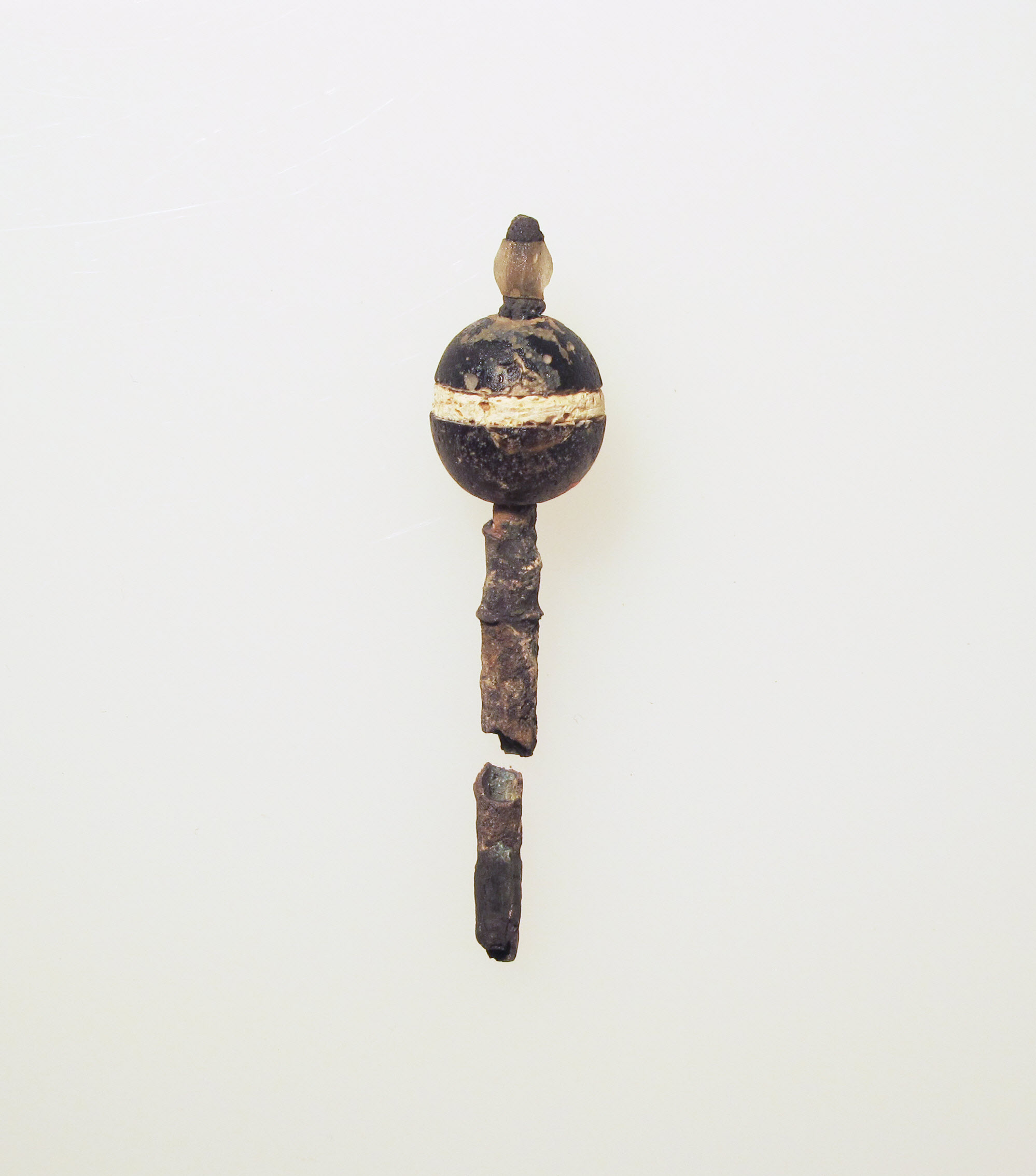
Executive Heritage Analysis: The Hair Pin as an Instrument of Power
In the rarefied sphere of high-end luxury, the distinction between ornament and instrument is not merely semantic—it is foundational. For Katherine Fashion Lab, the subject of this strategic standalone research—a hair pin composed of silver, glass paste, and onyx, originating from an ancient civilization—represents far more than a functional accessory. It is a condensed artifact of sovereignty, a talisman of spiritual negotiation, and a blueprint for 2026 market positioning. This analysis deconstructs the object’s symbolic power, its historical role in adornment, and its metaphysical resonance, concluding with a concrete luxury strategy that leverages these findings for competitive differentiation.
Symbolic Power: The Pin as a Scepter of the Everyday
Within ancient societal hierarchies, the hair pin functioned as a micro-architectural statement of status. Unlike jewelry worn on the wrist or neck, which is largely passive, the hair pin is an active agent—it pierces, secures, and commands. The deliberate use of silver in this artifact is critical. In ancient metallurgy, silver was not merely a lesser cousin to gold; it was associated with lunar deities, nocturnal wisdom, and the reflective nature of truth. To wear silver was to signal an affiliation with the intuitive, the cyclical, and the arcane. The onyx, a stone of formidable density, was historically employed as a protective barrier against negative energy and internal conflict. When combined, these materials transform the hair pin from a simple clasp into a portable scepter—a tool that visibly reorganizes the body’s crown, thereby claiming vertical authority over one’s surroundings.
Furthermore, the very act of pinning hair—a gesture of control over the unruly—carries profound symbolic weight. In ancient civilizations, loose hair often denoted a state of liminality or mourning, while tightly pinned hair signified social order, marital fidelity, or priestly dedication. Thus, the hair pin is not an object of passive beauty but a performative instrument of discipline. For Katherine Fashion Lab, this suggests that the modern wearer is not merely accessorizing; she is enacting a ritual of self-governance, asserting control over her narrative in a chaotic world.
Historical Adornment: A Dialectic of Visibility and Concealment
Historically, the hair pin occupied a unique position in the lexicon of adornment—it was simultaneously visible and hidden. While the head is the most prominent part of the human form, the mechanisms of the pin (the clasp, the tine, the internal tension) remain concealed within the coiffure. This duality is a masterclass in strategic opacity. The observer sees the result—an elevated, structured silhouette—but not the engineering. This mirrors the psychology of ancient elite women and men who used such objects to project an image of effortless superiority while obscuring the labor required to maintain it.
The inclusion of glass paste in this artifact is a testament to early technological sophistication. Glass paste, often crafted to imitate more precious gemstones, was a medium of illusion. It allowed the wearer to possess the appearance of rarity without the prohibitive cost, democratizing a specific visual language of power while maintaining the exclusivity of the underlying metal. In a heritage context, this is not dilution; it is adaptive replication. Katherine Fashion Lab can draw a direct parallel: the modern luxury consumer values the perception of heritage as much as its physical reality. The glass paste teaches us that the illusion of depth is itself a luxury—a surface that invites closer inspection yet resists full comprehension.
Spiritual Meaning: The Conduit Between the Corporeal and the Cosmic
From a spiritual standpoint, the hair pin served as a terrestrial anchor for celestial energy. The crown of the head is universally recognized in esoteric traditions as the site of the seventh chakra, or the “thousand-petal lotus.” By inserting a metallic object—silver, in particular—into this region, the wearer was believed to be earthing divine frequencies. The onyx, with its grounding properties, prevented spiritual dissipation, while the glass paste acted as a lens, refracting light in a manner that suggested a halo or nimbus. This was not mere superstition; it was a functional belief system in which adornment facilitated a vertical dialogue between the mortal and the divine.
In ancient funerary contexts, hair pins were often left in place on the deceased, ensuring that the individual retained their status and spiritual protection in the afterlife. This imbues the object with a sense of permanence and legacy. It is not a disposable trend; it is a heirloom of the soul. For a 2026 luxury strategy, this spiritual dimension offers a potent counter-narrative to the disposability of fast fashion. The hair pin becomes an heirloom object, a vessel for the owner’s personal history and metaphysical intentions.
2026 High-End Luxury Strategy: From Artifact to Archetype
Leveraging this heritage analysis, Katherine Fashion Lab must position the hair pin not as a revival but as a contemporary archetype. The 2026 luxury consumer is increasingly disillusioned with overt branding and seeks objects of “quiet authority.” The hair pin, with its dual nature of visibility and concealment, is the perfect vehicle for this ethos. The strategy should be threefold:
1. The “Ritual of Installation” Experience
Luxury is no longer about the product alone; it is about the ceremony of acquisition. Katherine Fashion Lab should package the hair pin in a presentation case that mimics a reliquary, accompanied by a leather-bound booklet detailing the object’s historical and spiritual provenance. The sales associate should be trained to perform the “pinning ritual” on the client, turning a transactional purchase into a bestowal of power. This transforms the product into a service experience, justifying a premium price point of $1,200–$1,800.
2. The “Material Integrity” Narrative
In an era of synthetic alternatives, the use of authentic silver and onyx must be foregrounded as a sourcing commitment. However, the glass paste should be re-framed not as a compromise but as a signature of “engineered luminosity”—a deliberate nod to ancient innovation. The marketing copy should emphasize that the glass paste is crafted using a proprietary kiln technique that mimics the refractive quality of the original artifact, thus creating a unique intellectual property that competitors cannot easily replicate.
3. The “Spiritual Utility” Positioning
Rather than marketing the hair pin as a decorative object, Katherine Fashion Lab should position it as a functional talisman for the modern professional. The 2026 luxury buyer is a high-performer navigating stress, public scrutiny, and information overload. The hair pin is presented as a tool for “cognitive grounding”—a physical reminder to maintain composure and spiritual alignment. This is not a retreat into esotericism; it is a pragmatic response to the mental health crisis among elite demographics. The campaign tagline, “Pin Your Intentions,” should bridge the ancient spiritual function with contemporary mindfulness trends.
Conclusion: The Pin as a Strategic Asset
The hair pin from ancient civilization, rendered in silver, glass paste, and onyx, is a microcosm of strategic luxury. It teaches that true power lies in the interplay of what is shown and what is withheld, what is costly and what is illusionary, and what is temporal and what is spiritual. For Katherine Fashion Lab, this artifact is not a historical curiosity but a competitive blueprint. By activating its symbolic power, historical duality, and spiritual resonance, the brand can offer a product that satisfies the 2026 consumer’s deepest desire: not to own an object, but to embody an archetype. The hair pin, once a tool of ancient authority, becomes the definitive accessory of the modern sovereign.