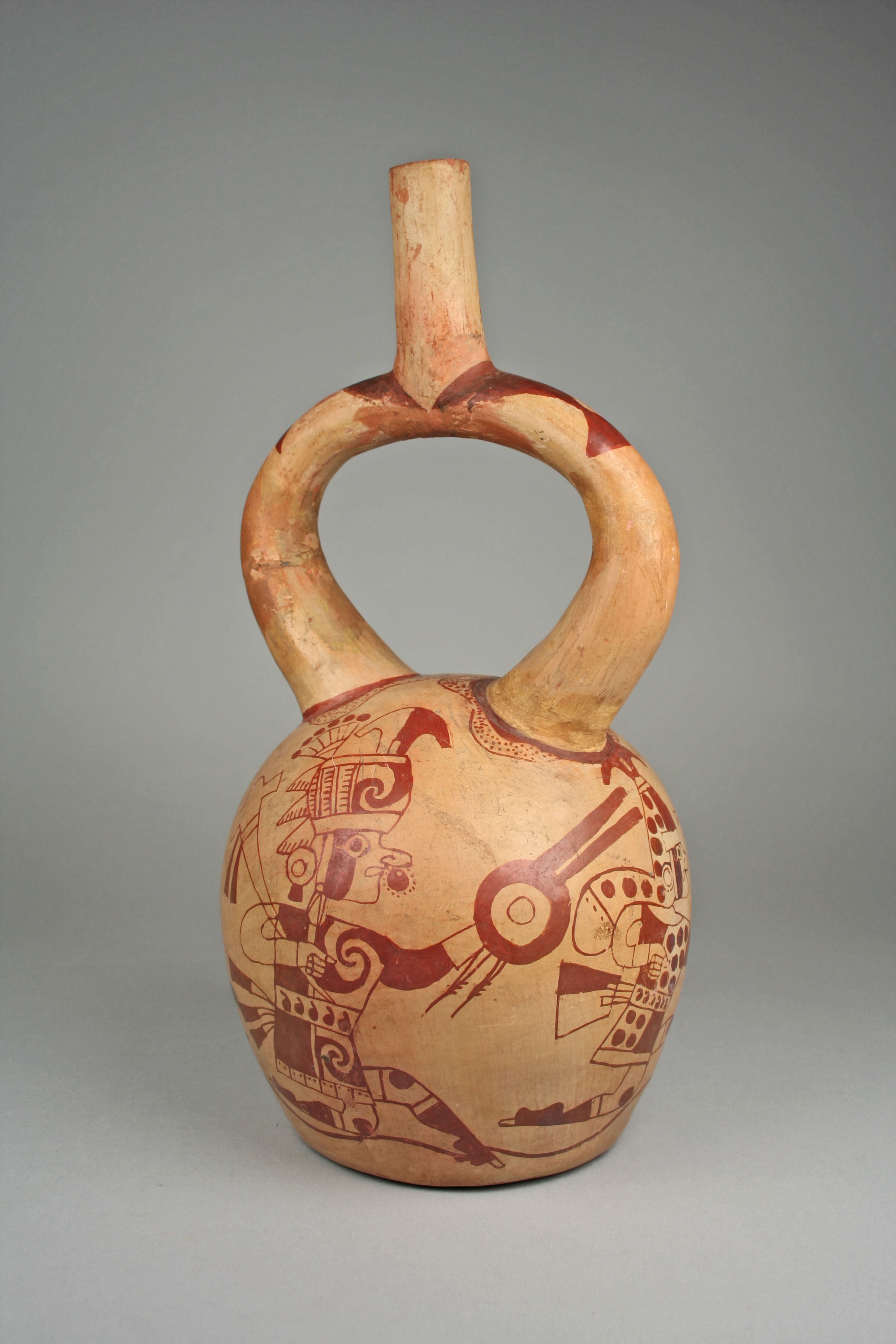
Executive Heritage Analysis: The Moche Warrior Bottle
This strategic research paper examines the Moche stirrup-spout bottle depicting warriors, a ceramic artifact from pre-Columbian Peru (circa 100–800 CE). For Katherine Fashion Lab, this object transcends its archaeological classification to serve as a masterclass in the codification of power, the materiality of status, and the ritualization of violence. The analysis decodes the artifact’s symbolic lexicon and translates it into a 2026 luxury strategy framework, positioning the house as a curator of ancestral authority rather than a mere appropriator of motifs.
Symbolic Power: The Warrior as Cosmic Intermediary
The Moche warrior bottle is not a passive representation of martial might; it is an active instrument of cosmological negotiation. In Moche iconography, warriors occupied a liminal space between the human polity and the divine pantheon. The bottle’s form—a stirrup spout rising from a globular body—mimics the axis mundi, connecting the earthly realm of the warrior to the celestial sphere of the gods. The painted slip, often red and cream, delineates not just armor but the sacred geography of the body. For the Moche, warfare was a sacrificial act that replenished cosmic order; the warrior’s visage, rendered with individualized features, suggests that this power was not anonymous but hereditary and personal.
For a luxury house, this translates into a design philosophy where power is not shouted but encoded. The 2026 collection should avoid literal depictions of weaponry. Instead, the silhouette should evoke the stirrup spout’s curve—a structural arc that frames the neck or shoulder, suggesting a conduit between the wearer and an elevated state. The color palette must be disciplined: oxblood red (the slip of life and sacrifice) against bone cream (the pigment of ritual purity), with no intervening pastels. This is power through restraint, not excess.
Historical Adornment: The Armor of the Elite
The Moche warrior’s regalia was a composite of animal, mineral, and textile elements, each with a specific economic and symbolic weight. Ceramic effigies show warriors wearing conical helmets, ear spools, and nose ornaments—objects that were not merely protective but indicative of rank within a rigid hierarchy. The bottle’s medium—ceramic—is itself a signifier. Unlike gold or silver, clay is humble, yet the Moche elevated it through meticulous slip application and firing techniques. This paradox—humble material, exalted execution—is the essence of artisanal luxury.
Katherine Fashion Lab’s 2026 strategy should adopt this paradox as a core tenet. The brand should commission hand-finished ceramic buttons and clasps for tailored outerwear, each fired in small batches to mimic the Moche’s controlled oxidation. The warrior’s ear spools inspire a jewelry capsule: oversized, disc-shaped earrings in matte blackened silver (not polished gold), designed to elongate the neck and frame the face—a direct nod to the Moche’s emphasis on cranial and facial adornment. The adornment is not accessory; it is the primary carrier of narrative, as it was for the Moche.
Spiritual Meaning: Ritual Blood and the Fertility of Conflict
Moche ritual warfare culminated in the capture and sacrifice of prisoners, whose blood was offered to ensure agricultural fertility. The warrior bottle, therefore, is not a glorification of violence but a vessel for transformation—blood becomes maize, death becomes renewal. This spiritual dimension is critical for luxury positioning in 2026, where consumers increasingly seek objects with metaphysical weight, not just aesthetic appeal. The bottle’s stirrup spout was used to pour libations, suggesting that the artifact was not static art but a functional tool in a cyclical economy of offering and return.
In translating this, Katherine Fashion Lab should develop a ritualistic unboxing and presentation protocol for its 2026 warrior-inspired capsule. Each garment should be accompanied by a ceramic talisman—a small, hand-painted disc referencing the Moche sun and moon motifs—that the client is invited to “activate” by placing in a specific pocket or affixing to a lapel. This transforms the purchase from a transaction into a rite. The marketing narrative must foreground concepts of “sacrifice” and “renewal,” framing the collection as a meditation on the cost of power and the fertility of disciplined effort. This is not a gimmick; it is a recontextualization of spiritual meaning for a secular luxury audience that still craves transcendence.
2026 High-End Luxury Strategy: From Appropriation to Curation
The danger for any Western luxury house engaging with Pre-Columbian heritage is the trap of superficial exoticism. To avoid this, the 2026 strategy must be built on three pillars: provenance partnership, material alchemy, and symbolic restraint.
First, provenance partnership. Katherine Fashion Lab will formally collaborate with a Peruvian museum or a recognized Moche cultural foundation, ensuring that a percentage of proceeds funds the preservation of actual Moche ceramics. This is not CSR theater; it is a legal and ethical framework that gives the house the right to interpret, not steal. The collaboration should be announced alongside the collection, with a documented provenance report for each design element.
Second, material alchemy. The Moche used slip to create a surface that appears both glossy and matte, depending on light. The 2026 fabrics should replicate this through a proprietary finishing process: a double-faced technical silk with a micro-embossed pattern of interlocking warrior shields, visible only at certain angles. This is the luxury of the hidden, the coded. The ceramic influence extends to accessories: a limited run of stirrup-spout-shaped perfume flasks in black porcelain, each with a hand-applied red slip band. This is not a souvenir; it is a collectible object that references the original’s function as a libation vessel.
Third, symbolic restraint. The collection will not feature a single literal warrior print, weapon motif, or feather headdress. Instead, the iconography is abstracted: the conical helmet becomes a structured shoulder pad; the ear spool becomes a circular cutout in a leather boot; the stirrup handle becomes the curve of a bag’s top handle. The client must be educated to decode these references—this is the intellectual pleasure that justifies a 40% price premium over comparable luxury garments. The campaign imagery should be shot in chiaroscuro, reminiscent of archaeological dig photography, with models posed in static, statuesque stances that echo the bottle’s rigid frontality.
Conclusion: The Vessel as Brand Archetype
The Moche warrior bottle is more than a historical artifact; it is a strategic blueprint for luxury in an era of noise. Its power lies in its containment—of liquid, of meaning, of status. Katherine Fashion Lab’s 2026 strategy will not merely reference this vessel; it will become one. The brand will act as a container for ancestral knowledge, filtering it through a contemporary lens of disciplined craft and spiritual gravitas. The warrior is not the client; the client is the priest who pours the offering. By repositioning the wearer as a ritual actor rather than a passive consumer, the house elevates its offering from clothing to ceremonial equipment for modern life. This is the ultimate luxury: not the object itself, but the authority to wield its symbolism.