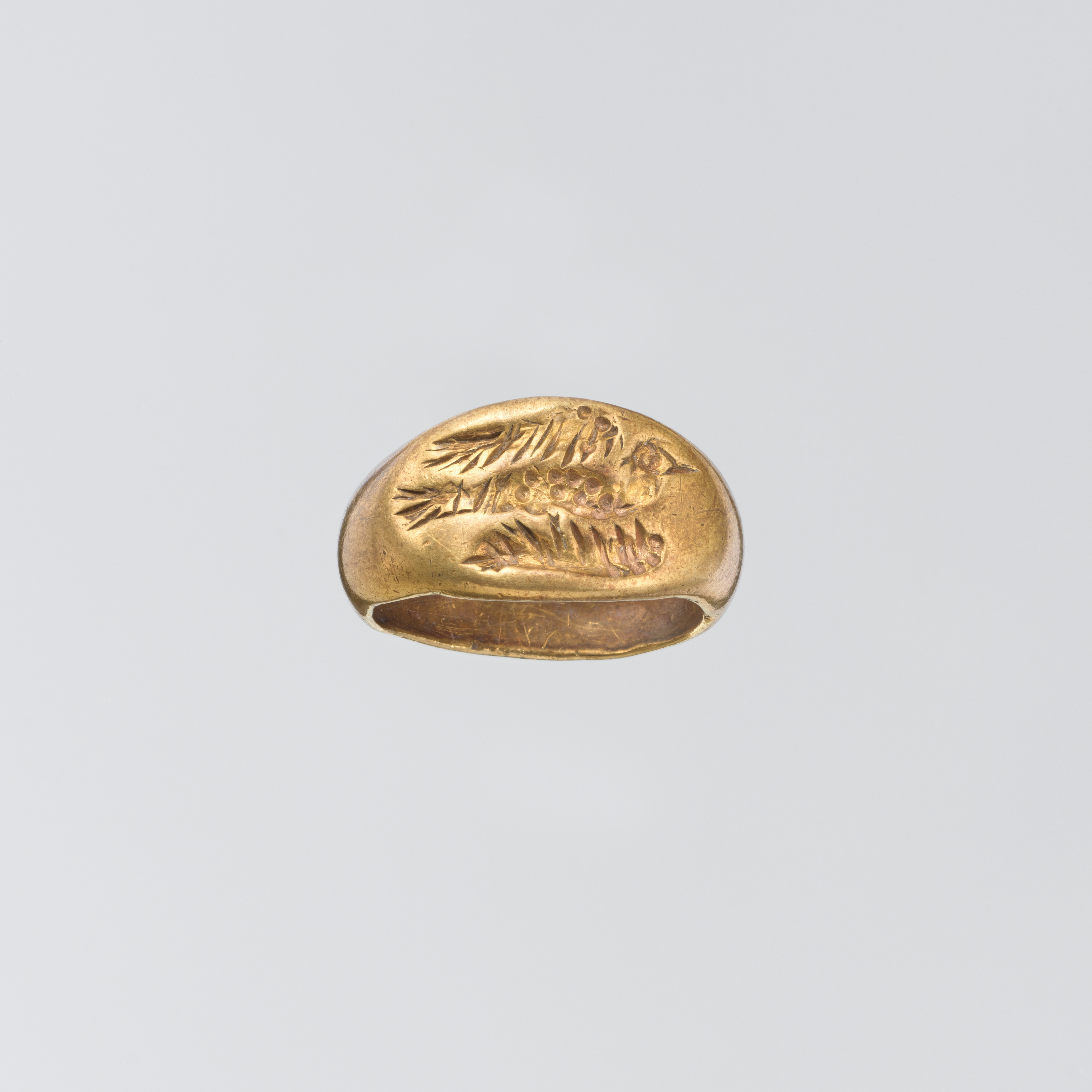
Heritage Analysis: The Avian Signet of Roman Cyprus
The gold ring engraved with a bird, attributed to Roman Cyprus, is not merely an artifact of personal adornment; it is a compressed testament to the intersection of imperial identity, local spirituality, and enduring human aspiration. For Katherine Fashion Lab, this object serves as a profound archaeological anchor, offering a lexicon of symbols that can be translated into a 2026 luxury strategy predicated on narrative depth and cultural authenticity.
This analysis positions the ring within the broader context of our ongoing research into Mirror with Split-Leaf—a study that juxtaposes the luminous, gold-inlaid palmettes of a polished silver mirror against the somber, relief-carved life narratives on a sarcophagus lid. The bird ring, like the mirror, belongs to the realm of the living and the luminous; yet its avian motif carries the soul's whisper, bridging the material and the ethereal.
Symbolic Power: The Bird as Imperial and Cosmic Messenger
In the Roman Cypriot milieu, the bird was not a singular signifier but a polyvalent emblem of authority, augury, and transcendence. The eagle, most prominently, was the sacred attribute of Jupiter and the military standard of the legions, representing imperial dominion and the apotheosis of the emperor. A gold ring bearing an eagle or a swift falcon would have signaled the wearer's alignment with Roman state power, a subtle yet potent declaration of civic loyalty and social rank.
However, on Cyprus—an island with a deep Phoenician and Hellenic substrate—the bird also evoked Aphrodite, whose cult at Paphos was among the most influential in the ancient world. Doves were sacred to the goddess of love and regeneration. Thus, the engraved bird on this ring functions as a dual cipher: it simultaneously encodes masculine imperial might and feminine divine grace. For the wearer, this was not a contradiction but a synthesis—the ability to navigate the public forum with authority while invoking private, spiritual protection.
This dual resonance is critical for Katherine Fashion Lab. In our 2026 collections, we must not present symbols as monolithic. Instead, we should embrace polyvalence, allowing a single motif to speak to power, beauty, and mystery simultaneously. The bird ring teaches us that true luxury lies in the layering of meaning, not in overt display.
Historical Adornment: The Ring as a Social Interface
In Roman society, the gold ring (anulus aureus) was initially a marker of equestrian and senatorial rank, though by the Imperial period its use had broadened. The choice of gold—a metal associated with the sun, eternity, and the divine body of the emperor—elevated the ring from a mere fastener to a micro-monument of personal status. The engraved bird, executed with the precision of a gem cutter's burin, demonstrates that the owner commissioned a piece of bespoke jewelry, not a mass-produced trinket.
Adornment in this context was a form of social currency. When the wearer extended a hand in greeting, signed a wax seal, or poured a libation, the ring caught the light, drawing the eye to the engraved avian form. This was a deliberate act of self-presentation, a silent biography etched in precious metal. The ring was an interface between the private self and the public gaze, a tool for negotiating identity in a multicultural, imperial world.
For our heritage strategy, this underscores the importance of bespoke craftsmanship and tactile engagement. A 2026 client does not merely purchase a product; they acquire a talisman that communicates their personal narrative. By reviving the practice of intaglio engraving—where the design is cut into the surface and only reveals its full depth under specific lighting—Katherine Fashion Lab can offer a modern equivalent of this ancient social interface. The piece becomes a conversation starter, a private code shared with those perceptive enough to read it.
Spiritual Meaning: The Soul's Flight and the Mirror's Echo
The bird is the most universal symbol of the human soul's journey. In funerary art, which our Mirror with Split-Leaf study addresses, birds are frequently depicted as psychopomps—guides of the deceased to the afterlife. Yet, on a ring worn by the living, the bird takes on a more immediate spiritual function: it is a guardian of vitality, a promise of resilience, and a reminder of one's own transcendent nature.
The connection to our mirror research is particularly apt. The mirror, with its gold-inlaid palmettes, represents the reflective and decorative surface of life—the world of appearances, vanity, and social performance. The sarcophagus lid, with its relief narratives, represents the permanent and scripted legacy—the story carved in stone. The bird ring occupies a liminal space between these two poles. It is worn on the hand that touches the mirror, yet its image is also the one that flies free of the tomb.
Thus, the ring offers a spiritual synthesis: it acknowledges the fleeting beauty of the mirror while affirming the soul's release, as depicted on the sarcophagus. This is a profound lesson for luxury branding. In 2026, high-end consumers are increasingly seeking products that offer ontological security—objects that help them reconcile their public persona with their inner, spiritual lives. By aligning our designs with this ancient understanding of the bird as a mediator between the temporal and the eternal, we can create pieces that are not just beautiful but meaningful.
2026 High-End Luxury Strategy: The Avian Code
Translating this heritage analysis into a forward-looking strategy requires a disciplined approach that avoids mere historical pastiche. The objective is not to reproduce a Roman ring but to extract its design DNA and recombine it into contemporary forms.
First: The Motif as a Signature. The bird must become a recurring, recognizable emblem within Katherine Fashion Lab's 2026 collection. However, we will reinterpret it through abstract minimalism. Instead of a literal eagle or dove, we will use a single, sweeping line to suggest a wing in flight—a visual shorthand that evokes the Roman intaglio but speaks to modern, reductionist aesthetics. This will be our Avian Code, a subtle identifier for the discerning collector.
Second: Material Alchemy. The original ring is gold, but our 2026 strategy will explore hybrid materials. We will pair 18k recycled gold with blackened titanium or meteorite inlay, echoing the contrast between the mirror's brilliance and the sarcophagus's shadow. This juxtaposition—light and dark, polished and textured—will create a tactile experience that honors the ring's historical weight while appealing to contemporary tastes for industrial elegance.
Third: Narrative Packaging and Digital Provenance. Each ring will be accompanied by a digital certificate of authenticity that includes a micro-documentary of its heritage inspiration, featuring archaeological imagery and a narration of the bird's symbolism. This transforms the purchase into an educational ritual, aligning with the growing demand for transparent luxury and cultural stewardship. The client is not just buying a ring; they are acquiring a fragment of Roman Cypriot history, recontextualized for the modern era.
Fourth: Limited Edition and Bespoke Service. We will produce a limited series of 300 rings, each numbered and engraved with a unique avian variant (eagle, dove, falcon) to allow for personal symbolic choice. Furthermore, we will offer a bespoke atelier service where clients can commission a ring with a specific bird that holds personal meaning—a direct continuation of the Roman practice of personalized intaglio. This service will be positioned as the pinnacle of our 2026 offering, with a price point that reflects the artisanal labor and heritage consultancy involved.
In conclusion, the Roman Cypriot gold bird ring is not a distant relic but a vibrant blueprint. By decoding its symbolic power, honoring its historical function as social interface, and embracing its spiritual depth, Katherine Fashion Lab can craft a 2026 luxury strategy that is both intellectually rigorous and commercially compelling. The bird, once engraved for a Roman hand, now takes flight into a new era of meaningful adornment.