The Parasol as Sovereign Architecture: A Heritage Analysis for Katherine Fashion Lab
Introduction: The Parasol as a Semiotic Instrument of Power
The parasol, often relegated to the status of a quaint Victorian accessory, is in fact one of the most potent instruments of symbolic power in American material culture. For Katherine Fashion Lab, a house dedicated to the interrogation of heritage through a contemporary luxury lens, the American parasol offers a rich, underutilized lexicon of status, protection, and spiritual demarcation. This analysis moves beyond the object’s functional utility—shade from the sun—to examine its role as a mobile throne, a gendered scepter, and a canvas for technological mastery. In the context of a 2026 high-end luxury strategy, the parasol represents a critical pivot from wearable garment to wearable architecture, offering clients a tangible connection to historical agency while satisfying the modern demand for experiential, narrative-driven opulence.
Historical Adornment and Material Hierarchy
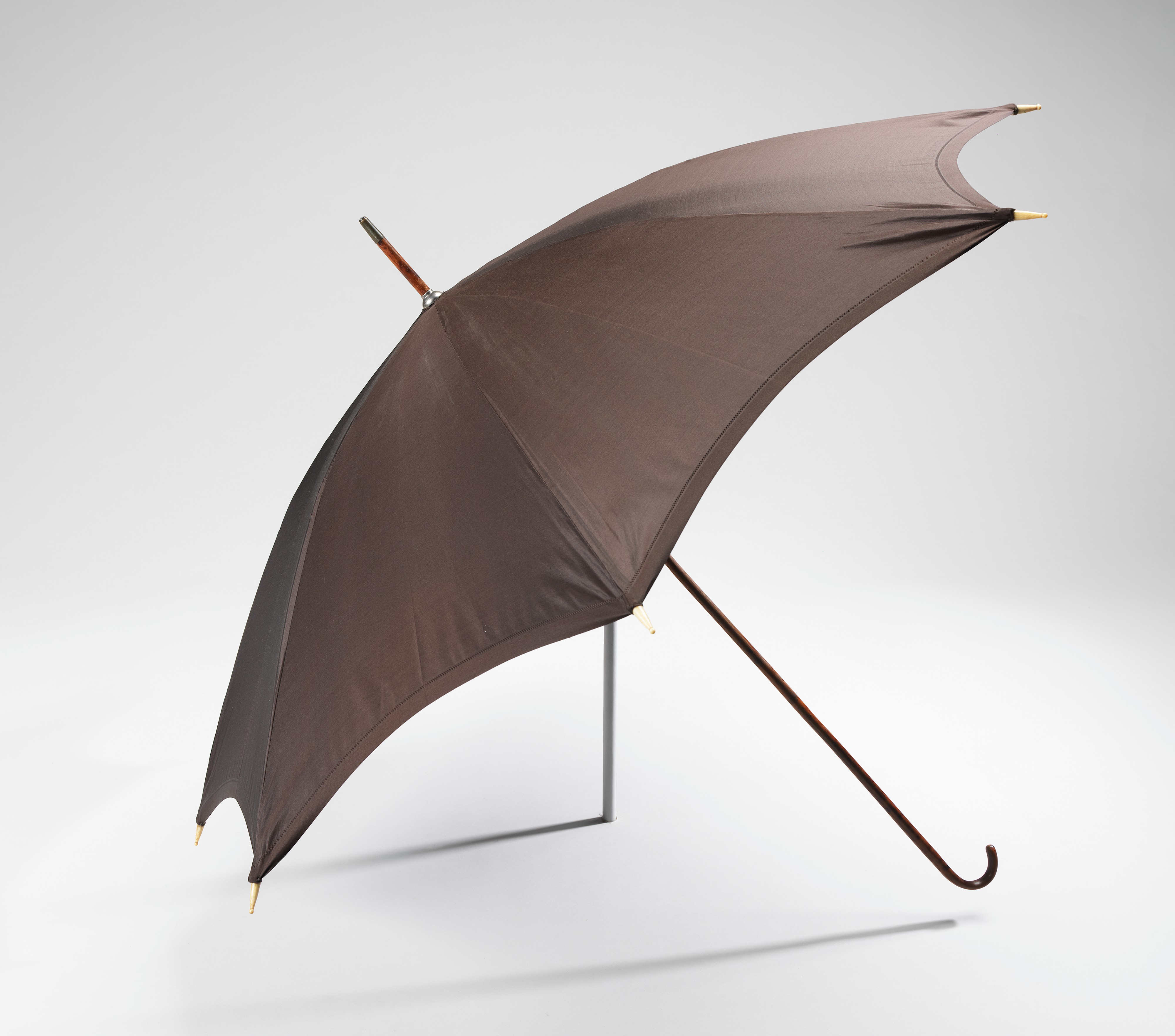
The American parasol of the late 19th and early 20th centuries was not a mere umbrella; it was a composite sculpture of global trade and industrial innovation. The materials specified—silk, metal, wood, baleen, and ivory—form a deliberate hierarchy of value. The silk canopy, often in deep jewel tones or pristine white, was a declaration of leisure; it signified that the wearer did not need to labor under the sun. The metal ribs, frequently of brass or later steel, spoke to the precision of American manufacturing, while the wooden shaft, often of exotic hardwoods like ebony or rosewood, introduced an organic, tactile warmth. Baleen, the flexible keratin from whale mouths, was the era’s carbon fiber—allowing for intricate, curved handles and flexible frames that were both resilient and extraordinarily expensive. Ivory, now a symbol of ecological tragedy, was then the ultimate signifier of colonial reach and artisanal carving mastery. For Katherine Fashion Lab, this material matrix is not historical trivia but a blueprint for modern scarcity. In 2026, we must substitute baleen and ivory with ethical, lab-grown or reclaimed equivalents—bone-white bio-resins and recycled titanium—while preserving the visual and tactile grammar of the original. The luxury is not in the material itself, but in the story of its sourcing and the precision of its assembly.
Symbolic Power and the Politics of Shade
The parasol’s primary function—the creation of shade—is inherently political. To cast a shadow is to control space. In the American context, particularly in the antebellum South and the Gilded Age, the parasol was a tool of racialized and gendered spatial control. White women used parasols to maintain a pallid complexion, a physical marker of racial purity and class distinction, while enslaved and working-class individuals were denied such protection, their skin darkened by forced exposure. This history is uncomfortable but essential for a heritage house to confront. The parasol’s symbolic power lies in its ability to invert this narrative. By reclaiming the parasol, Katherine Fashion Lab can offer a new form of agency—not the protection of privilege, but the protection of self. The shade becomes a metaphor for autonomy, a personal boundary that is both aesthetic and psychological. In a 2026 strategy, this is profoundly resonant; the modern luxury consumer seeks not just goods, but boundaries—privacy, digital detox, and personal sanctuary. The parasol, as a physical object that creates an invisible dome of exclusivity, is the ultimate wearable boundary.
Spiritual Meaning and the Canopy of the Divine
Beyond the secular, the parasol carries deep spiritual architecture. Across cultures, the canopy signifies divine protection—the baldachin over an altar, the umbrella held over a monarch. In the American context, this sacred lineage was secularized but retained its aura. The parasol’s radial structure, with its central spine and radiating ribs, echoes the mandala or the rose window, a geometric meditation on order and centrality. The act of opening a parasol is a ritual of unfolding—a transition from the mundane, collapsed state to a full, protective sphere. For Katherine Fashion Lab, this offers a profound spiritual narrative for the 2026 client. We can position the parasol not as a shield from the sun, but as a device for mindful presence. The slow, deliberate action of unfurling the canopy becomes a meditative pause, a physical anchor in a hyper-accelerated world. The silk, when held overhead, filters light into a soft, diffuse glow, altering the wearer’s perception of the environment—a secular, sensory form of transcendence. This is not about religious symbolism, but about the ritualistic elevation of the everyday, a key tenet of modern luxury wellness.
Strategic Imperatives for 2026: The Parasol as Luxury Architecture
To translate this heritage into a viable 2026 luxury strategy, Katherine Fashion Lab must move beyond the accessory’s historical silhouette. Three strategic imperatives emerge from this analysis.
First, the “Mobile Atelier” Concept. The parasol should be re-engineered as a modular system. The canopy, shaft, and handle should be interchangeable, allowing the client to compose a bespoke object that reflects their daily narrative—a deep emerald silk for a board meeting, a translucent pearl for a garden party, a matte black technical fabric for urban transit. This modularity extends the product’s lifecycle, aligning with the circular economy values of the next generation of ultra-high-net-worth individuals. The investment is not in a single object, but in a system of adornment.
Second, the “Legacy of Light” Material Program. Following the heritage of baleen and ivory, we must create a new material hierarchy. The 2026 parasol will feature a frame of aerospace-grade, hand-polished titanium, chosen for its strength-to-weight ratio and its cool, lunar sheen. The canopy will be a proprietary blend of silk and a bio-based, UV-reflective polymer developed exclusively for the Lab. The handle will be carved from reclaimed American black walnut, each grain unique and traceable to a specific forest. This program allows us to tell a story of technological stewardship that mirrors the 19th-century fascination with industrial progress, but updated for an ecologically conscious clientele.
Third, the “Ritual of Unfurling” Experience. The parasol must be sold not as a product, but as a performance. Katherine Fashion Lab will offer private appointments where clients are guided through the history of the object, the sourcing of its materials, and the proper choreography of its use—how to hold it, tilt it, and present it. The parasol will be delivered in a bespoke, magnetic-closure case that doubles as a display plinth. This transforms the purchase into a heritage acquisition, a piece of functional art that demands respect and knowledge. In a market saturated with logo-driven status, the parasol offers quiet, intellectual luxury—a signal of discernment that only a few can read.
Conclusion: A New Crown for a New Era
The American parasol is not a relic; it is a prototype. Its history is a complex tapestry of power, privilege, and protection. For Katherine Fashion Lab, the strategic opportunity lies in honoring that complexity while radically reimagining its materiality and meaning. By positioning the parasol as sovereign architecture—a personal, portable domain—we offer the 2026 luxury client something beyond a garment: a tool for presence, a statement of ethical mastery, and a silent declaration of self-governance. The parasol, once a symbol of enforced leisure, becomes a symbol of chosen autonomy. This is the heritage of the future.