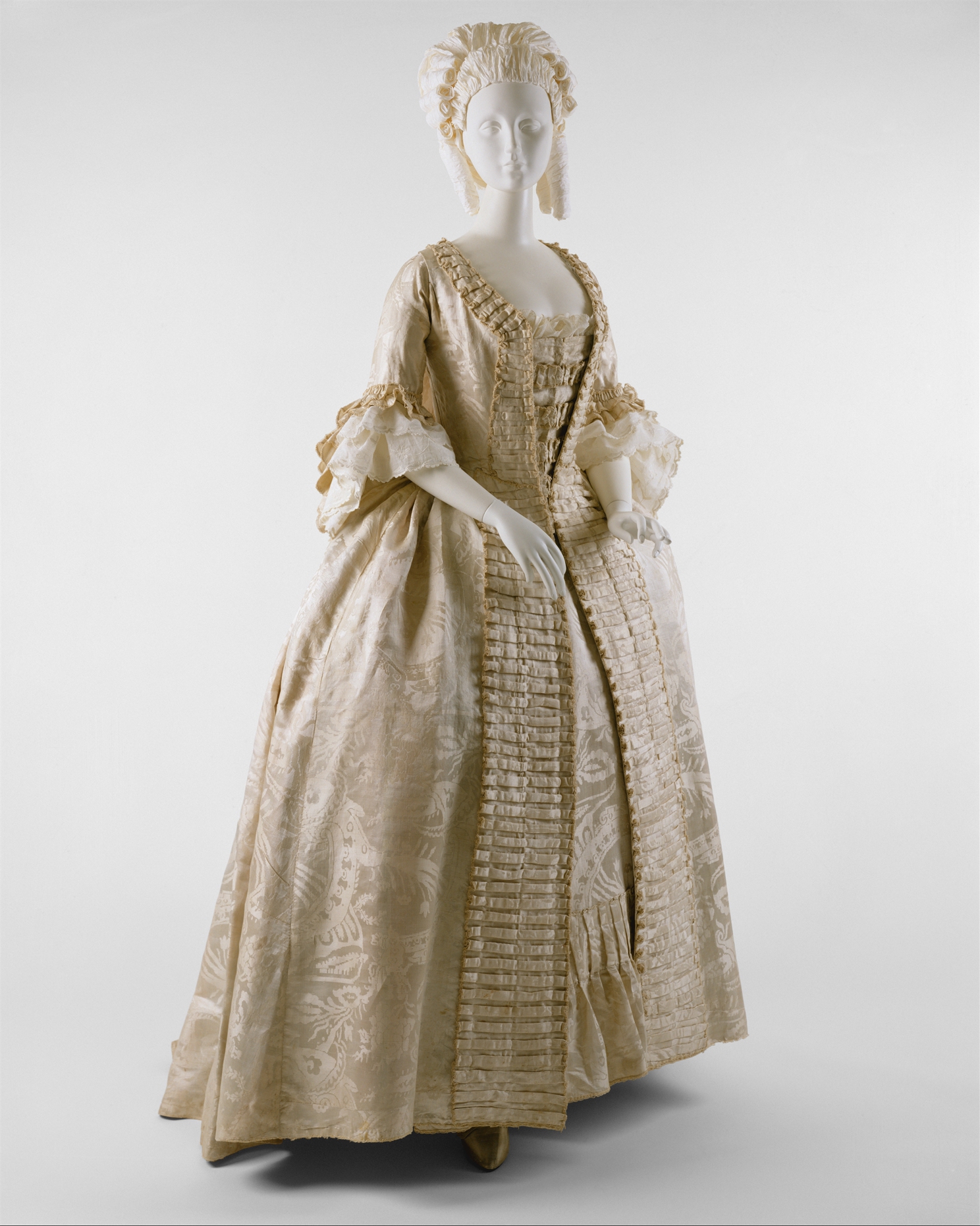
Executive Heritage Analysis: The Robe à la Française as a Strategic Archetype for Katherine Fashion Lab
The Robe à la Française, a defining silhouette of eighteenth-century French courtly fashion, represents far more than a historical garment. For Katherine Fashion Lab, this iconic form offers a profound case study in the intersection of symbolic power, material culture, and aristocratic self-fashioning. As we position our 2026 luxury strategy, this analysis decodes the garment’s layered meanings—from its spiritual resonance to its political instrumentality—and translates these into actionable design and brand narratives for the contemporary high-end consumer.
Symbolic Power: The Semiotics of the Sartorial Back
The Architectural Statement of the Back
The defining feature of the Robe à la Française is its unbroken, pleated back—the sacque—which cascades from the shoulders to the floor in a flowing train. This was not a mere aesthetic choice; it was a deliberate semiotic device. The uninterrupted expanse of silk signaled unencumbered wealth—the ability to move through space without practical constraint, a visual metaphor for aristocratic leisure. In the court of Versailles, where every gesture was scrutinized, the back of the gown functioned as a mobile canvas, announcing the wearer’s status before a single word was spoken. For Katherine Fashion Lab, this translates into a 2026 strategy where the rear silhouette becomes a signature brand identifier—a sculptural element that communicates power without overt display, appealing to clients who value quiet authority over loud branding.
Color and Fabric as Dynastic Currency
Silk, particularly the grand teint (fast-dye) silks of Lyon, was the era’s ultimate status commodity. The depth of color—whether the royal blue of the Bourbons or the deep plum reserved for the highest nobility—was achieved through expensive, labor-intensive processes. These hues were not merely decorative; they were chromatic declarations of lineage and political allegiance. The sheen of the silk, catching candlelight in the Hall of Mirrors, amplified the wearer’s presence, creating a halo effect that bordered on the divine. Our 2026 fabric strategy must therefore prioritize exclusive, high-lustre silks with bespoke dye formulations, offering clients a sensory experience that cannot be replicated by mass-market houses. The material itself becomes a carrier of meaning—a signal of rarity and ritual craftsmanship.
Historical Adornment: The Mechanics of Courtly Performance
The Pannier and the Politics of Proportions
The wide panniers (side hoops) of the Robe à la Française were not simply fashion; they were instruments of spatial dominance. In the crowded antechambers of Versailles, a woman with a wide pannier physically commanded more room, forcing others to yield. This was a non-verbal negotiation of hierarchy, enacted daily. The exaggerated width also elongated the torso, creating an idealized, almost ethereal proportion that distanced the wearer from the mundane realities of the body. For Katherine Fashion Lab, this informs a 2026 emphasis on architectural volume and engineered structure. Our designs will incorporate modern, lightweight crinolines or internal boning that recreate this commanding presence without sacrificing comfort—a fusion of historical authority and contemporary ergonomics.
Ornamentation as Ritual Layering
The Robe à la Française was typically worn over a stiffened bodice (stays) and a chemise, with intricate engageantes (lace ruffles) at the elbows. Each layer was a deliberate act of adornment, requiring hours of assistance from dressers. This ritual of dressing was a form of daily performance, a preparation for the public stage of court life. The lace, ribbons, and floral embellishments were not random; they often carried symbolic meanings—a specific knot or flower could signal a romantic affiliation or a political faction. In our 2026 strategy, we will revive this concept through modular adornment systems: detachable cuffs, brooches, and sashes that allow the client to personalize her garment, transforming it from a static object into a dynamic instrument of self-expression.
Spiritual Meaning: The Sacred and the Profane in Silk
The Gown as a Vessel of Divine Right
In the French court, the monarch’s authority was believed to be divinely ordained. The nobility, in turn, mirrored this sacred hierarchy through their dress. The Robe à la Française, with its flowing, almost liturgical lines, evoked the vestments of the clergy. The train, in particular, resembled a ceremonial cape, suggesting a processional, quasi-religious aura. Wearing such a gown was not merely vanity; it was a participation in the mystique of power, a physical embodiment of one’s place in a cosmic order. For Katherine Fashion Lab, this spiritual dimension offers a powerful narrative for 2026: we will position our garments as modern talismans, not just clothing but objects of intention. Each piece will be crafted with a meditative, almost monastic attention to detail, imbued with the idea of protection—protecting the wearer’s time, status, and personal narrative in a chaotic world.
The Alchemy of Silk
Silk itself has a transcendent quality. Derived from the silkworm’s cocoon, it is a material born of transformation—from caterpillar to moth, from raw filament to luminous textile. This alchemical metaphor resonates deeply with the spiritual aspirations of the aristocracy, who saw themselves as refined, elevated beings. The production of silk was a secretive, almost magical craft, guarded by guilds and passed down through generations. Our 2026 strategy will honor this alchemy by partnering with heritage silk mills and documenting the entire production journey—from mulberry leaf to finished bolt. This transparency becomes a form of sacred storytelling, allowing our clients to feel connected to a lineage of craftsmanship that predates industrialization.
2026 High-End Luxury Strategy: Translating Heritage into Future Value
Positioning: The New Aristocracy of Taste
The contemporary luxury consumer is not seeking nostalgia; she is seeking differentiation through meaning. The Robe à la Française offers a blueprint for this. In 2026, Katherine Fashion Lab will introduce a limited “Versailles Reimagined” capsule collection, featuring the iconic back pleat re-engineered for modern fluidity. The marketing narrative will not focus on historical accuracy but on the enduring principles of the garment: commanding presence, ritualistic dressing, and material transcendence. We will target ultra-high-net-worth individuals who value exclusivity—not through logos, but through the knowledge embedded in the garment’s construction.
Experiential Retail: The Court as a Service Model
To sell this collection, we will adopt a by-appointment-only salon model, reminiscent of a private cabinet de curiosités. Clients will be invited to a sensory environment—scented with orris and iris, the signature fragrances of Versailles—where they will be fitted by master tailors. The process will be slow, deliberate, and ceremonial, reinforcing the spiritual and symbolic weight of the garment. This experience becomes the product itself, justifying a premium price point that exceeds standard luxury benchmarks. The client is not buying a dress; she is buying an elevated state of being, a temporary ascension into a world of historical gravitas and personal power.
Digital Extension: The Virtual Court
While the physical experience is paramount, our 2026 strategy will also include a digital archive platform—an interactive, members-only site where clients can explore the historical provenance of their specific garment, including the weaver’s name, the dye batch, and the symbolic color meanings. This digital layer adds verifiable authenticity, appealing to a generation that values provenance as much as aesthetics. It transforms the garment into a collectible asset, akin to a limited-edition artwork, with a documented chain of custody.
Conclusion: The Gown as a Strategic Imperative
The Robe à la Française is not a relic; it is a masterclass in the management of perception. Its symbolic power lay in its ability to communicate status without words, its historical adornment was a daily ritual of self-creation, and its spiritual meaning connected the wearer to a transcendent order. For Katherine Fashion Lab, this analysis provides a clear directive for 2026: we will not merely create clothing; we will craft instruments of presence. By integrating the garment’s core principles—architectural volume, material sanctity, and ritualistic engagement—we will offer our clients a form of luxury that is intellectually rigorous, emotionally resonant, and commercially unprecedented. The future of high-end fashion lies not in novelty, but in the reinterpretation of timeless power—and the Robe à la Française remains our most potent guide.