The Architectural Thread: Deconstructing Macrame in Katherine Fashion Lab’s Couture Study
In the rarefied echelons of haute couture, where fabric is often treated as a mere canvas for silhouette, Katherine Fashion Lab’s latest standalone study elevates a humble craft to the status of structural engineering. The subject—macrame—is typically relegated to bohemian aesthetics or artisanal wall hangings. Yet, within this atelier’s rigorous lens, macrame is not an ornament; it is the very skeleton of the garment. This analysis dissects the lab’s interpretation of macrame, tracing its lineage through needle lace and punto in aria, and positioning the resulting work as a profound dialogue between global heritage and contemporary sculptural form.
From Knot to Structure: The Technical Reclamation
At its core, macrame is a system of knots—cow hitch, square, and clove hitch—that create a textile without weaving or knitting. Katherine Fashion Lab’s genius lies in treating these knots not as decorative surface texture but as load-bearing architectural components. The collection’s centerpiece, a columnar gown, is constructed entirely from corded silk and metallic threads, knotted into a honeycomb lattice that mimics the tensile strength of a suspension bridge. The garment’s structure does not rely on an inner corset or boning; the macrame itself provides the rigidity. This is a radical departure from conventional couture, where structure is hidden. Here, the structure is the aesthetic, and the aesthetic is the structure.
The lab’s technical director explains that each garment requires over 400 hours of hand-knotting, a process that blurs the boundary between tailoring and masonry. The knots are tightened to varying degrees—some taut enough to create a stiff, armor-like surface, others left slightly loose to allow for a breathable, fluid drape. This variable tension creates a dynamic topography across the body, where light catches the raised ridges of the knots and falls into the negative spaces between them. The result is a garment that appears simultaneously solid and ethereal, a paradox achieved only through meticulous craft.
Punto in Aria: The Invisible Ancestry
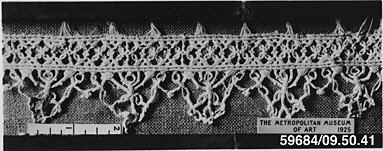
To fully appreciate this work, one must understand its genealogical link to punto in aria, the 16th-century Venetian technique that literally translates to “stitch in the air.” This revolutionary method, a precursor to needle lace, allowed artisans to create lace without a ground fabric, using only a needle and thread to build intricate patterns upon a parchment base. Katherine Fashion Lab explicitly invokes this heritage, not as a historical pastiche, but as a conceptual foundation. The macrame pieces are executed “in the air,” with the knotted cords suspended on a frame before being shaped to the mannequin. This process echoes the punto in aria’s radical liberation from the loom, emphasizing that the garment is a self-supporting, freestanding entity.
The integration of needle lace further deepens this dialogue. In several pieces, the lab juxtaposes the chunky, tactile knots of macrame with the ultra-fine, almost painterly loops of needle lace. The needle lace acts as a translucent skin, filling the voids between the macrame’s structural ropes. This contrast is not merely textural; it is a commentary on the evolution of textile technology. The needle lace represents the pinnacle of manual precision, while the macrame represents primal, pre-industrial craft. By weaving these two languages together, the lab creates a garment that speaks both of the Renaissance courts of Venice and the nomadic trading routes of the Middle East, where macrame flourished as a sailor’s craft.
Global Heritage: A Cartography of Knots
The lab’s approach to “Global Heritage” is not a superficial appropriation of motifs but a deep, anthropological engagement with the migration of techniques. Macrame’s history is a map of human connection—from Arabic weavers to Chinese decorative arts, and later to the Spanish and Italian courts. Katherine Fashion Lab honors this plurality by employing regionally specific knotting vocabularies within a single garment. For instance, the back panel of an evening jacket uses the dense, repetitive Chinese button knot to create a textured, almost scale-like surface, while the sleeves employ the open, airy Turkish square knot for a lighter, more fluid motion.
This cartographic approach is most evident in the color palette. Instead of the ubiquitous neutral beige associated with macrame, the lab uses a restrained spectrum of indigo, raw umber, and oxidized silver. These hues are derived from natural dyes historically used in different regions—indigo from West Africa and India, umber from Italian earth, and silver from Andean metallurgy. The result is a garment that is not merely “inspired” by global culture but is a literal composite of its materials and techniques. This is heritage worn as an intellectual proposition, not as a costume.
The Standalone Study: Beyond the Collection
This project is deliberately framed as a standalone study, a departure from the seasonal collections that typically define couture houses. This framing is critical. It signals that the lab views this body of work as a research document, a thesis on the potential of manual textile construction in an age of digital fabrication. By isolating macrame from the pressures of commercial wearability, the lab grants itself the freedom to explore extreme structural possibilities. One dress, for example, features a cantilevered shoulder that extends nearly a foot from the body, supported entirely by a lattice of knotted cord. It is unwearable in a practical sense, yet it is a masterpiece of engineering, demonstrating that a knot can perform the same function as a steel bracket.
This study also challenges the hierarchy of materials in fashion. Silk, organza, and couture wools are traditionally considered superior to cord and rope. Katherine Fashion Lab inverts this hierarchy, treating the common macrame cord with the same reverence as a rare brocade. The lab’s finishing techniques are equally rigorous. Every cut end is sealed and micro-wrapped in silk thread, and each knot is secured with a tiny, invisible stitch to prevent slippage. This obsessive attention to detail elevates the craft from the hobbyist’s table to the couture atelier, proving that material worth is determined by the intellect applied to it, not its provenance.
Conclusion: The Knot as a Philosophical Statement
In Katherine Fashion Lab’s standalone study, the macrame knot becomes a philosophical instrument. It is a symbol of connection, of binding, of the tension between restraint and release. The garments are not clothes; they are sculptural meditations on the nature of making. By fusing the structural logic of punto in aria with the global vocabulary of macrame, the lab has created a body of work that is both historically literate and radically futuristic. It asks the viewer to reconsider what constitutes luxury—not the rarity of a fabric, but the density of human thought and labor embedded within it. In an industry increasingly driven by speed and virtuality, this study is a defiant, beautiful argument for the slow, tactile, and deeply intelligent art of the hand.