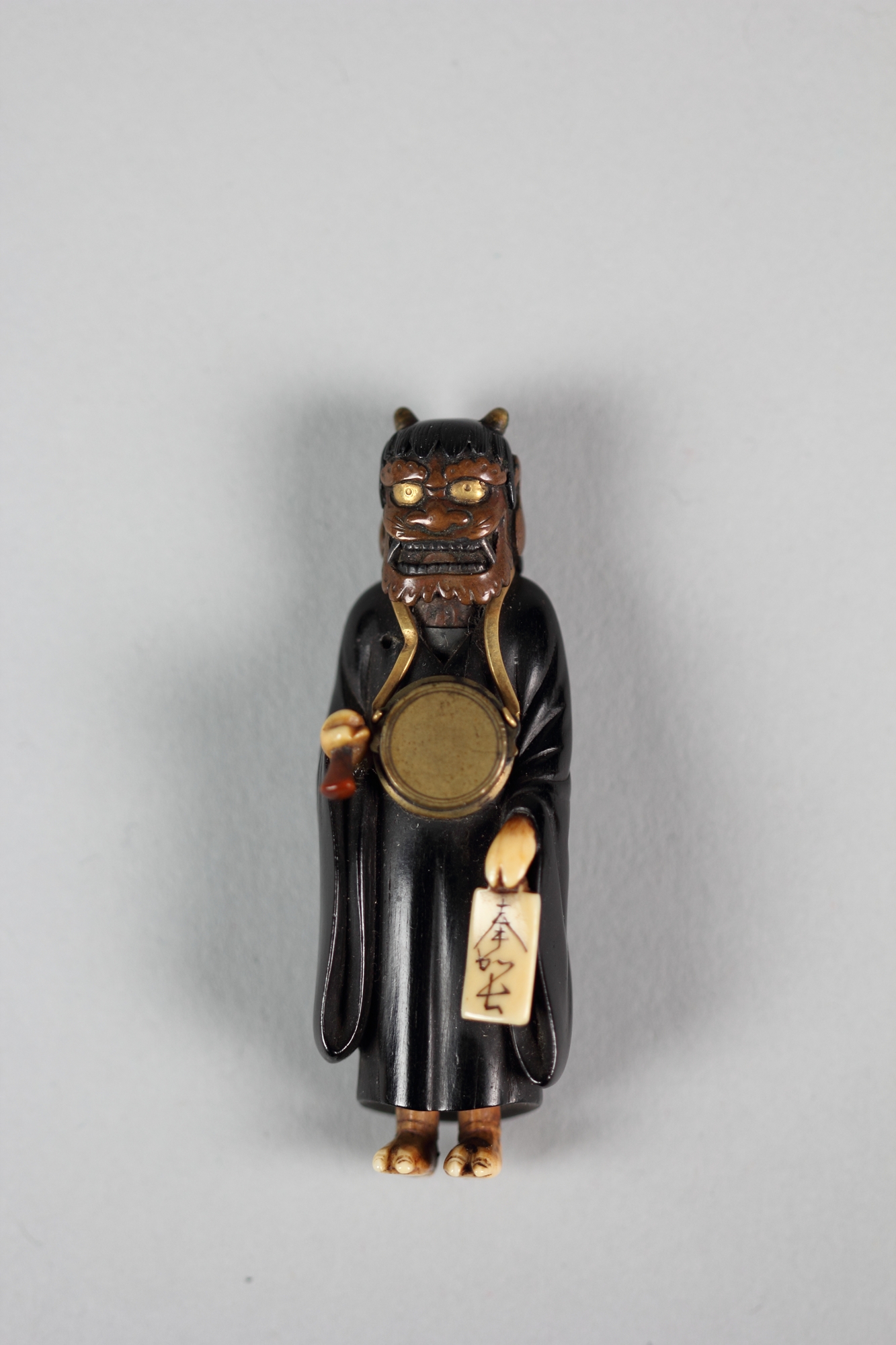
Executive Heritage Assessment: The Netsuke of Demon
This standalone strategic research paper examines the Netsuke of Demon, a Japanese miniature sculpture rendered in ebony with ivory hands and face, inlaid bronze facial features, and a brass drum. For Katherine Fashion Lab, this artifact represents more than a curatorial curiosity; it is a masterclass in the semiotics of power, the discipline of miniature luxury, and the translation of spiritual defiance into contemporary adornment. The following analysis deconstructs the object’s symbolic, historical, and spiritual DNA, culminating in a 2026 high-end luxury strategy that leverages its inherent tension between darkness and craftsmanship.
Symbolic Power: The Demon as a Talisman of Control
In Japanese cultural taxonomy, the oni (demon or ogre) is not a figure of pure evil but a complex agent of chaos, boundary enforcement, and protective ferocity. The Netsuke of Demon, carved in ebony—a wood prized for its density and near-black luster—encodes a dual narrative. First, the material itself signifies obscurity and depth, echoing the shadow realms where demons reside. Second, the demon’s posture, likely contorted or dynamic, suggests controlled aggression. Unlike Western demonology, which often depicts fallen angels, the Japanese oni is frequently a guardian of thresholds, warding off malevolent spirits while embodying raw, untamed nature.
For luxury branding, this symbolic power translates into a potent narrative of controlled rebellion. The demon does not represent destruction but rather the mastery of one’s inner chaos—a metaphor for the high-net-worth individual who navigates volatile markets and social pressures with deliberate ferocity. The inlaid bronze face and brass drum further amplify this: bronze is an alloy of strength and permanence, while the drum is a sonic symbol of summoning and proclamation. Together, they position the wearer or collector as one who commands attention without raising their voice.
Historical Adornment: The Netsuke as Functional Micro-Sculpture
Historically, the netsuke emerged in 17th-century Edo-period Japan as a functional toggle for securing inro (sealed containers) to the obi (sash) of traditional kimono. This object was not merely decorative; it was an engineering solution embedded in daily dress. The Netsuke of Demon, with its ivory hands and face, exemplifies the pinnacle of this craft—netsuke-shi (master carvers) competed for patronage by rendering microscopic details in materials of contrasting tactility.
From a heritage-adornment perspective, the netsuke occupies a unique niche: it is intimate, tactile, and portable. Unlike large ceremonial armor or lavish robes, the netsuke was handled, rotated, and admired at close range. This intimacy is critical for Katherine Fashion Lab’s strategy. In an era of oversized logos and conspicuous consumption, the netsuke offers a counter-narrative of quiet luxury—an object that reveals its complexity only upon close inspection. The ivory hands and face, now a sensitive material due to modern ethical regulations, historically signified purity against darkness, a chiaroscuro effect that elevated the demon from grotesque to sublime.
The brass drum is a particularly astute historical detail. Drums in Japanese ritual (such as taiko) are used to mark time, scare away evil, and signal transformation. In the netsuke’s miniature format, the drum is a microcosm of ritual power, suggesting that the wearer carries a portable altar of defiance. For a luxury house, this historical function translates into designing objects that are not passive ornaments but active instruments of personal narrative—pieces that “sound” metaphorically in social and professional spheres.
Spiritual Meaning: The Demon as a Guardian of Transformation
Spiritually, the Japanese demon in netsuke form is often linked to Shinto and Buddhist esoteric traditions, where demons are not adversaries of the divine but manifestations of karmic forces. The ebony body represents the void (ku), the formless potential from which all things emerge. The ivory face, conversely, symbolizes enlightenment emerging from darkness—a nod to the Buddhist concept of satori achieved through confronting one’s shadows. The bronze inlay on the face is a deliberate act of metallic alchemy, fusing the organic (ivory) with the mineral (bronze) to suggest the integration of spirit and matter.
This spiritual architecture offers a profound framework for luxury consumption. The modern affluent consumer is increasingly seeking objects with metaphysical resonance, not just aesthetic value. The Netsuke of Demon, when reinterpreted, can serve as a talisman for professional reinvention—a reminder that power is often found in embracing one’s darker, more aggressive instincts, channeled through discipline. The drum amplifies this: it is the heartbeat of the wearer, a call to action in a world of noise.
2026 High-End Luxury Strategy: From Artifact to Icon
To leverage this heritage asset for 2026, Katherine Fashion Lab must adopt a three-pillar strategy: Material Alchemy, Narrative Exclusivity, and Ritualized Consumption.
Pillar One: Material Alchemy
The original netsuke’s power lies in its contrasting materials. For 2026, Katherine Fashion Lab should launch a limited capsule collection of “Guardian Talismans”—brooches, cufflinks, or pendant toggles—using ethically sourced ebony (or a high-polish black zirconium as a modern equivalent) paired with recycled sterling silver or fair-mined gold. The bronze face should be reinterpreted as a micro-engraved plate, laser-cut with a proprietary geometric pattern inspired by the original oni’s expression. Crucially, the brass drum must be replaced with a titanium-acoustic alloy that produces a subtle, high-frequency chime when moved, offering a modern, silent-but-present sensory signature.
Pillar Two: Narrative Exclusivity
Each piece will be numbered and accompanied by a digital provenance ledger, tracing its design from the original Edo-period netsuke to the 2026 atelier. The narrative will not romanticize the demon as evil but as a “CEO of the Shadows”—a guardian for boardroom negotiations, creative breakthroughs, and personal boundaries. Marketing copy will avoid clichés of “dark luxury” and instead emphasize “controlled ferocity” and “intimate power”. The collection will be presented not as jewelry but as functional spiritual instruments, with a companion booklet explaining the oni’s role in Japanese folklore and its modern application in leadership psychology.
Pillar Three: Ritualized Consumption
Luxury in 2026 is defined by experience, not possession. Katherine Fashion Lab will host private “Netsuke Nocturnes”—invitation-only salons in Tokyo, Paris, and New York, where clients handle a certified replica of the original netsuke under guided meditation, learning to “activate” their talisman through a specific breathing ritual. This transforms a purchase into a rite of passage. The drum’s chime becomes the client’s personal signature, recorded and stored in a bespoke mobile app, allowing them to “summon” their talisman’s energy digitally before high-stakes meetings.
Conclusion: The Demon as a Mirror for Modern Luxury
The Netsuke of Demon is not a relic but a blueprint. Its ebony-and-ivory duality speaks to the contemporary luxury consumer’s desire for objects that acknowledge complexity—pieces that are simultaneously protective and provocative. By honoring its historical function as a portable, intimate tool of personal power, Katherine Fashion Lab can position itself as a house that does not merely sell adornment but curates transformation. The demon, once a guardian of kimono sashes, becomes a guardian of modern identity—a silent, powerful companion in a world that demands both ferocity and finesse.