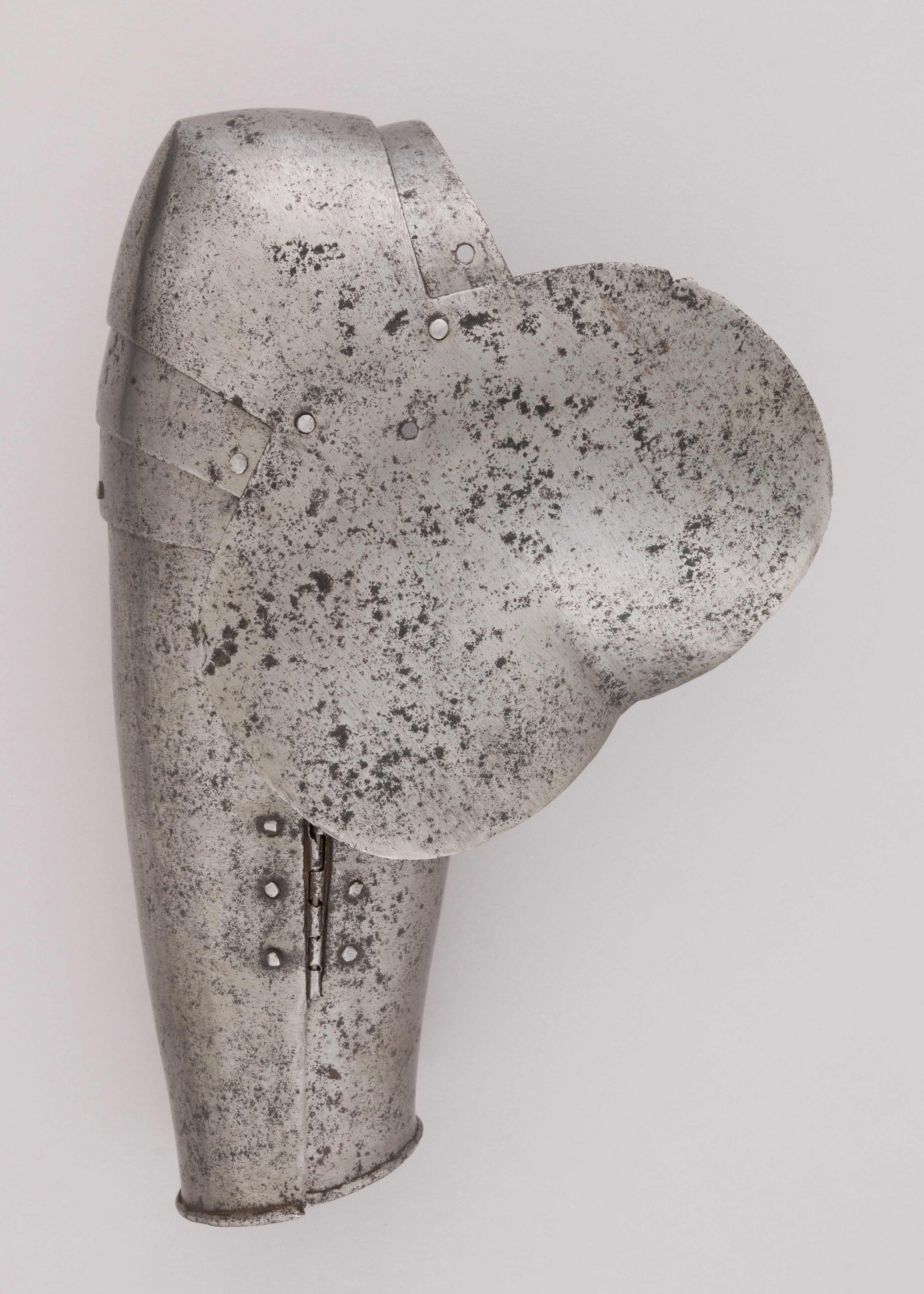
The Architecture of Armored Elegance: A Couture Analysis of the Italian Vambrace and Couter
In the rarefied atelier of historical arms and armor, few objects articulate the intersection of martial necessity and artistic genius as profoundly as the Italian vambrace and couter. These components—protecting the forearm and elbow respectively—are not merely utilitarian defenses. Within the context of Katherine Fashion Lab’s standalone study, they emerge as a masterclass in biomechanical design, metallurgical finesse, and the silent language of aristocratic power. This analysis deconstructs the pair through the dual lenses of couture construction and functional sculpture, arguing that their true genius lies in their paradoxical ability to enforce rigid protection while enabling fluid, predatory motion.
I. The Silhouette of Force: Form Following the Kinetic Line
At first glance, the vambrace presents a deceptively simple tubular form. Yet, unlike the static cylinders of later mass-produced munitions armor, this Italian exemplar is a study in organic asymmetry. The couture parallel is immediate: a bespoke sleeve cut on the bias, engineered to follow the natural rotation of the radius and ulna. The steel is not hammered flat but articulated with a subtle, convex sweep over the outer forearm—the coup de main—while the inner face is gently dished to accommodate the flexor muscles. This is not a tube; it is a three-dimensional mapping of the limb in motion, a pre-industrial exercise in ergonomic tailoring that anticipates the modern concept of performance wear.
The couter, or elbow cop, is where the design vocabulary becomes truly audacious. It flares outward into a pronounced, fluted wing—the ala—which extends over the joint’s lateral aspect. In couture terms, this is the architectural shoulder pad or the exaggerated peplum: a deliberate distortion of silhouette that commands space. The wing’s upward sweep is not decorative caprice; it is a deflector, designed to glance away a sword blow before it can shatter the hinge of the arm. The deep, central crimp—a raised, medial ridge—acts as a structural spine, channeling impact energy away from the vulnerable articulation. Here, the maker has transformed a point of weakness into a statement of aggressive elegance, a lesson in turning constraint into dramatic emphasis.
II. Materiality and Surface: The Textile Logic of Steel
Provenance is written in the metal’s very grain. The steel of this Italian pair is a high-carbon alloy, likely from Brescia or Milanese workshops, prized for its balance of hardness and ductility. The surface, while not mirror-polished for tournament display, retains a soft, satin sheen—the result of careful burnishing rather than abrasive grinding. This finish is crucial. It reduces glare on the battlefield, but from a couture perspective, it mimics the subtle luster of a heavy silk faille or a finely worsted wool. The metal appears to absorb and diffuse light, creating a depth that a high-gloss finish would obliterate.
Examine the edging. The vambrace’s proximal and distal rims are rolled outward—a technique known as roping. This is not merely to prevent the sharp edge from cutting the wearer’s own mail or padding; it is a deliberate decorative border, akin to a piped seam or a hand-rolled hem on a couture jacket. The roping adds visual weight and a tactile finish, framing the piece with a deliberate, jewel-like precision. The internal surface, though unseen, is equally telling. It retains faint hammer marks, evidence of the cold-raising process—a slow, laborious technique that hardens the steel while shaping it. This is the couture equivalent of hand-sewing a lining with silk thread: invisible labor that speaks to a philosophy of absolute integrity.
III. Articulation and the Grammar of Movement
The true genius of this armor lies in its articulation. The couter is not a solid cup but a complex sandwich of overlapping plates. The lower lames—narrow, curved strips of steel—are riveted to leather straps on the interior, allowing them to slide over one another as the elbow bends. This is the godet or the plissé of armor: a series of controlled, parallel folds that expand and contract with the body’s gesture. The design ensures that when the arm is extended, the plates overlap to form a continuous, unbroken shield; when flexed, they separate just enough to permit a full 120-degree arc of motion without pinching or binding.
This articulation is a direct antecedent to modern articulated sportswear—think of the gusseted underarm of a tailored overcoat or the segmented knee panels of technical riding trousers. The Italian armorer understood that protection is meaningless without mobility; a rigid shell is a coffin, not a garment. The precise placement of the rivets—each one a micro-pivot—demonstrates an anatomical understanding that borders on the obsessive. They are positioned not for ease of manufacture but for optimal load distribution, ensuring that no single point bears the brunt of a blow. The result is a symphony of controlled motion, where steel becomes a second, more confident skin.
IV. The Semiotics of Power: Armor as Status Garment
Beyond its physical function, this vambrace and couter are potent signifiers of social rank. In 15th-century Italy, armor was not merely military equipment; it was the ceremonial dress of the ruling class. The choice of steel, the complexity of the articulation, and the subtle, non-figurative decoration—perhaps a faint etched line along the couter’s wing—all denoted a patron of considerable means. This was bespoke work, commissioned from a master armorer whose reputation was akin to a modern couturier’s. To wear this armor was to declare one’s membership in an elite class that could afford both the finest materials and the intellectual capital required to design them.
In this context, the armor functions as a power suit—a garment that imposes authority before a single word is spoken. The broad, flared couter exaggerates the width of the shoulder, creating a V-shaped torso that projects dominance. The vambrace, with its clean, unbroken line, suggests control and precision. This is not the anonymous, utilitarian gear of a common soldier; it is a bespoke statement of identity, a wearable manifesto of the wearer’s place in the cosmos. The subtle interplay of light on the satin-finished steel mimics the sheen of expensive velvet, further blurring the line between the battlefield and the court.
V. Conclusion: A Legacy in Steel and Stitch
The standalone study of this Italian vambrace and couter reveals a profound truth: the principles of haute couture—fit, proportion, material integrity, and the celebration of the human form in motion—are timeless. The armorer, like the couturier, is a problem-solver who works in a unforgiving medium. Every curve, every rivet, every polished surface is a decision made in service of a singular vision: to clothe the body in a way that is both protective and expressive.
This pair is not a relic of a bygone era. It is a foundational text for any designer seeking to understand the relationship between structure and fluidity. Its articulation anticipates the hinges of a modern architectural gown; its roped edges echo the piping on a Chanel jacket; its satin sheen prefigures the matte finishes favored by contemporary minimalists. As a study in standalone form, it stands as a testament to the fact that true craftsmanship is never obsolete. It is merely waiting for the next visionary to read its language and translate it into a new context. In the steel of this vambrace, we find not just a defense for the arm, but a defense of the very idea that clothing can be both armor and art.