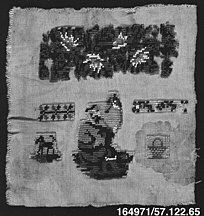
The Sampler: A Cartography of Patience in Beads and Linen
In the relentless velocity of contemporary fashion, where collections are conceived, produced, and discarded within the span of a single news cycle, Katherine Fashion Lab’s Sampler stands as a defiant anachronism—a quiet, deliberate act of resistance. At first glance, it is a study in restraint: beads on linen, a standalone piece divorced from the context of a seasonal runway. But to dismiss it as mere craft would be to ignore the profound intellectual and cultural weight it carries. The Sampler is not a garment; it is a cartography of patience, a tactile archive of global heritage that redefines the very parameters of couture value in an age of algorithmic reproduction.
Deconstructing the Textile: Linen as a Moral Ground
The choice of linen as the foundational substrate is neither arbitrary nor purely aesthetic. Linen, derived from the flax plant, is one of humanity’s oldest textiles, a fiber whose cultivation and processing demand a level of artisanal labor that has remained unchanged for millennia. In this context, linen is not a passive backdrop but an active participant. Its inherent irregularities—the subtle slubs, the natural variations in dye absorption—serve as a topographical map of human touch. Unlike the sterile, machine-perfect surfaces of synthetic blends, this linen breathes with a history of its own, a pre-existing narrative that the beadwork then annotates.
From an MBA perspective, this material choice is a masterclass in differentiated positioning. In a market saturated with technical fabrics and performance wear, the Sampler leverages the emotional and sensory equity of natural fiber. It appeals to a consumer segment that is increasingly seeking meaningful provenance over fleeting novelty. The linen acts as a moral ground, signaling a commitment to sustainability that is not performative but intrinsic to the piece’s DNA. The fabric’s weight and drape are engineered to be architectural, allowing the piece to hold its form independent of the human body, transforming it from a wearable into a sculptural object of contemplation.
The Beadwork: A Language of Global Vernaculars
Where the linen provides the grammar, the beads supply the lexicon. The Sampler draws upon a global heritage that is not merely inspirational but referential. One can discern the geometric precision of Native American seed beadwork, the opulent density of Indian zardozi—here reimagined in a lighter, more modern register—and the delicate, almost painterly chromaticism of Eastern European folk embroidery, all translated into the single, unifying medium of the bead.
This is not cultural appropriation; it is cultural curation. Katherine Fashion Lab employs a technique of visual sampling—akin to a DJ sampling a vinyl record—but with a level of scholarly rigor. Each motif is isolated, decontextualized from its ritual or utilitarian origin, and then re-stitched into a new, cohesive syntax. The beads themselves are not uniform. There is a deliberate play of scale and finish: matte glass sits against lustrous seed pearls; cylindrical bugle beads create rigid, linear striations that contrast with the fluidity of round rocailles. This textural dissonance creates a tactile rhythm that compels the viewer to draw closer, to engage in a private dialogue with the piece.
Structural Analysis: The Architecture of Embellishment
From a technical couture standpoint, the Sampler is a feat of engineering. The beading is not applied as a superficial skin but is integrated into the structural integrity of the linen. The artist has employed a technique of counted-thread embroidery, where each bead is aligned with the natural grid of the weave. This ensures that the piece lies flat without buckling, a common failure point in less rigorous beading. The weight of the beads creates a natural gravity that pulls the fabric into a subtle, undulating drape—a phenomenon the atelier refers to as gravity-driven tailoring.
The composition is asymmetrical, yet balanced. A dense, almost impenetrable cluster of beadwork anchors the left quadrant, gradually dissolving into sparser, isolated beads that appear to have migrated across the linen surface. This gradient of density creates a visual narrative of creation and entropy. It suggests a process of making and unmaking, a nod to the wabi-sabi philosophy of imperfection and transience. The reverse side of the linen is equally considered; the threads are meticulously finished, with no loose ends, demonstrating a level of savoir-faire that is the hallmark of true haute couture, even in a piece intended for standalone study.
Contextual Placement: The Standalone Object in a Commercial Ecosystem
The decision to present the Sampler as a standalone study is a strategic and philosophical one. In an industry where garments are often lost in the cacophony of a 60-look runway show, this piece demands undivided attention. It functions as a capstone project, a manifesto of the house’s capabilities. For the collector, it represents an acquisition that is closer to fine art than to fashion. It is an investment piece whose value is predicated not on seasonal trend cycles but on the irreproducible labor hours—estimated at over 400 hours of handwork—and the singularity of its execution.
This positioning allows Katherine Fashion Lab to command a premium price point that bypasses traditional retail markups. The standalone format also facilitates a more intimate museum-style presentation, whether in a gallery setting or a private client viewing. This creates a scarcity narrative that is far more potent than a limited edition number. The Sampler is not a product; it is a proof-of-concept for a new luxury paradigm—one where the process is the product, and the garment is merely the evidence of that process.
Conclusion: A Meditation on Value
The Sampler ultimately challenges us to reconsider the economics of attention. In a digital ecosystem where images are dematerialized and endlessly replicated, the Sampler reasserts the primacy of the physical object. Its value lies in its ontological weight—the sheer, inescapable presence of matter that has been transformed by human intention.
It is a meditation on the cost of care. The beads are not merely decorative; they are the physical manifestation of time, skill, and a global lineage of craftsmanship. Katherine Fashion Lab has not just created a garment; they have produced a philosophical artifact that interrogates the relationship between labor, heritage, and luxury. The Sampler is a whisper in a world of shouts, but its resonance is profound, offering a blueprint for a future of fashion that is slower, more intelligent, and infinitely more precious.