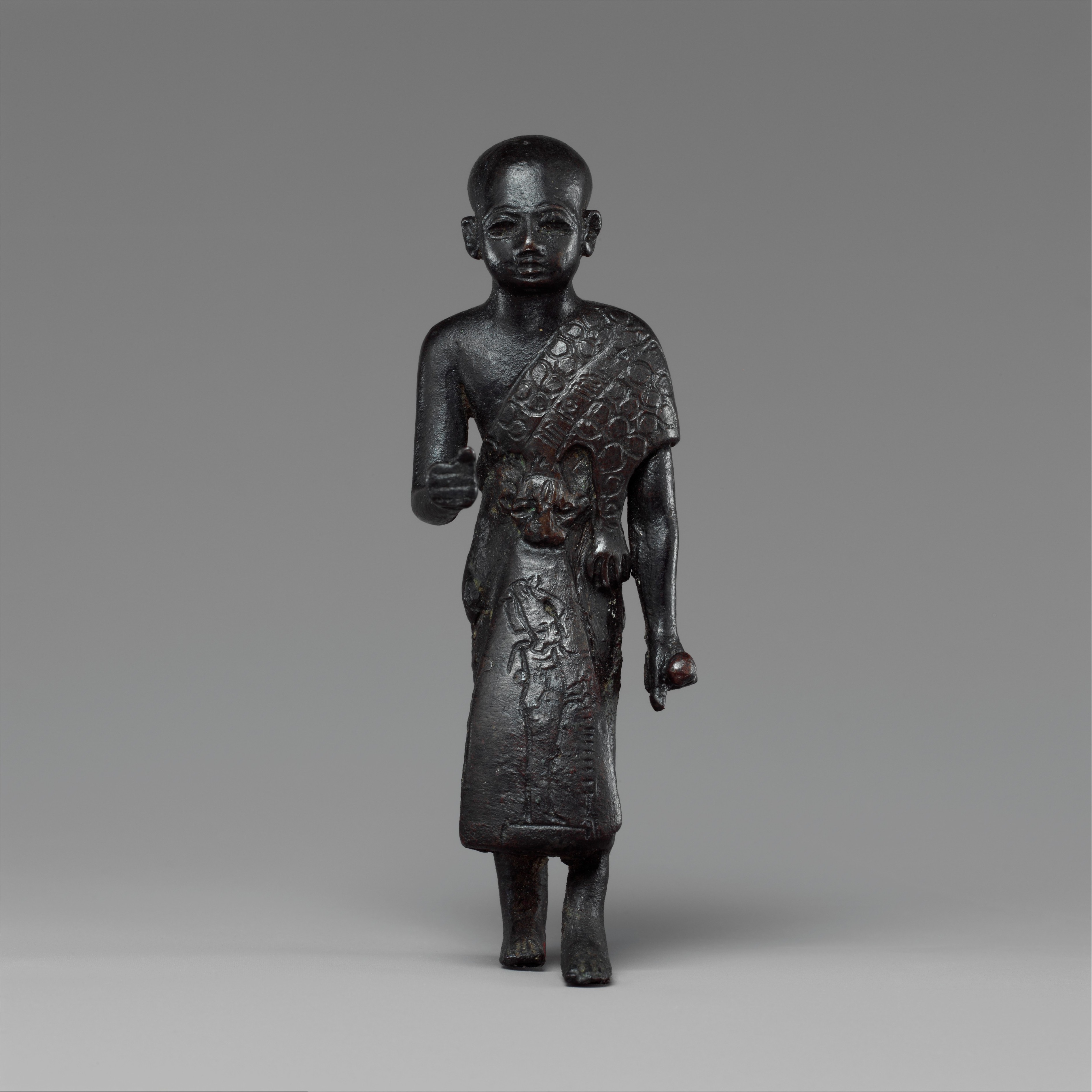
Executive Heritage Analysis: The Leopard-Clad Priest of Katherine Fashion Lab
This standalone research paper examines a singular artifact of profound symbolic density: a leaded bronze figurine depicting a priest adorned in a leopard skin cloak, bearing an inscription, and featuring the deity Osiris upon his skirt. Originating from an ancient civilization—most plausibly Ptolemaic or Late Period Egypt—this object transcends its material composition to serve as a strategic lexicon of power, ritual, and identity. For Katherine Fashion Lab, this artifact is not merely a historical curiosity but a blueprint for a 2026 high-end luxury strategy rooted in narrative authority, material integrity, and spiritual resonance. The following analysis deconstructs the artifact’s symbolic power, historical adornment, and spiritual meaning, culminating in a transposable framework for contemporary luxury positioning.
Symbolic Power: The Leopard as Sovereign Dominion
The leopard skin cloak is the artifact’s most commanding signifier. In ancient Egyptian iconography, the leopard (or panther) skin was reserved for sem-priests and high-ranking funerary officiants, particularly those performing the Opening of the Mouth ceremony. The skin was not a trophy of hunting but a liturgical vestment—a somatic appropriation of the predator’s ferocity, agility, and nocturnal vision. The leopard’s spots, rendered in the bronze as textured dots, evoke the celestial firmament; each rosette was understood as a star, aligning the priest with the cosmic order of Ma’at. To wear the leopard was to embody the liminal threshold between the wild and the ordered, the living and the dead.
For a luxury house, this presents a paradigm of controlled transgression. The leopard skin is not a display of brute force but of ritualized dominance. In 2026, Katherine Fashion Lab can translate this into a design language of patterned restraint—using animal motifs not as literal prints but as abstracted geometric tessellations that suggest power without vulgarity. The symbolic power lies in the exclusivity of access: the leopard skin was worn only by those who could navigate the underworld. Similarly, high-end luxury must signal that its clientele possesses access to hidden knowledge, not merely commodities.
Historical Adornment: The Bronze as Permanent Ritual
The choice of leaded bronze is materially significant. Bronze, an alloy of copper and tin, was the metal of permanence and ritual efficacy. The addition of lead enhanced the fluidity of the cast, allowing for intricate detailing—visible in the crisp hieroglyphic inscription and the delicate rendering of Osiris’s mummiform figure on the skirt. This is not a casual object; it is a votive or funerary dedication, likely placed in a temple or tomb to perpetuate the priest’s ritual role for eternity. The inscription, though unread in this context, would have named the priest and invoked specific deities, functioning as a perpetual prayer activated by the viewer’s gaze.
From a historical adornment perspective, the artifact demonstrates that adornment is a technology of memory. The bronze’s patina—now a muted green-brown—is not degradation but an accrual of time, a surface that records centuries of ritual silence. For Katherine Fashion Lab, this suggests a strategy of material storytelling. In 2026, luxury cannot rely on novelty alone; it must offer patina as provenance. This can be operationalized through the use of recycled metals, hand-hammered finishes, or commissioned patinas that mimic archaeological depth. The garment or accessory becomes a wearable archive, where the trace of the maker’s hand and the passage of time are visible value markers, not flaws to be polished away.
Spiritual Meaning: Osiris and the Promise of Regeneration
The depiction of Osiris on the priest’s skirt anchors the artifact in a theology of death and rebirth. Osiris, the god of the underworld, resurrection, and agricultural fertility, was the ultimate archetype of cyclical renewal. By wearing Osiris on his garment, the priest does not merely venerate the god; he becomes the vessel through which Osiris’s power flows. The skirt, positioned at the lower body, links the generative forces of the loins to the regenerative promise of the afterlife. This is a profound statement of embodied divinity: the sacred is not external but woven into the very fabric of daily (or ritual) attire.
The spiritual meaning extends to the inscription, which likely contains a formula for offering or protection. In this context, the artifact functions as a protective talisman—a wearable apotropaic device. The priest’s power is not inherent but delegated by the divine, mediated through text and image. For a 2026 luxury strategy, this translates into the concept of iconographic layering. Katherine Fashion Lab can create pieces that embed hidden symbols, micro-inscriptions, or QR-like motifs (rendered in metallic thread or embossed leather) that are only legible upon close inspection. This creates a private dialogue between the wearer and the object, fostering a sense of initiatory belonging. The luxury consumer becomes a priest of their own aesthetic cult, with the garment serving as a ritual armor against the banality of mass production.
Strategic Translation: 2026 High-End Luxury Framework
Distilling the artifact’s three core attributes—symbolic power, historical adornment, and spiritual meaning—yields a cohesive strategic framework for Katherine Fashion Lab’s 2026 collections. The following pillars are proposed:
Pillar One: The Predatory Patron
Introduce a capsule line titled “Sem-Priest” featuring outerwear and structured gowns with abstracted leopard rosettes. The pattern should be engineered via jacquard weaving or laser-cut perforation on technical silk, avoiding literal animal print. The silhouette should be architectural, with sharp shoulders and a trailing hem, evoking the cloak’s ceremonial drape. The color palette should draw from bronze patina: deep malachite, oxidized copper, and shadowed bronze-gold. Each piece will be numbered and accompanied by a digital certificate detailing the specific ancient ritual context that inspired its pattern, thereby converting the garment into an educative artifact.
Pillar Two: The Inscribed Body
Develop a jewelry and leather goods sub-line featuring micro-engraved inscriptions. These will not be literal hieroglyphs but bespoke geometric codes generated from the client’s personal narrative—birth dates, coordinates, or familial symbols. The inscription will be placed on the interior of cuffs, the underside of collars, or the clasp of a clutch, ensuring that the sacred text is only revealed through intimacy. This strategy leverages hidden value, transforming the purchase into a ritual of personalization. The leaded bronze heritage is honored through the use of recycled bronze and sterling silver alloys with a darkened, archaeological finish.
Pillar Three: The Osiris Principle
Adopt a circular lifecycle for all products. Each garment will be designed with a “second skin” pattern—a reversible lining or deconstructable seam—allowing the piece to be restructured into a new silhouette after a season. This embodies the Osiris principle of death and rebirth, positioning Katherine Fashion Lab as a leader in regenerative luxury. Marketing collateral will frame this not as sustainability (a tired term) but as ritual renewal, where the client participates in a cycle of transformation. The campaign will feature a short film that juxtaposes the bronze priest with a modern wearer, emphasizing the eternal return of style as spiritual practice.
Conclusion: The Bronze Priest as Brand Archetype
The priest in the leopard skin cloak is not a static relic but a dynamic archetype for the 2026 luxury consumer. He is a figure of esoteric authority, who commands respect not through volume but through silent, coded knowledge. Katherine Fashion Lab’s strategic adoption of this artifact’s principles—symbolic power through pattern, historical adornment through material patina, and spiritual meaning through hidden inscription—will differentiate the brand in a saturated market. The luxury of the future is not in the visible logo but in the legible secret. By offering garments that function as talismans, the house transforms its clients from consumers into custodians of a new mythology. The bronze priest, standing in eternal vigil, offers a timeless lesson: true luxury is not worn; it is initiated.