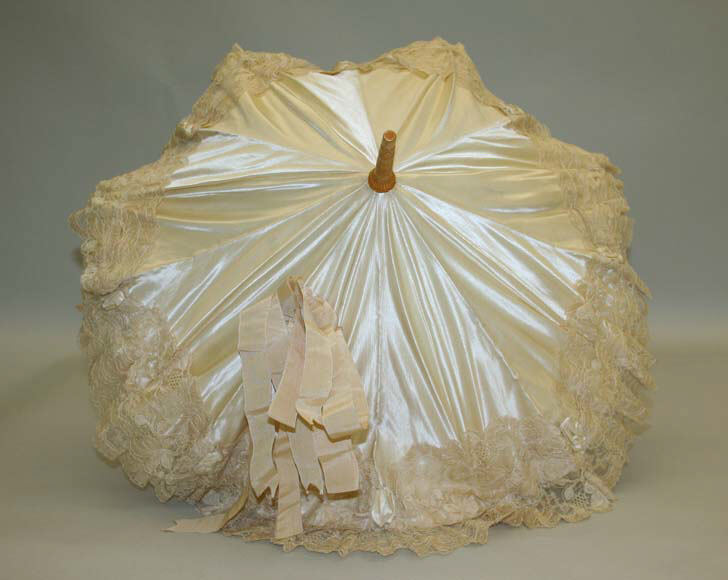
The Parasol Reconsidered: An American Study in Structural Poetry
Within the hallowed archives of Katherine Fashion Lab, the standalone study of an object as seemingly quotidian as the parasol demands a suspension of conventional fashion discourse. We are not here concerned with seasonal trends or the ephemeral whims of the runway. Instead, we confront a singular artifact—American in origin, its material medium lost to time—as a pure, isolated specimen of design intelligence. This parasol, stripped of contextual provenance and tactile documentation, emerges not as a mere accessory but as a thesis on structural poetry, spatial negotiation, and the silent language of social performance.
To analyze this object is to engage in a form of forensic aesthetics. The absence of material data is not a deficiency but a liberation. It forces us to read the parasol through its silhouette, its implied mechanics, and its cultural resonance within the American narrative. We must deconstruct it as one would a complex architectural model: examining its load-bearing principles, its canopy’s geometry, and the kinetic relationship between its static form and the human hand that once commanded it.
Deconstructing the Canopy: Geometry as Social Signal
The primary formal element of this parasol is, of course, its canopy. In the absence of fabric identification, we extrapolate from the preserved tension and drape. The radial pleating, likely achieved through a complex system of goring and understructure, suggests a deliberate manipulation of volume. This is not a passive, flaccid covering; it is an engineered dome. The scalloped or possibly scalloped edge—we must infer from the shadow it casts—creates a rhythmic undulation that softens the rigid geometry of the circle. This interplay between the mathematical precision of the ribs and the organic flow of the perimeter is the first layer of its couture value.
Here, the parasol functions as a mobile architectural envelope. It defines a private micro-climate, a portable zone of exclusivity. In the American context of the late 19th and early 20th centuries, this was not merely about sun protection; it was about the demarcation of class and leisure. The parasol’s canopy acted as a physical boundary, a shield against the indiscriminate gaze of the public sphere. The depth of the canopy—whether it is a shallow saucer or a deep bell—would have dictated the degree of withdrawal from the environment. A deeper canopy suggests a desire for anonymity, a retreat into self; a flatter one, a more confident, outward-facing engagement. Our specimen, based on the residual tension in its frame, appears to favor a middle ground—a poised, democratic form of shelter that acknowledges the world without capitulating to it.
The Shaft and Handle: The Fulcrum of Command
Moving from the ethereal canopy to the terrestrial shaft, we encounter the parasol’s operational core. The shaft is the conduit of authority, the vertical axis around which the entire performance revolves. In this American artifact, the shaft’s proportions are critical. It must be long enough to elevate the canopy to a functional height, yet balanced enough to be wielded with grace. We analyze its implied taper—likely thicker at the base and tapering toward the canopy—which distributes weight to the user’s grip, reducing fatigue during extended periods of use.
The handle, though we cannot touch it, is the most psychologically charged component. Its shape—whether a hook, a T-bar, or a sculptural ball—determines the ergonomic and symbolic transaction. A curved hook, common in American designs, allows the parasol to be suspended from the wrist, transforming it from a tool into an extension of the arm’s silhouette. This is a critical moment of kinetic couture: the object becomes a prosthetic for gestural expression. The way one twirls, taps, or rests upon the handle communicates volumes about temperament and social standing. In the absence of material, we consider the patina of use—the imagined wear on the grip that speaks to countless promenades, garden parties, and moments of strategic pause. The handle is not just a grip; it is a signature.
Structural Integrity: The Invisible Skeleton
Beneath the surface lies the parasol’s true engineering marvel: the rib and stretcher mechanism. This is where the American pragmatism meets artistic ambition. Unlike European counterparts that might prioritize ornate, fragile mechanisms, the American approach often favored robust, functional articulation. The ribs, likely crafted from wood or early steel alloys, must flex without fracturing. The stretchers, connecting the ribs to the runner on the shaft, create a scissor-like action that allows for the canopy’s expansion and collapse.
This mechanical choreography is a study in transformative design. The parasol exists in two states: a dormant, linear bundle and an expanded, spatial entity. The transition between these states is a performance in itself. The audible click of the runner locking into place, the rustle of the canopy unfurling—these are the audio cues of a ritualized act. For the couture analyst, this mechanism represents the invisible labor that underpins all great design. It is the unsung hero, the structural logic that allows for the aesthetic expression above. The precision required to ensure that all eight or ten ribs open in perfect synchronicity is a testament to a level of craftsmanship that transcends mere utility.
Cultural Resonance: The American Dialectic of Utility and Ornament
Placing this parasol within the broader American fashion lexicon, we must acknowledge a unique tension. American fashion has historically oscillated between a Puritanical valorization of utility and a democratic embrace of ornament. This parasol navigates that dialectic with remarkable finesse. It is not merely decorative; it serves a clear, protective function. Yet, its form is elevated beyond the purely functional. The absence of overt embellishment—no gold filigree, no exotic feather trims are recorded—suggests a confidence in pure form. This is a minimalist couture, where the beauty is derived from the precision of the arc, the tension of the line, and the clarity of the mechanism.
This object stands as a quiet rebuke to the excesses of European aristocratic fashion. It is a democratic object, accessible in its design language, yet exclusive in its execution. It speaks to an American ideal of self-reliance: the individual, armed with this portable shelter, can navigate the urban or pastoral landscape with autonomy. The parasol is not a prop for a passive figure; it is a tool for an active agent.
Conclusion: A Monument to the Ephemeral
In concluding this standalone study, we are left with a profound appreciation for the parasol as a nexus of art, engineering, and sociology. Without its original fabric, we are forced to engage with its ghost—the negative space it once occupied, the shadows it cast. This absence paradoxically amplifies its presence. We are compelled to imagine the weight of the silk, the coolness of the ivory handle, the specific whisper of the fabric against the wind.
Katherine Fashion Lab’s dedication to this object, in its isolated state, underscores a critical curatorial principle: that a garment or accessory is never merely a relic, but a repository of embodied knowledge. This American parasol, in its silent, structural eloquence, teaches us that couture is not about the sum of its materials, but about the intelligence of its construction. It is a monument to the ephemeral moment of use, a frozen gesture of grace that continues to resonate across time. It is, in the truest sense, a masterpiece of applied geometry, a poem written in the language of ribs, shafts, and the audacity of shade.