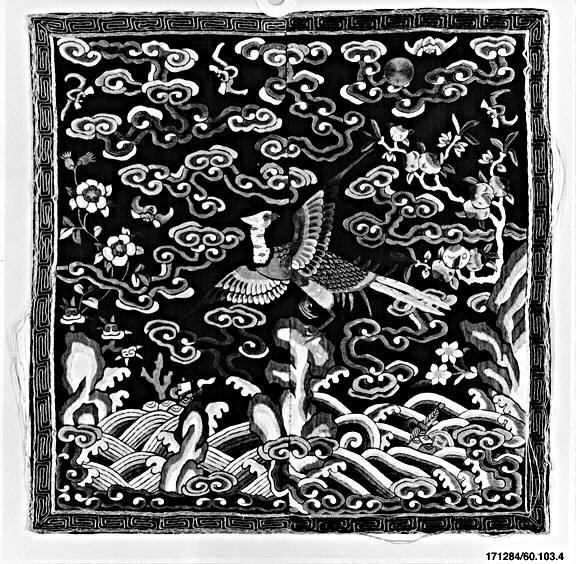
Decoding Distinction: A Structural Analysis of the Qing Dynasty Rank Badge
Within the curated archives of Katherine Fashion Lab, the Rank Badge, or Buzi, emerges not merely as a textile artifact but as a sophisticated system of non-verbal communication engineered into wearable form. Originating in Ming Dynasty China and codified under the Qing (1644–1912), this particular example—featuring the Golden Pheasant (jinji) rendered in silk and wrapped gold thread—serves as a standalone study in how power, hierarchy, and cosmology were meticulously woven into the very fabric of bureaucratic life. Our analysis deconstructs this emblem not as a simple ornament, but as a pinnacle of sartorial semiotics, where every thread and motif is a deliberate data point in a vast imperial network.
The Architecture of Authority: Silhouette, Grid, and Symbolic Hierarchy
The immediate visual impact of the badge is one of structured opulence. Its square form is not an arbitrary choice but a profound cosmological reference, mirroring the ancient Chinese conception of a square earth under a round heaven. This shape imposed a rigid, bordered canvas upon the wearer's chest, a literal and figurative framework for identity. The composition is typically bifurcated: a terrestrial realm at the bottom, often featuring rolling waves or a rocky outcrop, supporting a central, dominant avian figure set against a void or a finely patterned ground. This creates a clear vertical hierarchy on the badge itself, mirroring the hierarchical ascent of the official within the imperial system.
The use of silk as the foundational ground speaks to control and exclusivity. As the product of sericulture, a state-monopolized industry for centuries, silk itself was a material manifestation of imperial power. The application of wrapped gold thread—thin strips of gold foil coiled around a silk core—through techniques like couching or satin stitch, transforms the surface into a low-relief tapestry. This technique does not merely depict wealth; it creates a tangible, light-capturing density. The pheasant is not printed but built, its form emerging through a topographic play of textures that would catch the light with the slightest movement, ensuring the badge functioned as a dynamic beacon of rank in court assemblies.
The Golden Pheasant as Semiotic Code
The choice of the Golden Pheasant is where iconography converges with bureaucratic function. In the Qing administrative taxonomy, the jinji was exclusively assigned to civil officials of the second rank. This was a critical tier, just below the most senior ministers, encompassing positions like vice-presidents of the Six Boards and provincial governors. The pheasant, a bird known in Chinese culture for its beauty, elegance, and associative literary connotations, was an apt symbol for the scholarly civil servant. Unlike the martial prowess symbolized by beasts like the lion or tiger for military officials, the pheasant alluded to refinement, civil virtue, and the cultivated mind.
However, a deeper analysis reveals a more complex narrative. The pheasant is often depicted in a highly stylized, almost confrontational posture, its head turned to the side in the "frontal profile" view, with tail feathers magnificently splayed. This is not a naturalistic portrait but a heraldic assertion. Its poised alertness symbolizes the vigilance and discernment expected of a high-ranking official. The surrounding motifs—stylized clouds, the sun disk, perhaps a flaming pearl—embed the official within the universal order, suggesting his role is sanctioned by celestial forces. Thus, the badge performs a dual function: it identifies the wearer's precise bureaucratic coordinate while simultaneously projecting the idealized attributes he must embody.
Wrapped Gold: The Materiality of Prestige and Protocol
The material execution, specifically the wrapped gold thread, is where technical mastery meets political theater. This material was prohibitively expensive and its use was strictly regulated by sumptuary laws. The application of gold was not merely decorative; it was a visual metaphor for the emperor's grace and the luminous value of the official's service. In the dim, incense-filled halls of the Forbidden City, these badges would have glimmered softly, creating a constellation of rank that visually mapped the imperial power structure during audiences.
The craftsmanship required—the precise couching of each gold thread to create smooth, radiant surfaces without puckering the silk ground—represents a zenith of Chinese textile arts. It signifies a system where the object's manufacture was as controlled and hierarchical as its usage. The badge is, therefore, a nexus point of empire: it consumes state-controlled silk and precious metals, is fashioned by state-sanctioned artisans, to be worn by a state-appointed official, creating a closed loop of imperial production and consumption.
Contemporary Resonance: From Bureaucratic Uniform to Conceptual Catalyst
As a standalone study for Katherine Fashion Lab, this Rank Badge transcends its historical context to offer profound insights for contemporary design thinking. It is a masterclass in embedded narrative. Today's luxury brands meticulously craft logos and monograms to signify belonging; the Buzi system presents a more nuanced model where the entire visual field is a legible code, communicating specific data (rank, department) alongside aspirational virtues.
Furthermore, it challenges modern conceptions of wearable technology. This badge was, in essence, an analog "smart" garment. It interfaced with a vast social and political network, transmitting the wearer's identity and status instantly to any informed viewer without a single spoken word. Its function was purely communicative and regulatory. In an age of digital wearables, the Buzi reminds us that the most potent data can be woven, not wired.
Finally, it raises critical questions about uniformity and individuality. The badge standardized identity, subsuming the individual into his bureaucratic function. Yet, within that strict framework, artisanship flourished—no two pheasants are absolutely identical. The tension between rigid protocol and exquisite handcraft is a poignant dialogue between the collective and the singular, a tension ever-present in the world of haute couture and uniform design today.
In conclusion, the Rank Badge with Golden Pheasant is a sartorial microcosm of the Qing Empire. Through its deliberate form, regulated iconography, and luxurious materiality, it performed the essential work of state administration on the body of the official. For the modern analyst, it stands as a timeless case study in how clothing can be engineered as a tool of power, a medium of art, and a sophisticated language unto itself.