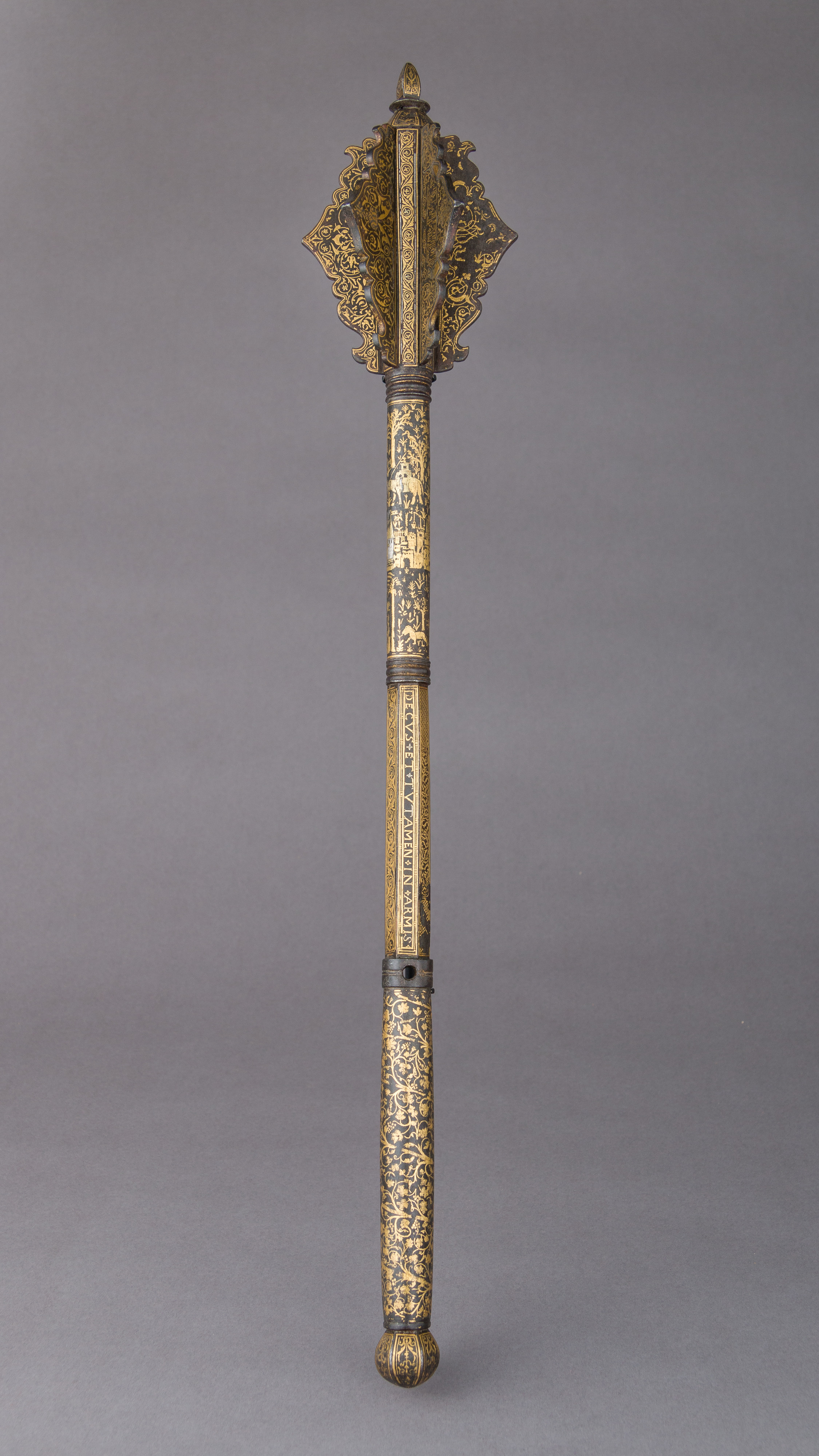
Heritage Analysis: The Ceremonial Mace of Henry II of France
At Katherine Fashion Lab, we approach heritage artifacts not merely as historical objects, but as repositories of encoded power—visual, spiritual, and strategic. The ceremonial mace created for Henry II of France (reigned 1547–1559) is a masterclass in the fusion of martial authority, sacred kingship, and artisanal virtuosity. Crafted from steel, gold, and silver, this object transcends its functional origins to become a wearable ideology, a precursor to the modern luxury statement piece. For a 2026 high-end strategy, this mace offers a profound blueprint for communicating dominance, divine favor, and unassailable refinement.
Symbolic Power: The Mace as an Instrument of Sovereign Will
The mace, in its medieval and Renaissance iterations, was a dual-signifier. On the battlefield, it was a blunt-force weapon capable of crushing armor—a symbol of brute, irresistible force. In the ceremonial court, however, it transformed into a scepter-like emblem of juridical and monarchical authority. For Henry II, a king perpetually engaged in the Italian Wars and the Habsburg-Valois rivalry, the mace was a deliberate assertion of martial supremacy tempered by diplomatic gravitas.
The material hierarchy within the artifact is telling. Steel forms the core—unyielding, functional, and masculine. Yet it is encased and accented with gold and silver, elevating the weapon from a tool of violence to an object of aesthetic and symbolic veneration. This juxtaposition is not incidental; it mirrors the Renaissance ideal of the “warrior-king” who pairs military might with humanist cultivation. For Katherine Fashion Lab, this translates into a 2026 strategy where raw power is never presented without an overlay of cultural sophistication. The modern luxury consumer does not buy aggression; they buy controlled power—the ability to command a room without raising a voice, the quiet confidence of a blade sheathed in gold.
Heraldic and Dynastic Messaging
Historical records and surviving examples of French royal armaments from this period indicate that such maces were often adorned with the king’s personal emblem—the crescent moon—and the motto “Donec totum impleat orbem” (“Until it fills the whole world”). This crescent, associated with the goddess Diana and Henry’s mistress Diane de Poitiers, was a layered symbol: it referenced his chivalric devotion, his astrological destiny, and his imperial ambition. The mace, therefore, was not a generic royal accessory; it was a personalized narrative device. Each engraved crescent and gilded flourish told a story of conquest, love, and cosmic inevitability.
For a 2026 luxury house, the lesson is clear: heritage is not a static logo but a living lexicon. Katherine Fashion Lab should encourage clients to commission or acquire pieces that embed their own personal iconography—a monogram, a crest, a symbolic motif—into the design. The mace’s power lies in its specificity; it was made for this king, not for any king. Hyper-personalization, executed with museum-grade craftsmanship, will be the defining differentiator in the ultra-high-end market.
Historical Adornment: The Art of Gilded Authority
From an adornment perspective, the Henry II mace exemplifies the French Renaissance’s obsession with champlevé enamel, damascening, and fire-gilding. The steel core would have been etched with acid to create recessed patterns, into which gold and silver wire were hammered—a technique known as damascening. This process was painstaking, requiring hours of labor per square inch, and it rendered each mace a unique, non-reproducible artifact. The gold was not merely applied; it was married to the steel, creating a surface that simultaneously reflected light and absorbed it, producing a play of shadow and brilliance.
This technical mastery is the historical antecedent of what Katherine Fashion Lab should champion in 2026: “material storytelling.” The modern equivalent is not mass-produced gold plating but the deliberate, visible integration of contrasting materials—titanium with 24k gold inlay, ceramic with hand-set pavé diamonds. The goal is to create pieces that invite close inspection, rewarding the viewer with hidden details that reveal themselves only upon proximity. The mace’s adornment is a form of intimate theater—it performs at a distance but captivates up close. High-end strategy must prioritize this tactile, almost secretive complexity over loud branding.
Ergonomics of Power
Notably, the mace’s grip and balance were designed for a gloved hand, often ornately wrapped in velvet or leather beneath the metal. This detail underscores an essential principle: adornment must never compromise authority. The gold does not make the weapon less lethal; it makes its lethality more elegant. In 2026, luxury accessories should follow this same logic—a handbag with a sculptural gold clasp must still function flawlessly; a watch with a diamond bezel must still offer precision chronometry. Form and function are not opposed; they are mutually reinforcing. The mace teaches us that the most persuasive luxury is that which is effortlessly capable.
Spiritual Meaning: The Sacred Right to Rule
Beyond politics and aesthetics, the mace carried profound spiritual weight. In French coronation liturgy, the king was anointed with holy oil, transforming him into a semi-sacred figure—the Rex Christianissimus (“Most Christian King”). The mace, often blessed or presented alongside other regalia, became a physical extension of this divine mandate. Its steel core symbolized the earthly sword of justice; its gold overlay represented the incorruptible light of God’s favor. To hold the mace was to hold a fragment of the divine order on earth.
This spiritual dimension offers a potent 2026 strategy: luxury as a talismanic practice. Modern high-net-worth individuals are increasingly seeking objects that provide not just status but meaning—protection, legacy, alignment with personal values. Katherine Fashion Lab can draw on this heritage by offering pieces that incorporate sacred geometry, protective gemstones, or engraved invocations, positioning them not as mere jewelry but as contemporary amulets. The mace’s spiritual aura was not abstract; it was tangible, worn, and brandished. The 2026 luxury client wants to feel the power of their possessions, not just display them.
2026 High-End Luxury Strategy: Translating the Mace
To operationalize this heritage analysis, Katherine Fashion Lab must adopt a three-pillar strategic framework:
Pillar One: The “Sovereign Object” Collection
Launch a limited-edition capsule collection titled “Le Sceptre Caché” (The Hidden Scepter), featuring unisex cufflinks, signet rings, and belt buckles that mirror the mace’s material hierarchy—brushed steel bases with 18k gold inlays and silver micro-engravings. Each piece would be individually numbered and accompanied by a certificate detailing its “symbolic genealogy,” referencing the Henry II crescent and motto. This creates scarcity, narrative depth, and an emotional connection to French royal heritage.
Pillar Two: Commission-Based Personal Heraldry
Offer a bespoke atelier service where clients work with a heritage curator and master metalsmith to design their own personal emblem, which is then damascened into a wearable object. This service taps into the ancient practice of armorial identity, providing a modern equivalent to the king’s personalized mace. Pricing would be positioned at six figures, targeting collectors who value provenance over volume. This is not a product; it is a legacy investment.
Pillar Three: Experiential Power Narratives
Develop a private client event series, “The Gilded Court,” held in partnership with French châteaux or museum spaces. Attendees would be shown the actual Henry II mace (via loan from a collection) alongside Katherine Fashion Lab prototypes, with a live demonstration of damascening techniques. This experiential marketing transforms the brand from a seller of goods into a custodian of cultural memory. The mace’s spiritual and martial aura becomes a shared experience, deepening client loyalty and word-of-mouth prestige.
Conclusion: Power, Adorned
The mace of Henry II of France is not a relic; it is a strategic manifesto. It teaches that true luxury is the harmonious union of formidable substance, exquisite adornment, and transcendent meaning. For Katherine Fashion Lab in 2026, the path forward is not to replicate historical forms but to reanimate their principles: personalize relentlessly, craft obsessively, and imbue every object with a story that elevates the wearer from consumer to sovereign. In a market saturated with noise, the mace’s silent, gilded authority offers a timeless model for commanding attention—and respect.