The Sacred Geometry of Suffering: A Couture Analysis of “The Martyrdom of Saint Lawrence”
At Katherine Fashion Lab, we do not merely observe art; we deconstruct its drapery, its palette, and its compositional tension as if they were haute couture garments stitched from history. The double-sided panel—The Martyrdom of Saint Lawrence on the obverse and Giving Drink to the Thirsty on the reverse—is not a relic to be viewed through a glass case. It is a masterclass in the semiotics of sacrifice, rendered in oil on fir with a gold ground that functions less as a background and more as a structural corset for the soul. This standalone study, originating from the nebulous yet resonant sphere of Global Heritage, demands we read its iconography as a runway narrative: one side a brutal spectacle, the other a quiet act of mercy. Together, they form a diptych of moral couture—cut from the same cloth of human virtue, yet tailored to opposite ends of the emotional spectrum.
Obverse: The Theatricality of Torment
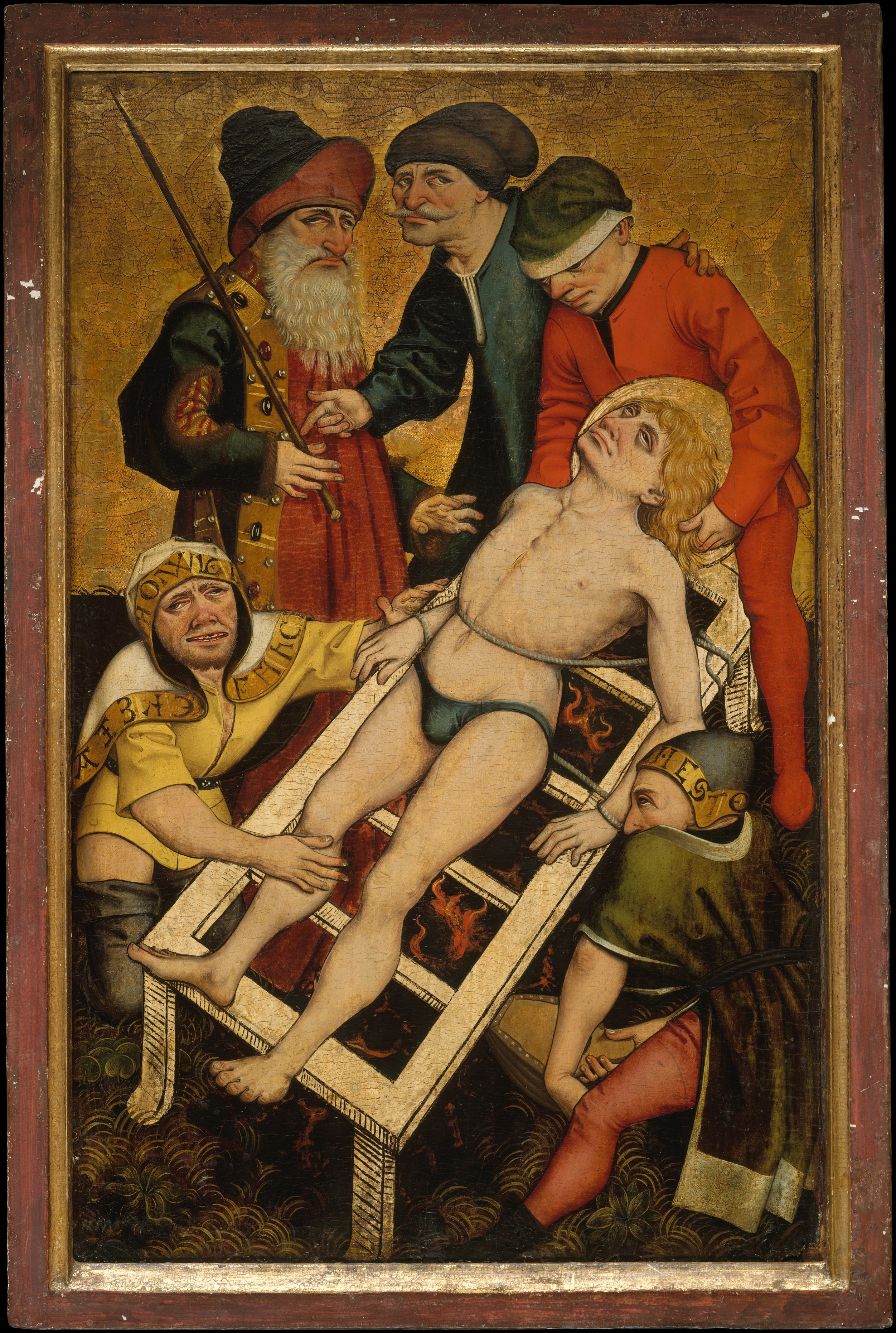
The obverse panel presents the titular martyrdom with a stark, unflinching precision that rivals the finest tailoring of a sharp-shouldered blazer. Saint Lawrence, traditionally depicted on his gridiron, is here rendered not as a passive victim but as a figure of defiant stillness amidst the chaos of his execution. The gold ground—applied with the meticulousness of a gilded lamé—does not merely illuminate the scene; it elevates it. It strips the narrative of earthly time, placing the event in a perpetual, sacred present. In couture terms, this is the equivalent of a metallic thread running through an otherwise matte fabric: it catches the light, forcing the eye to trace the contours of agony and grace simultaneously.
The composition is a study in diagonal tension. The executioners’ bodies lean into their task, their musculature exaggerated beneath folds of fabric that fall in heavy, sculptural pleats—reminiscent of a bias-cut gown that clings and releases with every movement. Their garments are not incidental; they are character actors. The deep crimsons and ochres of their tunics speak to a worldly, violent passion, while Lawrence’s own robe—a stark, almost clinical white—reads as the ultimate blank canvas, a garment stripped of ornament to signify the purity of his conviction. The oil medium allows for a chiaroscuro that models these fabrics with a three-dimensionality that borders on the tactile. You can almost feel the coarse weave of the executioner’s sleeve versus the finer, almost liturgical texture of the saint’s vestments.
What is most striking is the controlled chaos of the scene. There is no gratuitous bloodshed; instead, the agony is communicated through posture and the angularity of the gridiron’s iron bars. These bars form a rigid, horizontal lattice that cuts across the verticality of the figures—a brutalist grid that anchors the composition. This is where the couture analysis deepens. The gridiron is not merely an instrument of torture; it is a structural device, a foundational pattern piece. It imposes order upon the disorder of martyrdom, suggesting that even in the extremity of suffering, there exists a divine symmetry. The artist’s use of perspective is slightly skewed, elongating the saint’s form in a manner that evokes the distortions of a fashion illustration—where the body is lengthened not for realism but for idealization. Lawrence’s face, turned upward, is a mask of serene acceptance, a final fitting before the ultimate runway.
Reverse: The Quiet Architecture of Mercy
Turning the panel—a literal act of reversal, akin to flipping a garment inside out to reveal its hidden seams—we encounter Giving Drink to the Thirsty. This reverse side is a radical departure in tone, yet it shares the obverse’s rigorous compositional logic. Here, the gold ground is less dominant, giving way to a more naturalistic, though still stylized, landscape. The palette shifts from the fiery crimsons of martyrdom to cooler, more contemplative blues and greens, as if the very fabric of the painting has been dyed in a different vat. This is the under-construction of the soul, the unadorned reverse of the embroidered front.
The act of giving drink is rendered with a profound intimacy. A figure—often interpreted as a personification of Charity or a saintly attendant—bends to offer water to a parched soul. The drapery here is softer, more fluid. The folds cascade in gentle, rhythmic waves, reminiscent of a silk charmeuse that pools at the feet. There is no tension, only release. The artist’s brushwork becomes more gestural, less precise, suggesting a spontaneity that contrasts with the obverse’s deliberate rigor. This is not a scene of public spectacle but of private, anonymous virtue. It is the quiet work of the atelier, the invisible stitching that holds the garment together.
The iconographic pairing is crucial. The reverse does not negate the obverse; it completes it. Martyrdom without charity is mere theatrics; charity without the courage of martyrdom is mere sentiment. The panel, therefore, operates as a single, unified garment with two distinct faces. The fir wood support—a sturdy, unglamorous material—serves as the canvas and the structural spine, much like a sturdy muslin toile that underpins a couture gown. The choice of fir, with its subtle grain, adds a textural warmth that neither side fully exploits but both rely upon. It is the foundational fabric, the unseen but essential element.
Global Heritage and the Language of Fabric
The attribution to “Global Heritage” is not a vague curatorial gesture; it is a deliberate acknowledgment that this visual language—of gold grounds, of oil on wood, of hagiographic narrative—transcends a single geographic origin. The technique speaks to the workshops of early Renaissance Italy, the iconography to Byzantine traditions, and the emotional register to a universal humanism. At Katherine Fashion Lab, we recognize this as the ultimate cross-cultural collaboration. The gold ground, for instance, is a material signifier that appears across Byzantine, Sienese, and even Persian miniature traditions. It is a global currency of the sacred. The artist has cut this fabric to fit a narrative that is at once specifically Christian and broadly human.
The standalone nature of this study is significant. It is not part of an altarpiece or a polyptych; it is a self-contained meditation. This allows the viewer—or the wearer, in our metaphorical lexicon—to engage with each side in isolation and in tandem. It is a capsule collection, complete unto itself. The obverse is the evening gown, dramatic and demanding; the reverse is the day dress, functional and compassionate. Both are necessary for a complete wardrobe of the spirit.
In conclusion, this double-sided panel is a triumph of narrative engineering. The artist, as a master couturier, has used oil and gold not merely as pigments but as threads to weave a complex moral tapestry. The tension between the public spectacle of pain and the private act of kindness is the central seam of this work. It challenges us to consider that true elegance—whether in art or in life—is not about avoiding the harsh light of suffering but about draping it in such a way that grace remains visible. The Martyrdom is not a horror; it is a haute couture statement of faith. And the Giving Drink is not a footnote; it is the lining that makes the garment wearable. Katherine Fashion Lab celebrates this panel as a timeless example of how the human form, when subjected to the most extreme conditions, can still be tailored into a silhouette of transcendent dignity.