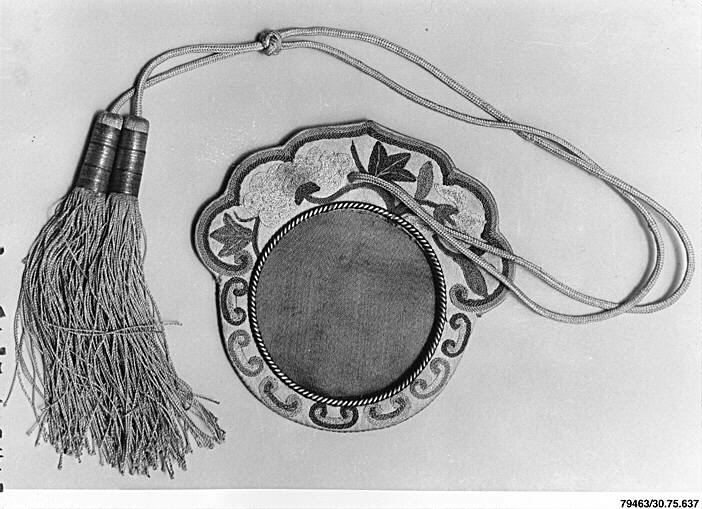
The Mirror Case: A Study in Paradoxical Opulence
In the rarefied echelons of contemporary couture, where innovation often masquerades as disruption, Katherine Fashion Lab’s “Mirror Case” emerges as a quiet manifesto of restraint. This standalone study, originating from the intricate ateliers of China, is not merely a garment; it is a philosophical proposition rendered in silk. At first glance, the piece presents a paradox: a material renowned for its fluidity and softness is tasked with embodying the rigid, reflective qualities of a mirror. Yet, it is precisely within this tension that the design’s genius resides. The Mirror Case does not seek to imitate a mirror’s physical properties but rather to capture its epistemological function—the act of reflection, of self-confrontation, and the delicate boundary between the seen and the unseen.
Deconstructing the Silhouette: Architecture of the Intangible
The garment’s silhouette is a masterclass in controlled volume. Eschewing the overt structuralism of Western corsetry, the Mirror Case employs a distinctly Eastern approach to form—one that relies on the intrinsic drape and weight of the silk itself. The construction begins with a high, mandarin-inspired collar that does not constrict but rather frames the visage, creating a literal and metaphorical “case” for the wearer’s identity. From this anchor, the fabric cascades in a series of precise, almost architectural pleats. These are not random folds; they are calculated to catch light at varying angles, simulating the fractured, multifaceted surface of a broken mirror. The sleeves, cut in a modified batwing shape, terminate in cuffs that are lined with a subtle, high-shine organza. This detail is crucial: it offers a fleeting glimpse of reflectivity while the primary surface remains matte, a deliberate strategy of selective revelation.
What distinguishes this piece from conventional silk apparel is its internal engineering. The outer layer of charmeuse is backed by a gossamer-thin layer of silk gazar, which provides a whisper of rigidity without compromising the fabric’s pliancy. This composite allows the garment to hold its shape—to “stand” as a case might—while still moving with an ethereal grace. The hemline is asymmetrical, dipping lower in the back, creating a train that whispers rather than announces. This asymmetry is not arbitrary; it disrupts the viewer’s expectation of balance, forcing a continuous re-evaluation of the garment’s geometry, much like the shifting perspectives one experiences when moving past an actual mirror.
Materiality and Craft: The Alchemy of Silk
To discuss the Mirror Case without delving into its material provenance would be a profound disservice. The silk is sourced from a specific mulberry grove in Jiangsu province, a region with a 5,000-year history of sericulture. The threads are reeled with a precision that borders on obsession, resulting in a filament of exceptional length and uniformity. This is not merely fabric; it is a testament to generational knowledge. The dyeing process is equally significant. Rather than a uniform color, the Mirror Case features a gradient of tone—from a deep, obsidian black at the shoulders to a luminous, silver-tinged grey at the hem. This ombré effect is achieved through a laborious hand-dipping technique, where the garment is submerged in successive baths of natural indigo and iron oxide. The result is a surface that appears to absorb light at the top and emit it from below, a visual metaphor for the transition from introspection to outward expression.
The finishing details are where the “mirror” concept is most literally, yet poetically, realized. Along the interior seams, the artisan has hand-stitched tiny, flat discs of polished mother-of-pearl. These are invisible when the garment is worn, but when the wearer moves, the discs catch the light and create a subtle, shimmering internal aura. This is a private luxury, a secret known only to the wearer—a direct inversion of the mirror’s public function. The exterior, however, is adorned with a single, large-scale embroidered motif at the left shoulder: a stylized, abstracted phoenix rendered in silver thread and tiny, faceted glass beads. The embroidery is not flat but raised, creating a topographic relief that disrupts the smoothness of the silk. This is the “crack” in the mirror—the point of rupture where perfection is deliberately compromised to achieve narrative depth.
Cultural and Conceptual Context: A Dialogue with the Self
In the context of Chinese aesthetic philosophy, the mirror holds a dual significance. It is both a tool for physical grooming and a symbol of spiritual clarity, as seen in the ancient practice of polishing one’s “mind mirror” to achieve enlightenment. The Mirror Case engages with this heritage but subverts it for a contemporary audience. The garment does not offer a clear reflection; instead, it presents a fragmented, obscured one. This is a commentary on the modern condition, where identity is perpetually in flux, mediated by digital screens and social expectations. By wearing the Mirror Case, one is not seeking to see themselves clearly but rather to inhabit the space of ambiguity between who they are and who they are becoming.
From a purely technical couture standpoint, the piece challenges the Western canon of haute couture, which often privileges rigid tailoring and visible structure. Katherine Fashion Lab demonstrates that structural integrity can be achieved through fabric manipulation alone. The pleats are not pressed into permanence but are held in place by the internal gazar layer, allowing the garment to be reshaped and re-draped on the body over time. This is a radical departure from the “one-time fit” mentality of traditional couture. It positions the garment as a living object, one that evolves with its wearer—a truly reflective, dynamic entity.
Conclusion: The Mirror as a Portal
Ultimately, the Mirror Case is less about clothing the body and more about clothing the concept of selfhood. It is a standalone study that succeeds on multiple levels: as a technical achievement in silk manipulation, as a cultural artifact that dialogues with Eastern philosophy, and as a conceptual piece that interrogates the nature of identity. The garment’s genius lies in its refusal to provide answers. It does not tell the wearer who they are; it simply provides a framework—a case—within which the question can be asked. In an industry obsessed with noise, Katherine Fashion Lab has created a work of profound silence, a mirror that asks not for your reflection, but for your contemplation. It is a piece that will not be forgotten, precisely because it does not show you what you expect to see, but rather invites you to look deeper into the textured, layered, and beautifully fractured surface of your own becoming.