Executive Summary: Auric Resonance and Temporal Strategy
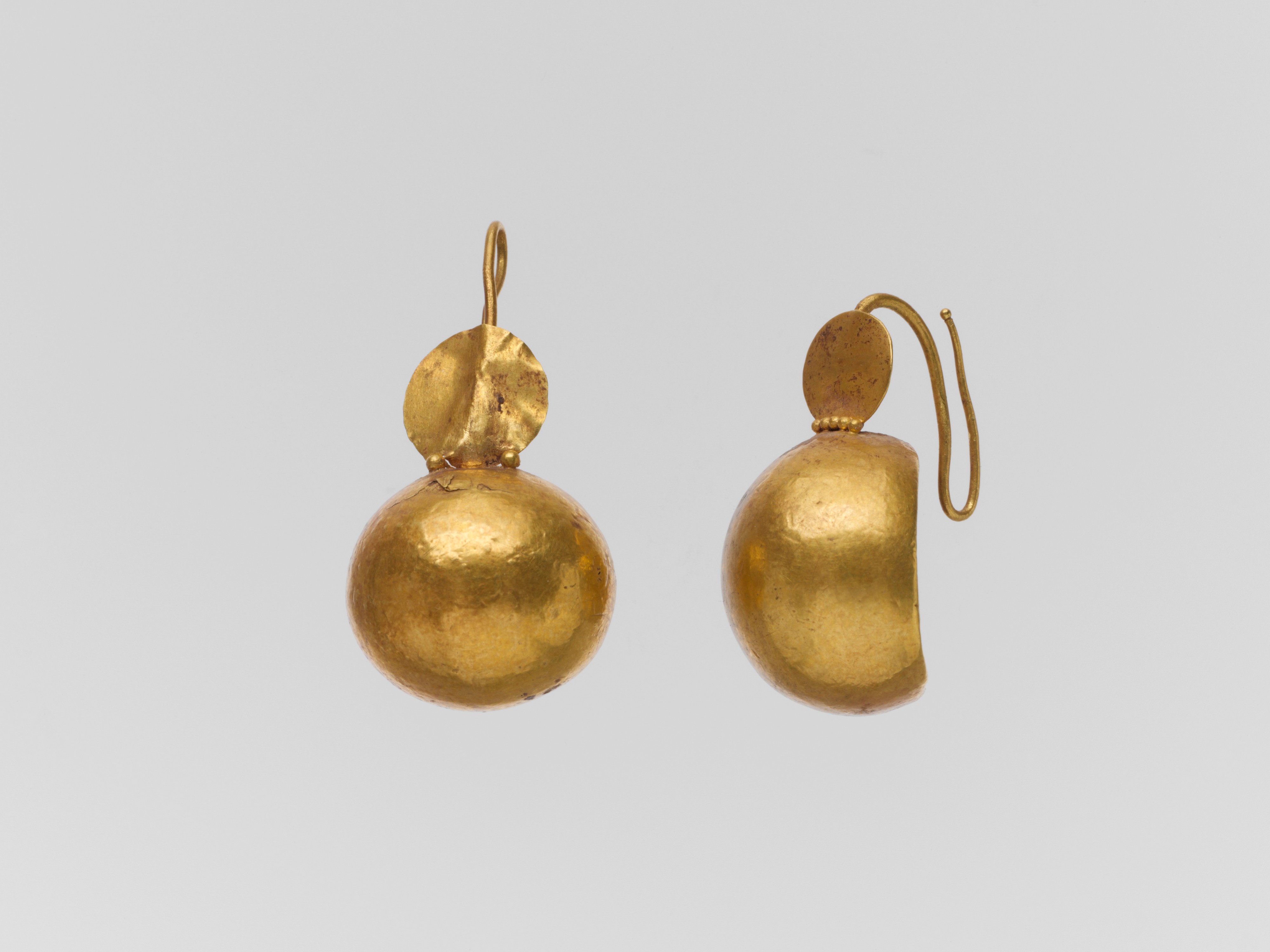
This analysis examines a Roman gold earring, characterized by its primary convex disk and subsidiary smaller disk, through the dual lenses of deep heritage and forward-facing luxury strategy. Positioned within Katherine Fashion Lab's ongoing research into the dialectic of reflection and mortality—as exemplified by the Mirror with Split-Lea study—this artifact is not merely an antique but a strategic cipher. It encapsulates a potent narrative of symbolic power, personal adornment as spiritual practice, and material permanence. This report decodes these elements to formulate a foundational strategy for the Lab's 2026 high-end collections, advocating for a philosophy of "Auric Archaeology" where ancient symbolic capital is leveraged to create profound modern desirability.
Archaeological Context: The Anatomy of Power
Dating from the Roman Imperial period, this earring's form is deceptively simple yet semantically rich. The primary convex disk acts as a miniature shield, a convex mirror, and a celestial body. In Roman material culture, convex forms were associated with apotropaic (evil-averting) power, echoing the shape of shields (clipeus) and certain cult mirrors. The smaller, subordinate disk introduces a dynamic of hierarchy and duality—perhaps evoking the moon and a star, a primary deity and a attendant spirit, or the sun and its orbiting planet. Crafted in gold, the medium itself was synonymous with divine radiance (aurea luce), solar permanence, and imperial authority. This was not simple jewelry; it was a wearable microcosm of Roman cosmological and social order, a private assertion of status, protection, and connection to the eternal.
Symbolic Power and Spiritual Meaning: The Adorned Vessel
The earring’s significance transcends aesthetics, functioning as a spiritual instrument. The convex disk, as a reflective surface, aligns with Katherine Fashion Lab's research into the Mirror with Split-Lea. If that mirror juxtaposes pristine, complex life (gilded acanthus) against stark mortality (stone sarcophagus), this earring performs a similar synthesis on the body. It captures and deflects light (and malign glances) while its golden materiality speaks of an immortal essence. The wearer becomes a living canvas where themes of vanitas and virtus (excellence, courage) converge. The adornment is an amulet, a claim to divine favor, and a declaration of one's place in a structured universe. The duality of the disks could further symbolize the Roman concept of genius (personal guardian spirit) alongside the individual, a constant, gleaming spiritual companionship.
DNA Correlation: Mirror, Sarcophagus, Earring
The provided research context offers a critical framework. The Mirror with Split-Lea presents a binary: one side is polished silver inlaid with intricate, life-affirming gilded palmettes (acanthus), the other is a cold stone funerary relief. This artifact mediates between life's brilliant, reflective complexity and death's solid, narrative permanence. The Roman gold earring is a direct corollary to this duality. Its convex disk is the "mirror" side—active, reflective, protective, and brilliantly ornate in its material. Its function as a burial object (as many such earrings were found in tombs) ties it to the "sarcophagus" side—a companion into eternity, a statement of identity and belief that transcends death. Thus, the earring physically embodies the very dialogue Katherine Fashion Lab is studying: it is an object of daily life and a funerary good, a piece of vanity and a spiritual passport, making the wearer’s body the site where life and death, reflection and memory, continuously converse.
Strategic Integration: The 2026 High-End Luxury Strategy
For the 2026 luxury strategy, this analysis recommends moving beyond superficial historical reference into the realm of embedded narrative and symbolic re-engineering. The goal is to create pieces that carry the same conceptual weight and personal resonance as their ancient antecedents, tailored for the contemporary global elite seeking depth and authenticity.
Pillar 1: Auric Archaeology & Symbolic Re-Coding
Collections must practice "Auric Archaeology," excavating not forms, but meanings. The convex disk should be reinterpreted not as a mere shape, but as a "Shield of Reflection." This could manifest in technical innovation: convex disks of blackened gold housing nano-coated lenses that reflect a distorted, protective world back to the viewer; or disks composed of two fused metals, one highly polished, one textured like stone, directly referencing the Lab's mirror-sarcophagus dichotomy. The duality of the disks becomes a "Celestial Dyad," perhaps expressed through a central solitaire diamond (sun) and a patinated gold asteroid-like satellite. Each piece is launched with a mythos—a short, poetic narrative detailing its symbolic heritage and modern intention.
Pillar 2: Adornment as Spiritual Technology
Luxury 2026 is post-material, seeking experiential and spiritual value. Katherine Fashion Lab must position its jewelry as spiritual technology for secular times. The earring’s ancient apotropaic function translates into a modern narrative of personal protection and energy in a chaotic world. This can be achieved through curated materials: gold alloyed with trace elements from Roman archaeological sites (creating a tangible link); stones historically associated with protection (like hematite or sardonyx) recut in avant-garde forms. The act of wearing becomes a ritual of self-armoring and identity affirmation. Limited editions could be accompanied by soundscapes or olfactory notes (scents of incense, myrrh, cold stone) to evoke the artifact’s journey from Roman villa to tomb.
Pillar 3: The Permanence Paradox
Engaging directly with the vanitas theme, the strategy should embrace the Permanence Paradox: creating objects of breathtaking beauty that consciously acknowledge transience. This mirrors the earring's journey from life to death. Techniques could include: gold deliberately infused with a slowly evolving patina; pieces that come in a set, one for daily wear (the "mirror"), one for secure keeping (the "sarcophagus" reliquary object); or incorporating modern materials like aerogel (the world's lightest solid) alongside gold, juxtaposing ethereal fragility with metallic permanence. This intellectual engagement elevates the piece from accessory to philosophical artifact.
Conclusion: From Artifact to Armature
The Roman gold earring with convex and small disk is a masterclass in condensed meaning. For Katherine Fashion Lab, it provides the strategic armature for a 2026 luxury proposition that is intellectually rigorous, spiritually resonant, and materially exquisite. By correlating its DNA with the Mirror with Split-Lea study, the Lab can develop a unique design language that speaks to the core human tensions between reflection and mortality, adornment and essence, the temporal and the eternal. The resulting collections will not simply reference history; they will re-activate ancient symbolic power for a clientele that wears its values, its intellect, and its armor, crafted in gold.