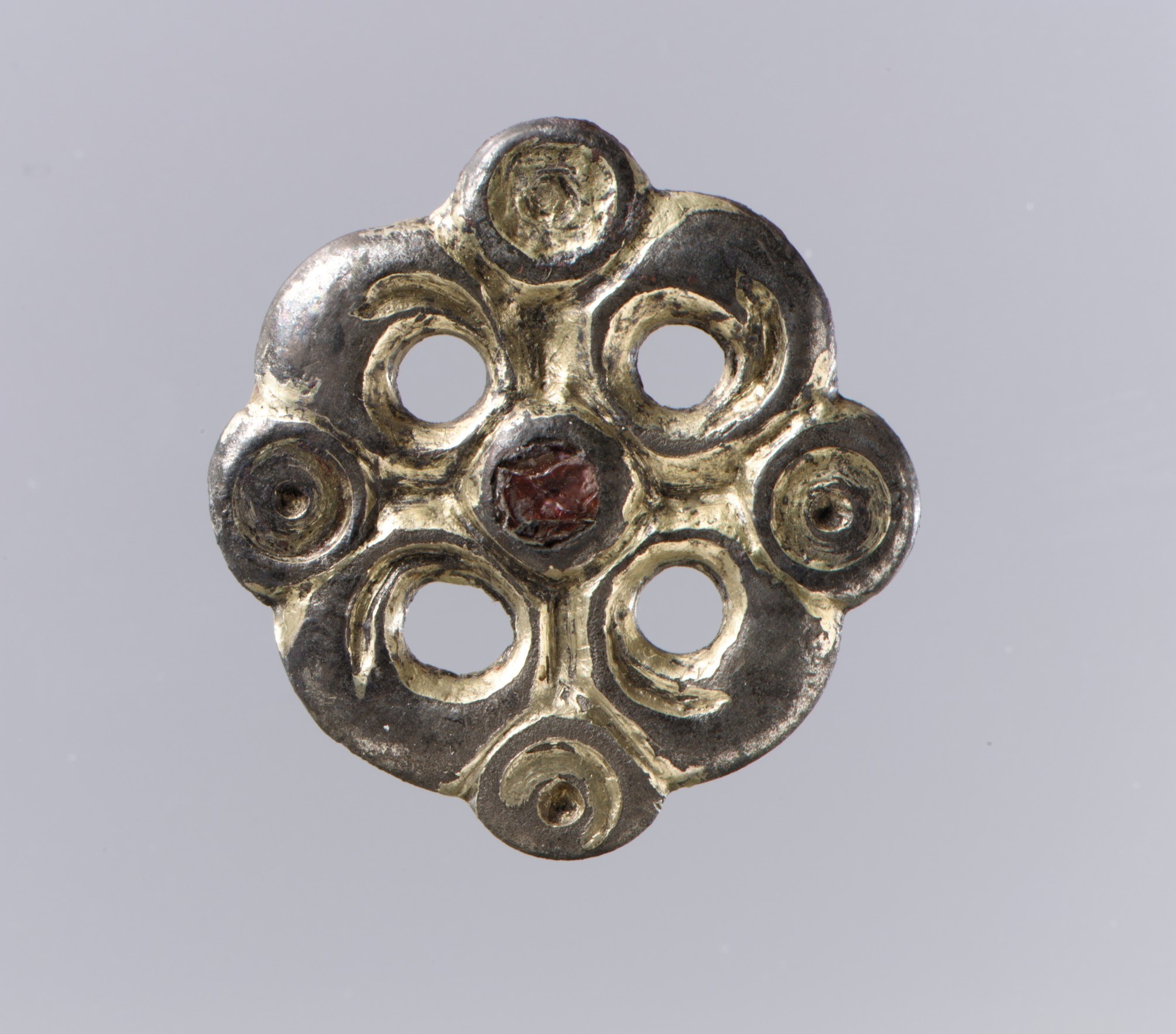
The Openwork Rosette Brooch: A Frankish Legacy of Power and Adornment
The openwork rosette brooch, a singular artifact of Frankish origin, is far more than a decorative clasp. Rendered in gilded silver, garnet, and iron, this object is a condensed archive of early medieval cosmology, social hierarchy, and martial spirituality. For Katherine Fashion Lab, this is not merely a historical curiosity; it is a strategic blueprint. In the context of 2026 high-end luxury, the brooch offers a profound counter-narrative to mass-produced minimalism, presenting a lexicon of symbolic power that can be translated into a collection defined by heritage, protection, and conspicuous spiritual authority.
Symbolic Power and the Architecture of Light
The brooch’s defining feature—its openwork construction—is a testament to the Frankish mastery of negative space. Unlike solid metalwork, the openwork rosette allows light to pass through, creating a dynamic interplay of shadow and illumination on the wearer’s garment. This was not accidental. In early medieval thought, light was synonymous with divine presence and royal legitimacy. The pierced pattern, likely derived from Late Antique and Byzantine motifs, functioned as a miniature architectural portal. When affixed to a cloak or tunic, the brooch did not simply reflect status; it actively generated a halo effect around the wearer, signaling that the individual was a conduit for celestial favor. For a 2026 luxury strategy, this suggests a pivot away from static brilliance. The modern counterpart should be designed to interact with ambient light—utilizing laser-cut precision in precious metals to create a living, breathing ornament that shifts with movement, turning the wearer into a moving source of radiance.
Historical Adornment: The Cloak as a Canvas of Rank
In Frankish society, the brooch was an indispensable element of elite dress, particularly for men of warrior-aristocratic standing. It secured the heavy woolen cloak, the sagum, which was the primary garment of the free Frank. The placement of the brooch—typically at the right shoulder—was deliberate, leaving the sword arm unencumbered. This functional necessity elevated the brooch to a symbol of readiness and martial capability. The materials themselves reinforce this hierarchy: gilded silver denotes wealth and access to skilled artisans, while the inset garnets, often imported from as far as India or Bohemia, signify vast trade networks and diplomatic reach. The iron core, usually hidden, grounds the piece in utility and strength. For Katherine Fashion Lab, this translates into a design philosophy where form follows power. The 2026 collection should not treat the brooch as a mere accessory but as a piece of functional armor for the modern professional—a clasp for a structured cape or an asymmetric blazer that locks the silhouette, visually asserting command before a single word is spoken.
Spiritual Meaning: The Talisman of the Threshold
Beyond secular rank, the rosette form carries deep spiritual resonance. The rosette, or wheel, is an ancient solar symbol, representing cyclical renewal, life, and cosmic order. In the Frankish Christian context, this pagan solar symbol was seamlessly syncretized, becoming a sign of Christ as the Sol Invictus (Unconquered Sun). The openwork design, with its perforations, also held apotropaic qualities; it was believed that evil spirits and malevolent glances could be caught and dispersed within the intricate lattice. Thus, the brooch was a threshold guardian, worn at the point where the body met the external world. It was a physical prayer for protection in battle and in daily life. For the high-end consumer of 2026, who navigates a world of digital surveillance and social volatility, the brooch can be repositioned as a totem of psychological sovereignty. The marketing narrative should emphasize the piece as a "sanctuary" for the self—a wearable boundary that filters external noise, offering the wearer a sense of grounded invulnerability.
2026 High-End Luxury Strategy: The Heirloom of the Future
To leverage this artifact for Katherine Fashion Lab, the strategy must move beyond mere reproduction. The objective is to create a neo-heritage object that satisfies the 2026 luxury consumer’s demand for authenticity, narrative, and ethical provenance. The following strategic pillars are proposed:
Pillar One: Material Alchemy and Provenance
The 2026 luxury market is increasingly scrutinizing the origin of materials. The Frankish brooch offers a template for a "material story." Katherine Fashion Lab should commission a limited run using recycled gilded silver and lab-grown garnets that mimic the deep, pigeon-blood red of the original. This addresses sustainability concerns while retaining the opulent visual signature. The iron element can be forged from reclaimed historical steel, such as repurposed railway tracks, embedding a narrative of industrial heritage into the piece. Each brooch would be accompanied by a digital certificate of authenticity, tracing the material lineage—a modern version of the guild mark.
Pillar Two: The "Active Heritage" Modular System
To honor the openwork's dynamic nature, the brooch should be designed as a modular system. The central rosette can be detached and re-attached to different bases—a silver collar, a leather belt, or a silk scarf slide. This allows the consumer to "re-ritualize" the object for different contexts, from boardroom to gala. This versatility positions the brooch not as a static relic but as an adaptable talisman, mirroring the Frankish warrior who adapted his gear for war, governance, or ceremony. This modularity also encourages a second purchase cycle, enhancing customer lifetime value.
Pillar Three: The Narrative of Protection
The marketing campaign for 2026 should pivot on the theme of Protection in the Age of Exposure. The campaign imagery should contrast the brooch against stark, contemporary backdrops—glass skyscrapers, digital interfaces—to highlight its archaic, grounding power. The copy should use language of "warding," "centering," and "anchoring." The brooch is not just jewelry; it is a ceremonial object for the secular age. This positions Katherine Fashion Lab as a house that understands the psychological needs of its clientele, offering not just aesthetic pleasure but a sense of existential security.
Pillar Four: Exclusivity via Commission
To elevate the piece to true haute luxe, the brooch should be offered via a private commission model. Clients are invited to a "heritage atelier" experience, where they can select the specific garnet hue, the finish of the silver (antiqued vs. high-polish), and even have a personal motto engraved on the iron backplate—hidden from view, known only to the wearer. This creates an intimate, bespoke ritual that mirrors the personal significance the original brooch held for its Frankish owner. It transforms a purchase into a rite of passage.
Conclusion: The Brooch as a Strategic Compass
The Frankish openwork rosette brooch is a masterclass in the fusion of utility, beauty, and belief. For Katherine Fashion Lab, it provides a rigorous historical foundation upon which to build a 2026 luxury strategy that is both intellectually credible and commercially avant-garde. By translating the brooch’s symbolic power—its light-play, its martial history, and its spiritual protective function—into a modular, ethically-sourced, and commission-based offering, the brand can capture a discerning demographic seeking more than fashion. They seek legacy. The brooch becomes a wearable manifesto, proving that true luxury is not the loudest statement, but the most profound and enduring one. This is not a revival; it is a re-engineering of power for the modern elite.