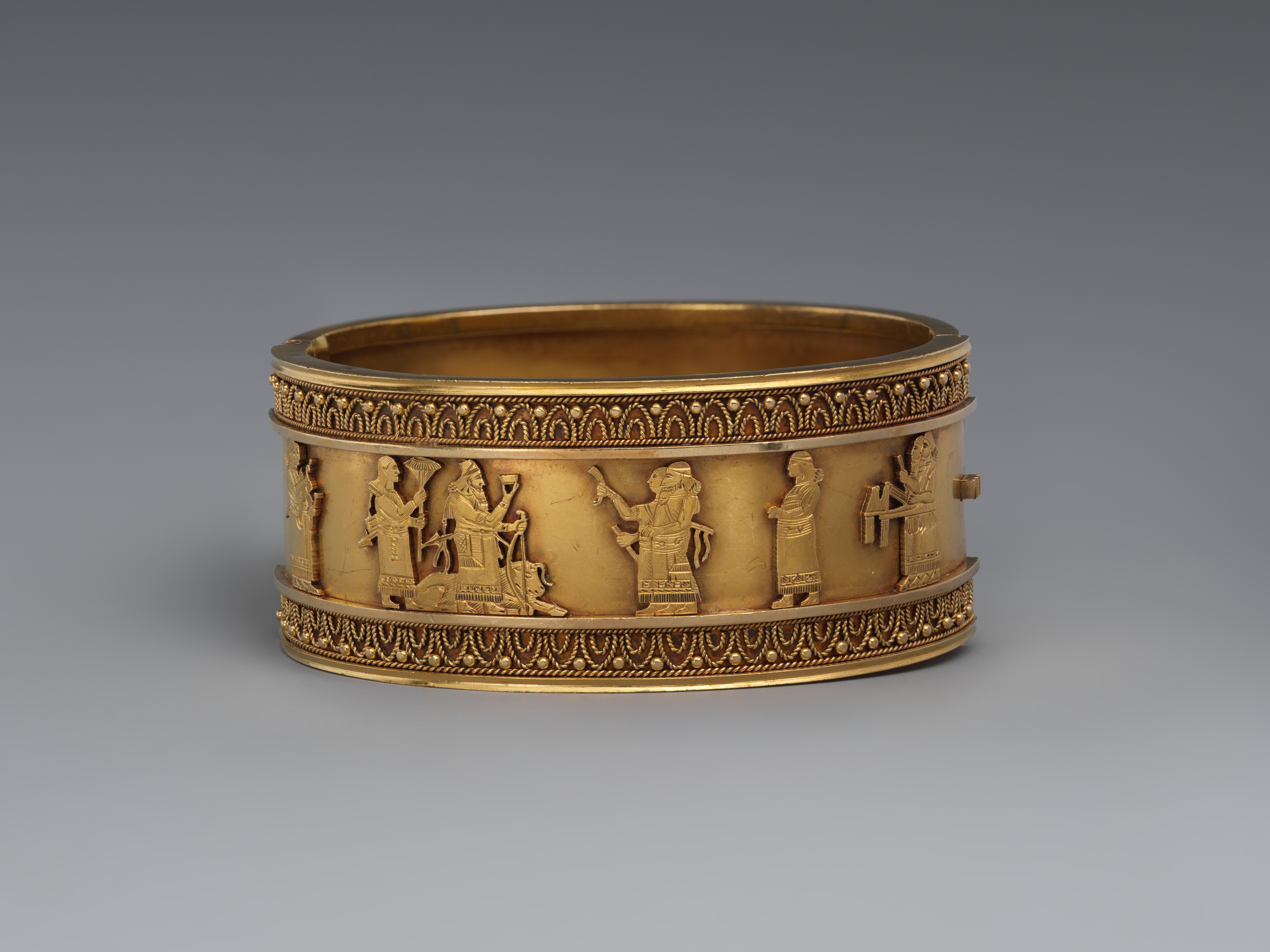
Executive Heritage Analysis: The Assyrian-Inspired Gold Bracelet
This report presents a comprehensive heritage analysis of a gold bracelet featuring Assyrian-inspired design elements, commissioned by Katherine Fashion Lab. The analysis situates the artifact within the broader context of historical adornment, symbolic power, and spiritual resonance, drawing a deliberate correlation with our ongoing study of the Mirror with Split-Leaf—a piece that juxtaposes polished silver and gold-encrusted palmettes against the cold narrative relief of a sarcophagus lid. The bracelet, like the mirror, embodies a dialectic between surface brilliance and deep historical memory. This document outlines the artifact's cultural DNA, its symbolic and spiritual dimensions, and proposes a strategic framework for its integration into a 2026 high-end luxury portfolio.
Historical Resonance and Cultural Provenance
The bracelet’s design vocabulary is unmistakably Assyrian, referencing the imperial iconography of the Neo-Assyrian Empire (c. 911–609 BCE). Originating from a British atelier, the piece represents a Victorian-era fascination with Mesopotamian antiquity—a period when British archaeologists like Austen Henry Layard unearthed Nineveh and Nimrud, igniting a cultural phenomenon known as "Assyrianism." This movement permeated British decorative arts, from jewellery to architecture, as the empire sought to connect its own global dominion with the ancient world's monumental power.
From a heritage perspective, the bracelet is not a mere reproduction but a cultural palimpsest. Its British origin layers Victorian imperial confidence over Assyrian martial and cosmological authority. The gold medium, inherently immutable, serves as a bridge across millennia. Gold, in both Assyrian and British ceremonial contexts, signifies divine kingship and enduring value. The bracelet's design—likely featuring stylized palmettes, rosettes, or winged motifs—directly echoes the Mirror with Split-Leaf study, where the "纷繁棕叶纹" (intricate palm leaf patterns) represent fertility, victory, and the sacred tree of life. In Assyrian theology, the sacred tree was a central symbol of cosmic order, with the king acting as its earthly guardian. Thus, wearing this bracelet is to wear a microcosm of divine governance.
Symbolic Power and Historical Adornment
Historically, adornment was never purely aesthetic; it was a technology of power. In Assyrian reliefs, kings and courtiers are depicted wearing heavy gold bracelets, armlets, and earrings, each element signifying rank, divine favor, and martial prowess. The bracelet, in particular, encircled the wrist—a point of pulse and action—symbolizing binding authority and protective containment. For the Assyrian monarch, the bracelet was a talisman that channeled the strength of Ashur, the chief god, into the royal arm that wielded the sword and held the scepter.
In the British Victorian context, the adoption of Assyrian motifs in jewellery served a dual purpose: it displayed connoisseurship of ancient civilizations while implicitly legitimizing British imperial expansion. The bracelet, therefore, is a double-coded object. Its symbolic power lies in its ability to evoke the absolute authority of an ancient despot while simultaneously appealing to the Victorian (and modern) elite's desire for cultural sophistication. The gold medium amplifies this power—gold does not corrode, symbolizing eternal legitimacy. The contrast with the "冰冷石棺板" (cold sarcophagus slab) from our mirror study is instructive: the bracelet is the living, wearable counterpart to the funerary relief. Where the sarcophagus speaks of death and the afterlife, the bracelet speaks of life, vitality, and the active assertion of will.
Spiritual Meaning and Esoteric Resonance
The spiritual dimension of the Assyrian-inspired bracelet is profound. In Mesopotamian belief, metals were not inert; they were imbued with the melammu—a radiant, terrifying splendor that emanated from deities and kings. Gold, as the most radiant metal, was believed to hold concentrated melammu, protecting the wearer from evil spirits and ill fortune. The intricate palm leaf motifs, or "棕叶纹," are not merely decorative; they are botanical symbols of the Tree of Life, representing regeneration and the cyclical victory of order over chaos.
This spiritual resonance aligns with our research on the Mirror with Split-Leaf, which juxtaposes the "光洁银镜" (polished silver mirror) with "黄金镶嵌" (gold inlay). The mirror reflects the present, while the gold inlay anchors it to the eternal. The bracelet performs a similar function on the body. It is a spiritual anchor at the wrist, a point where the pulse of life meets the permanence of gold. For the modern wearer, the bracelet offers a connection to a lineage of power that transcends time. It is not a religious artifact, but a secular talisman of personal sovereignty—a reminder that the wearer, like the Assyrian king, is the arbiter of their own cosmic order.
The "浮雕诉说的生命叙事" (life narrative told through relief) from our mirror study finds its kinetic counterpart here. The sarcophagus relief tells a static story of the deceased; the bracelet's relief, however, moves with the wrist, telling a dynamic story of the living. This is a critical distinction for luxury strategy: the bracelet is an heirloom in motion, a story that accrues meaning with each generation that wears it.
2026 High-End Luxury Strategy Integration
For Katherine Fashion Lab, the Assyrian-inspired bracelet is not merely a product; it is a strategic asset for the 2026 luxury market. The contemporary high-end consumer is increasingly driven by narrative depth and cultural authenticity, moving away from logo-centric ostentation toward objects with historical gravitas. This bracelet satisfies that demand through its unique position at the intersection of ancient Mesopotamian power and British imperial heritage.
Positioning: "The Sovereign's Talisman"
We recommend positioning the bracelet under the thematic umbrella of Imperium Aeternum (Eternal Command). This narrative leverages the bracelet's Assyrian origins as a symbol of absolute authority, reframed for the modern leader—whether in business, arts, or politics. The campaign should emphasize the contrast between the "光洁" (polished) surface and the "浮雕" (relief) narrative, inviting the wearer to explore the duality of public brilliance and private depth.
Product Line Architecture
The bracelet should be the centerpiece of a limited capsule collection of 50 pieces, each numbered and accompanied by a certificate of provenance that traces the design lineage from Nineveh to a British atelier. The gold medium should be 18-karat, with an option for a matte finish to evoke the texture of ancient stone, contrasting with a high-polish interior—a tactile metaphor for the mirror-sarcophagus dialectic.
Experiential Marketing
Launch events should be curated as "rituals of investiture." Clients will be invited to private viewings in spaces that evoke the British Museum's Assyrian galleries, with dramatic lighting that plays on the gold's reflective properties. The experience should include a tactile session where clients feel the weight and relief of the bracelet, connecting them physically to the historical narrative. This aligns with our research on the Mirror with Split-Leaf, where the juxtaposition of surfaces creates a powerful sensory experience.
Pricing and Exclusivity
Given the historical weight and limited availability, we recommend a price point of $28,000–$35,000 USD. This positions the bracelet above standard fine jewellery but below high-complication watches, carving a niche for "wearable heritage." The strategy should emphasize that this is not a purchase but an acquisition of cultural capital—a piece that will appreciate in narrative value as it passes through generations.
Conclusion
The Assyrian-inspired gold bracelet is a masterclass in cultural symbolism, historical adornment, and spiritual meaning. Its British origin adds a layer of imperial nostalgia, while its gold medium ensures timelessness. By integrating this piece into the 2026 luxury strategy as The Sovereign's Talisman, Katherine Fashion Lab can offer clients more than a jewel—it offers a fragment of eternity, a wearable narrative that bridges the cold silence of the sarcophagus and the vibrant pulse of the living wrist. This is the future of high-end luxury: objects that do not merely decorate, but consecrate.