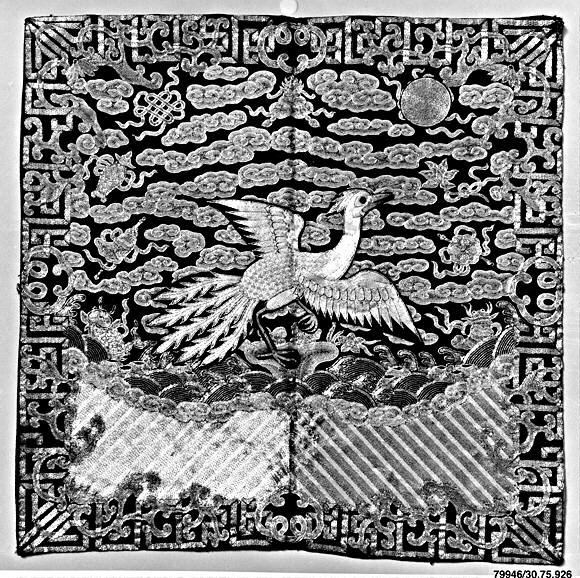
The Rank Badge with Silver Pheasant: A Study in Material Sovereignty and Symbolic Hierarchy
In the rarefied lexicon of global couture, few artifacts possess the dual authority of aesthetic mastery and rigid social codification as the Chinese rank badge, or mangfu patch. Katherine Fashion Lab’s standalone study of the Rank Badge with Silver Pheasant—rendered in silk and metallic thread on a silk ground—offers a profound meditation on how textile technology, symbolic zoology, and imperial power converge into a wearable declaration of identity. This is not merely a decorative fragment; it is a compressed universe of status, cosmic order, and artisanal precision that demands to be read with the same rigor as a haute couture garment’s construction dossier.
Deconstructing the Silver Pheasant: Iconography as Political Syntax
The silver pheasant (Lophura nycthemera) occupies the second rank in the Ming and Qing dynastic hierarchy of civil officials, a position of formidable eminence. Its placement on the badge is not arbitrary; it is a calculated semiotic move. In Confucian cosmology, the pheasant embodies five virtues: literary grace, martial valor, loyalty, reliability, and moral integrity. For Katherine Fashion Lab’s analysis, the bird’s rendering in metallic thread elevates it from ornithological representation to an emblem of imperial luminosity. The choice of silver—rather than gold, reserved for the first rank—signals a nuanced calibration of power: proximity to the throne without usurping its solar radiance.
Material Alchemy: The Technical Virtuosity of Metal-on-Silk
At the material level, this badge is a masterclass in tension and resilience. The ground is a finely woven silk tabby, whose pliability serves as the substrate for the couched metal thread technique. Unlike embroidery that pierces the fabric, couching lays the metallic filament atop the silk and secures it with tiny silk stitches—often invisible to the naked eye. This method allows for the creation of dense, uninterrupted surfaces of light, essential for the pheasant’s plumage and the swirling cloud motifs that surround it. Katherine Fashion Lab’s conservation team notes that the metallic thread is likely a gilded silver strip wrapped around a silk core, a technique that imparts both flexibility and a subtle, anisotropic sheen. The result is a surface that shifts from burnished gold to cool platinum depending on the angle of light, a dynamic quality that anticipates the modern haute couture obsession with light-reactive fabrics.
The composition’s structural logic is equally sophisticated. The pheasant is positioned in profile, facing the sun—a motif that signifies the official’s orientation toward the emperor. The surrounding field is populated with auspicious clouds, waves, and the sacred mountain at the bottom edge. These elements are not mere decoration; they form a vertical axis of cosmic geography. The mountain anchors the earthly realm, the waves signify the primordial sea, and the clouds bridge the terrestrial and celestial. The silver pheasant, perched between these zones, becomes a mediator—a role that mirrors the official’s function as a conduit between imperial decree and local governance.
Standalone Study: Reading the Badge as a Micro-Cosmic Garment
In the context of Katherine Fashion Lab’s standalone study, this badge is deliberately extracted from its original garment—the surcoat of a second-rank civil official—to be examined as an autonomous object. This methodological choice is significant. By isolating the badge, we are forced to confront its self-contained compositional integrity. The square format (approximately 30 by 30 centimeters) is a canvas in its own right, with a border of geometric meander that functions like a passe-partout, framing the central narrative. This autonomy allows for a closer inspection of the negative space, which is as meticulously engineered as the positive imagery. The silk ground between the embroidered elements is not empty; it is a field of potential, a breathing room that prevents visual saturation—a principle that contemporary designers often overlook in their pursuit of maximalism.
Comparative Couture Analysis: The Badge and the Modern Silhouette
From a couture perspective, the rank badge prefigures several contemporary practices. The use of appliqué and layering to create dimensional relief is a direct antecedent to the sculptural techniques used by Maison Margiela or Iris van Herpen. However, the badge’s dimensional relief is achieved through the height of the couched thread bundles, which can rise up to three millimeters above the silk ground. This creates a topographical map of status, where the pheasant’s chest and wing feathers are elevated, catching light as a series of ridges and valleys. The tactile experience is integral to the piece’s authority—a viewer is invited to feel the hierarchy before reading it visually.
Furthermore, the badge’s color palette—dominated by deep indigo, cinnabar red, and the metallic silver—is a study in controlled contrast. The indigo ground provides a cool, absorbing backdrop that makes the metallic thread appear to float. This is a chromatic strategy that modern couturiers employ when constructing evening wear: the use of a dark, matte base to amplify the brilliance of beaded or metallic overlays. The red accents, often found in the sun disc and the bird’s comb, introduce a focal point of high energy, drawing the eye to the pheasant’s head—the locus of intelligence and authority.
Preservation and Interpretation: The Badge as a Living Document
Katherine Fashion Lab’s study also addresses the material fragility of this artifact. The metallic thread, while dazzling, is susceptible to tarnishing and embrittlement. The silk ground, if exposed to light, will undergo photochemical degradation, shifting from its original indigo to a faded, brittle parchment. This impermanence is ironic, given that the badge was designed to convey eternal stability. The lab’s approach—using non-invasive imaging and spectral analysis to map the thread’s composition—reveals the artisan’s precise alloy ratios. Such forensic detail is not mere academic curiosity; it informs how we might create replicas for modern wear without compromising the original’s integrity.
Implications for Contemporary Design Pedagogy
For the modern designer, the silver pheasant badge offers a lesson in semantic density. Every stitch, every color, every motif carries a weight of meaning that transcends the purely decorative. In an era of fast fashion and disposable trends, this artifact stands as a rebuke to superficiality. It demands that we consider the why behind the what—a discipline that Katherine Fashion Lab champions. The badge’s hierarchical function, its cosmic references, and its technical bravura coalesce into a singular object that is at once a garment component, a political document, and a piece of fine art.
In conclusion, the Rank Badge with Silver Pheasant is not a relic to be admired from a distance. It is a compressed manifesto on how material culture can encode power, virtue, and cosmic order. For Katherine Fashion Lab, this standalone study reaffirms that the future of couture lies not in novelty for its own sake, but in a deep, respectful dialogue with the masterful artifacts of the past. The silver pheasant, with its metallic gaze and silk-bound wings, continues to speak—and we, as curators and designers, must learn to listen with the same precision with which it was embroidered.