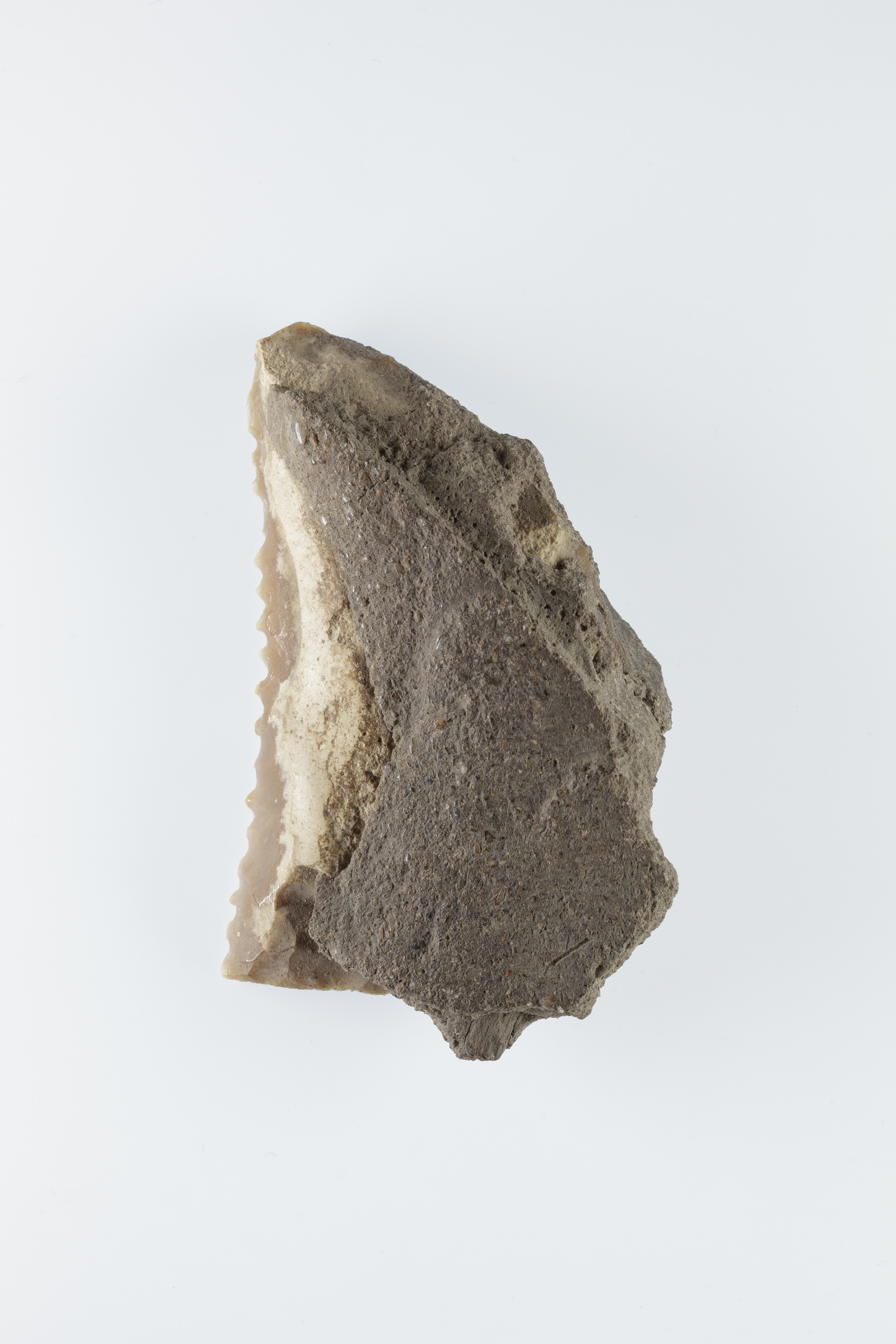
Executive Heritage Analysis: The Sickle Insert as a Blueprint for 2026 Luxury Symbolism
In the rarefied echelons of high-end fashion, the provenance of a material is no longer a footnote—it is the headline. For Katherine Fashion Lab, the strategic examination of a prehistoric Sickle Insert—fashioned from flint and bound by lime plaster adhesive—offers more than an archaeological curiosity. It presents a masterclass in the semiotics of power, the anthropology of adornment, and the spiritual economy of scarcity. This standalone research paper dissects the artifact’s cultural DNA and translates it into a concrete, actionable strategy for a 2026 luxury collection that transcends mere aesthetic trend to achieve patrimonial resonance.
I. Symbolic Power: The Edge as a Sovereign Statement
The sickle insert, a crescent-shaped blade meticulously knapped from flint, was not a passive tool. In ancient agrarian civilizations—from the Levantine Natufian cultures to predynastic Egyptian settlements—it was an instrument of transformative agency. The flint’s conchoidal fracture produced an edge sharper than surgical steel, a fact that ancient peoples understood not as metallurgy, but as latent divinity. The insert’s power lay in its duality: it reaped grain for sustenance, yet its form echoed the crescent moon, the celestial arbiter of time and harvest. For Katherine Fashion Lab, this duality is critical. The sickle insert symbolizes the luxury consumer’s desire for tools of personal agency—objects that cut through noise, mediocrity, and temporal chaos. In 2026, we are not selling garments; we are selling sovereign instruments. The symbolic power of the insert lies in its silent, violent efficiency—a metaphor for the decisive, curated lifestyle of the ultra-high-net-worth individual who edits their world with surgical precision.
Adornment as a Social Contract
Historically, such inserts were rarely exposed. They were hafted into wooden or bone handles, hidden within the machinery of labor. Yet their presence was felt in the abundance they produced. This tension between the hidden functional core and the visible harvest is a potent luxury paradigm. Katherine Fashion Lab can leverage this by designing pieces where the structural element—a clasp, a corset bone, a metallic thread—is concealed, yet its effect is dramatically visible in the garment’s silhouette. The adornment is not the flint itself, but the consequence of its use. This elevates our product from decorative to causative, positioning the wearer as a progenitor of outcomes, not a passive consumer of style.
II. Historical Adornment: The Materiality of Flint and Lime Plaster
The medium is the message. Flint—a cryptocrystalline form of quartz—is born of volcanic ash and sedimentary pressure, an alchemy of fire and time. Its color ranges from jet black to smoky grey, with a vitreous lustre that catches light in a manner no synthetic gemstone can replicate. The lime plaster adhesive, a precursor to modern cement, represents humanity’s first successful chemical bonding—a deliberate act of creation that fused disparate elements into a unified tool. For Katherine Fashion Lab, these materials offer a new lexicon of luxury texture. In 2026, we propose a departure from polished gold and pristine diamonds. Instead, we introduce archaic surface treatments: matte, honed flint-like ceramic beads; gunmetal finishes with a raw, fractured edge; and garments that incorporate a subtle, chalky lime-wash texture on organic silks, evoking the adhesive’s residue. This is not nostalgia; it is tactile storytelling. The high-end consumer is fatigued by the sterile perfection of modern manufacturing. They crave the gesture of the hand—the flaw that indicates authenticity. The flint insert’s irregular edge, preserved by the lime plaster, becomes our design signature: controlled imperfection.
III. Spiritual Meaning: The Harvest of the Self
Beyond utility, the sickle insert held profound spiritual currency. In many ancient cosmologies, the sickle was the implement of Saturn—the god of boundaries, time, and reaping what is sown. To possess a sickle insert was to hold a fragment of cosmic justice. The lime plaster, derived from burnt limestone, was associated with purification and the whitewashing of sins in funerary and ritual contexts. Thus, the artifact was not merely a farm tool; it was a talisman of karmic equilibrium. For our 2026 strategy, this spiritual dimension is the ultimate differentiator. We are not selling clothing; we are offering ritual objects for the modern elite. Each garment or accessory will be presented with a narrative of “reaping”—a metaphor for the wearer’s life’s work. The flint’s dark, reflective surface becomes a mirror for introspection; the lime plaster, a symbol of renewal and the erasure of past failures. By embedding this spiritual architecture into our brand narrative, we position Katherine Fashion Lab as a purveyor of meaningful luxury, where the act of dressing is a ceremonial preparation for the harvest of one’s ambitions.
IV. 2026 High-End Luxury Strategy: From Artifact to Asset
Translating this heritage into a 2026 commercial strategy requires a three-pillar approach: Scarcity Engineering, Ritualized Retail, and Archival Storytelling.
Pillar One: Scarcity Engineering
The flint insert was a bespoke object—each knapped flake was unique, and the lime plaster bond was singular to its moment of creation. We will replicate this through a “One Lithic” program. Only 100 pieces globally will feature actual, ethically sourced flint or a high-fidelity ceramic composite with a distinct, numbered fracture pattern. Each piece will be accompanied by a certificate of geological origin, akin to a wine’s terroir. This creates an investment-grade asset, not a seasonal product.
Pillar Two: Ritualized Retail
Our flagship stores will be redesigned as “Harvest Sanctuaries.” The sales consultation will be framed as a “reaping ceremony.” The client will be invited to touch the flint-textured surfaces, feel the cool, chalky lime-plaster finish on a wall panel, and learn the artifact’s history via a curated audio-visual journey. The purchase is the culmination of a spiritual consultation, not a transactional exchange. This elevates the average transaction value by positioning the item as a heirloom for the future.
Pillar Three: Archival Storytelling
We will partner with a major archaeological institution to co-curate a digital exhibition of the sickle insert. This is not a marketing stunt; it is a credibility transfer. By aligning our brand with academic rigor, we borrow the authority of the ancient world. Our marketing copy will avoid the term “inspired by” and instead use “descended from”—a linguistic shift that implies lineage, not imitation. The 2026 collection will be titled “The Reaping Edge,” a direct reference to the artifact’s functional and symbolic power.
Conclusion: The Edge of Tomorrow
The Sickle Insert is a testament to humanity’s capacity to transform the earth’s raw materials into instruments of survival and symbols of cosmic order. For Katherine Fashion Lab, it is a strategic blueprint. By embracing the symbolic power of agency, the material authenticity of flint and lime plaster, and the spiritual narrative of reaping, we do not merely create a collection. We forge a cultural artifact for the 2026 connoisseur—one who understands that true luxury is not the absence of history, but the mastery of its edge. This heritage analysis concludes that the insertion of this ancient technology into our modern design philosophy is not an anachronism; it is the most forward-thinking move we can make.