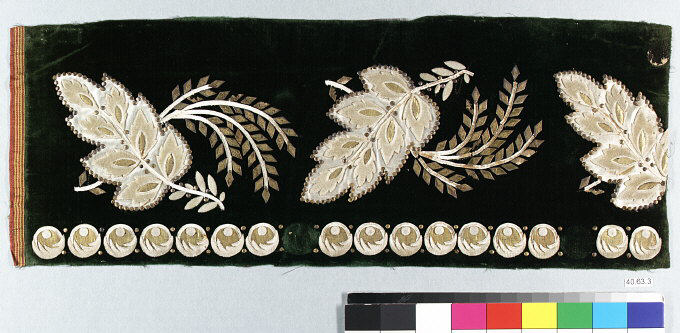
The Border as Narrative: A Couture Analysis of Katherine Fashion Lab’s Global Heritage Velvet Study
In the rarefied echelons of haute couture, the border is seldom a mere terminus. It is a threshold—a liminal space where construction meets concept, and where the artisan’s hand inscribes its final, most intimate signature. Katherine Fashion Lab’s standalone study of the dress border, executed in sumptuous velvet and drawn from a lexicon of Global Heritage, elevates this peripheral detail to a central thesis. This is not a garment awaiting completion; it is a finished meditation on the politics of edges, the weight of tradition, and the tactile poetry of materiality. The analysis that follows dissects this work as a masterclass in deliberate restraint, where the border functions not as decoration but as a structural and philosophical anchor.
Material Dialectics: Velvet as a Carrier of Memory
The choice of velvet is neither nostalgic nor arbitrary; it is a strategic deployment of a textile that carries a dense cultural and sensory payload. Velvet, historically woven from silk and associated with royal courts from Byzantium to the Medici, possesses an inherent gravity. Its pile—the raised looped or cut threads—creates a surface that absorbs and reflects light asymmetrically, producing a depth that flat weaves cannot approximate. In this study, Katherine Fashion Lab exploits velvet’s chameleonic luminosity: under direct illumination, the border appears almost black, absorbing photons; under raking light, it reveals a deep, bruised plum or a forest green, depending on the dye lot. This optical instability is the first act of the border’s narrative—it refuses to be static, mirroring the fluidity of cultural identity itself.
Furthermore, velvet’s weight is a physical argument. A velvet border is not appliquéd; it is felt. The fabric’s drape pulls the dress’s hem downward, creating a gravitational tension that grounds the silhouette. In couture, weight is often perceived as a negative—a limitation on movement. Here, Katherine Fashion Lab repositions weight as presence. The border’s heft signals a commitment to permanence, a counterpoint to the ephemerality of fast fashion. The tactile experience—the cool, dense smoothness of the pile against the skin—is an intimate dialogue between wearer and garment, a reminder that heritage is not an abstract concept but a material inheritance.
Global Heritage: Deconstructing the Ornamental Lexicon
The term “Global Heritage” in the collection’s title is not a vague gesture toward multiculturalism. Rather, it is a rigorous, anthropological approach to ornament. The border pattern, upon close inspection, reveals a palimpsest of motifs: a geometric interlace recalling Andalusian zellige, a scalloped edge echoing the paisley (buta) of Persian shawls, and a subtle, repeated chevron that nods to Pre-Columbian Andean textiles. This is not a pastiche; it is a synthesized grammar. Katherine Fashion Lab has extracted the structural logic—not the literal imagery—from each tradition. The result is a border that feels universally familiar yet specifically unplaceable, a deliberate strategy to avoid cultural appropriation while honoring cultural confluence.
The intellectual rigor here is commendable. The border’s scale is carefully calibrated: too wide, and it becomes a costume; too narrow, and it is lost in the velvet’s depth. The lab has chosen a width of approximately eight centimeters, a dimension that allows the motifs to breathe while maintaining the border’s role as a framing device. The pattern is not printed or embroidered onto the velvet but is created through selective pile manipulation—a technique where sections of the velvet’s nap are crushed or sheared to different heights. This creates a tonal, monochromatic relief effect, avoiding the crudeness of applied trim. The border thus becomes a topographic map of light and shadow, a subtlety that demands proximity and rewards the attentive eye.
Structural Sovereignty: The Border as Load-Bearing Element
In conventional dressmaking, the border is an afterthought—a hem facing or a ribbon. Katherine Fashion Lab inverts this hierarchy. In this standalone study, the border is structural, not supplemental. The velvet is cut on the bias to allow for natural stretch, but the border is cut on the straight grain and interlined with a fine horsehair canvas. This combination creates a differential stiffness: the dress’s body flows, while the border resists. The result is a controlled flare at the hem, a slight architectural flare that holds its shape without the use of crinoline or petticoats. The border, therefore, is the dress’s skeleton, its unseen armature.
This engineering decision has profound aesthetic consequences. The dress’s silhouette is not imposed from the bodice down but is determined from the hem upward. The border’s rigidity creates a fulcrum, allowing the skirt to fall in clean, uninterrupted planes. This is a couture-level manipulation of physics, where the seamstress’s understanding of fabric behavior supersedes mere decoration. The border’s inner edge is finished with a hand-rolled, micro-sitched hem—a detail invisible to the casual observer but a testament to the atelier’s obsessive precision. This internal finish, hidden within the velvet’s pile, speaks to a philosophy of integrity over visibility: the craft is honest even where unobserved.
The Standalone Context: A Fragment as a Complete Statement
The decision to present this as a “standalone study” is a curatorial masterstroke. By isolating the border from a full garment, Katherine Fashion Lab reframes the viewer’s perception. There is no face, no body, no social context to distract from the object itself. The border, displayed on a dress form with a raw, unfinished top edge, becomes an artifact—a relic of a process rather than a product of fashion. This framing aligns with contemporary couture’s shift toward conceptual transparency, where the sketch, the toile, and the fragment are elevated to the status of finished art.
In this context, the border is not a part of a whole; it is the whole. It invites a forensic examination: one can study the density of the pile, the precision of the sheared lines, the way the velvet’s nap changes direction at each motif junction. The absence of a complete garment is not a lack but a liberation—it frees the border from the tyranny of function. It becomes a pure object of contemplation, a study in the relationship between material memory and human hands.
Conclusion: The Edge as Center
Katherine Fashion Lab’s velvet border study is a quiet manifesto. It argues that in an era of digital print and disposable aesthetics, the physical, hand-worked edge retains a sovereign power. The border is no longer a frame for the dress; it is the dress’s argument. Through the strategic use of velvet’s optical and tactile depth, a synthesized global pattern, and a load-bearing structural role, this standalone piece demonstrates that couture’s future lies not in louder spectacle but in deeper material intelligence. The border, traditionally the point where the garment meets the world, here becomes the point where heritage meets innovation. It is a study in edges that reveals, ultimately, that the most profound statements are often made at the periphery—where the fabric ends, the idea begins.