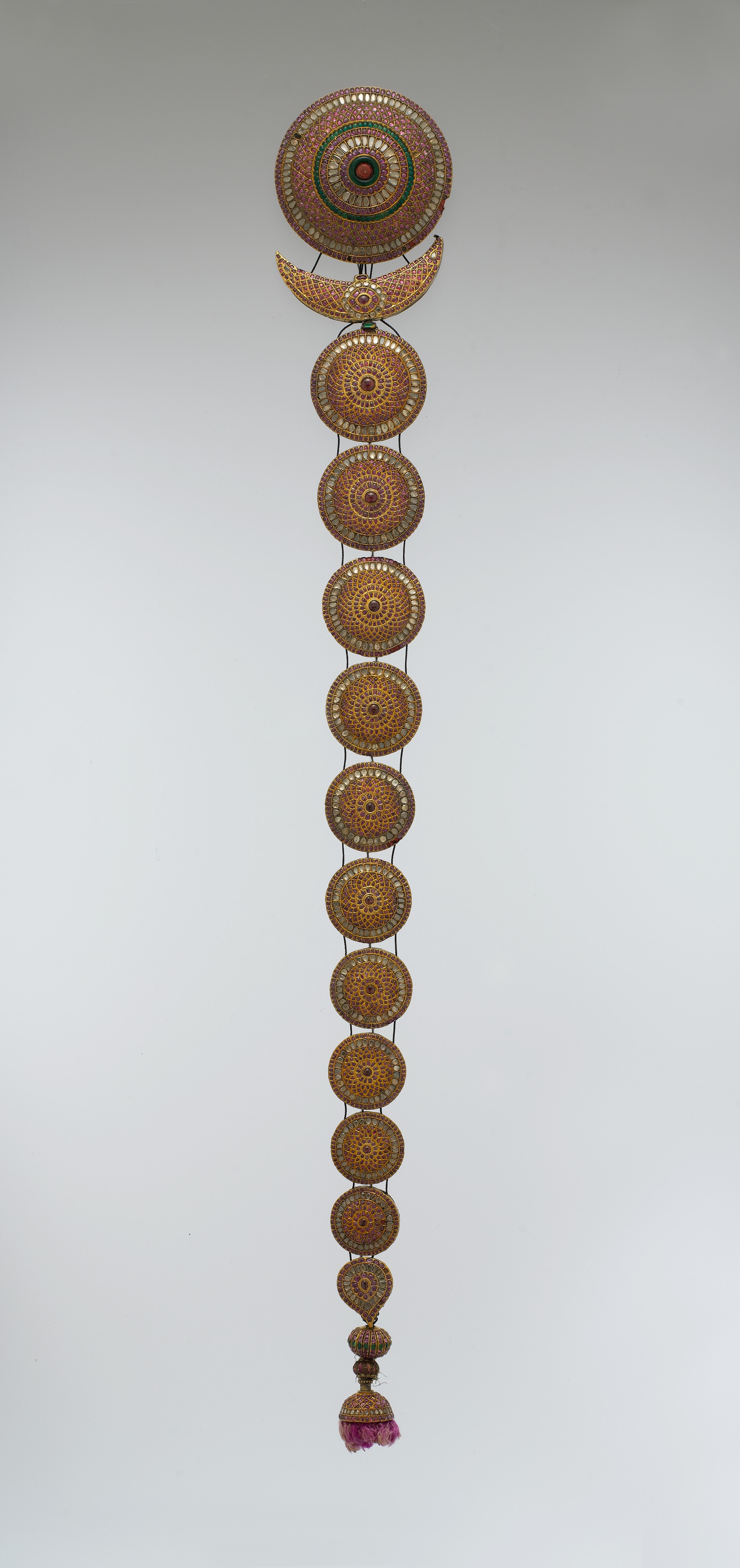
Executive Heritage Analysis: The Jadanagam as a Strategic Luxury Archetype
The Jadanagam, a plait ornament of profound antiquity, represents far more than a decorative artifact. Within the context of Katherine Fashion Lab’s 2026 high-end luxury strategy, this object serves as a masterclass in the convergence of symbolic power, material mastery, and spiritual resonance. For the discerning modern collector, the Jadanagam is not merely an accessory; it is a wearable declaration of lineage, authority, and metaphysical alignment. This analysis deconstructs the ornament’s historical gravitas and translates its intrinsic values into actionable, forward-looking luxury positioning.
Symbolic Power and the Architecture of Authority
In ancient civilizations, the plait—or braid—was consistently coded as a locus of contained energy and controlled chaos. The Jadanagam, designed to adorn the braided hair at the nape or crown, functioned as a physical seal of that energy. Its placement was deliberate: the occipital region, considered the seat of primal instinct and ancestral memory, was framed by gold to signify the wearer’s mastery over their own primal nature. The ornament’s linear, elongated form echoed the braid itself, creating a visual and spiritual continuum between the human body and the divine. To wear the Jadanagam was to assert that one’s personal narrative was not a random sequence but a deliberate, gilded path.
The strategic implication for Katherine Fashion Lab is clear: the 2026 client is not purchasing a jewel; they are purchasing narrative sovereignty. The Jadanagam’s symbolic power—rooted in the idea of the “unbroken line”—translates directly to a luxury positioning that emphasizes legacy over trend. We recommend framing the ornament not as a “hair accessory” but as a “Sigil of Continuity,” a piece that empowers the wearer to visually articulate their own curated history.
Historical Adornment: The Grammar of Prestige
Historically, the Jadanagam was reserved for the upper echelons of society—priestly classes, warrior elites, and royal consorts. Its creation was a specialized craft, often involving the swarnakara (goldsmith) who held esoteric knowledge of metallurgy and gemstone energetics. The use of gold was not arbitrary; gold was the metal of the sun, imperishable and associated with immortality. Inset rock crystal, a material of exceptional clarity, was believed to amplify intention, while rubies (the “lord of gems”) conferred invincibility. Emeralds, sacred to Venus, attracted prosperity and eloquence, and amethysts served as a bulwark against intoxication of the mind and spirit.
This specific gemological combination was a calculated lexicon of power. Each stone was a word in a sentence of authority, and the gold was the syntax that bound them. For the modern luxury market, this offers a profound lesson in material storytelling. Katherine Fashion Lab must move beyond the generic “precious metals and stones” descriptor. The 2026 strategy should adopt a “Gemological Semantics” approach, where each material is explicitly linked to a benefit or attribute—e.g., “Amethyst for executive clarity,” “Ruby for market dominance.” This transforms a purchase into an act of self-composition.
Spiritual Meaning: The Ornament as a Talismanic Interface
Beyond the physical, the Jadanagam operated as a talismanic interface between the wearer and the cosmic order. In Vedic and proto-Dravidian traditions, the braid was considered a conduit for prana (life force). The Jadanagam, by anchoring this conduit with specific stones, was believed to recalibrate the wearer’s energetic frequency. Rock crystal, in particular, was used as a “programmable” stone—a blank slate that could be charged with the wearer’s intentions. The ornament was not passive; it was an active agent in the wearer’s spiritual hygiene.
This spiritual dimension is the most potent, yet most delicate, asset for Katherine Fashion Lab. In 2026, the high-end consumer is increasingly seeking “functional spirituality”—objects that offer a tangible sense of protection, clarity, or grounding in a hyper-digital world. The Jadanagam’s heritage provides a credible, non-appropriative foundation for this narrative. The strategy must pivot from “spiritual jewelry” (a diluted term) to “Intentional Anchors.” The marketing language should emphasize the ornament’s role as a personal frequency modulator, a piece that offers the wearer a moment of deliberate pause and recalibration amidst the chaos of modern executive life.
2026 High-End Luxury Strategy: From Artifact to Archetype
To position the Jadanagam effectively for 2026, Katherine Fashion Lab must execute a three-tiered strategy that honors the artifact’s origins while propelling it into a futuristic luxury context.
Tier One: The Limited Heritage Edition
This tier involves a meticulous, museum-grade recreation of the original Jadanagam. We recommend a run of no more than 25 pieces, each accompanied by a digital provenance ledger (blockchain-verified) detailing the historical research, the specific mine origins of the stones, and the artisan’s certification. This edition is not for sale in the traditional sense; it is offered through a private, invitation-only acquisition process. The price point should be set at a premium that reflects its status as a collectible cultural asset, not a wearable commodity. This tier establishes the brand’s intellectual and artisanal credibility.
Tier Two: The Contemporary Adaptation
For a broader ultra-high-net-worth audience, we propose a deconstructed adaptation. The Jadanagam’s linear form is reimagined as a modern hair cuff, a minimalist pendant, or a brooch that can be worn on tailoring. The materials remain authentic—gold and the specified gemstones—but the design is simplified for daily wear. This tier utilizes a “Stealth Wealth with Spiritual Depth” positioning. The ornament is understated in silhouette but overwhelming in material quality and historical resonance. The marketing narrative here focuses on “quiet power” and “internal authority,” appealing to the client who eschews logos but demands significance.
Tier Three: The Bespoke Commission Program
Leveraging the Jadanagam’s history as a personalized talisman, this tier offers clients the opportunity to commission their own ornament. Katherine Fashion Lab’s heritage curators will work with the client to select stones based on their personal astrological, professional, or spiritual objectives. This is a co-creation ritual, not a sale. The process is documented in a leather-bound folio, and the final piece is presented in a ceremony that acknowledges its symbolic weight. This tier generates significant margin and creates an unassailable emotional bond between the client and the brand.
Conclusion: The Gilded Path Forward
The Jadanagam is a testament to the enduring human desire to externalize inner power. For Katherine Fashion Lab, it is not a historical curiosity but a strategic blueprint. By decoding its symbolic power, respecting its historical grammar, and reinterpreting its spiritual function, the brand can offer a 2026 luxury experience that is profoundly differentiated. In a market saturated with visual noise, the Jadanagam offers a quiet, gilded frequency. The strategy is not to sell an ornament, but to bestow a legacy. The client is not buying a product; they are acquiring a piece of ancestral authority, meticulously recalibrated for the modern epoch. This is the ultimate expression of high-end luxury: the purchase of meaning, executed with impeccable, scholarly precision.