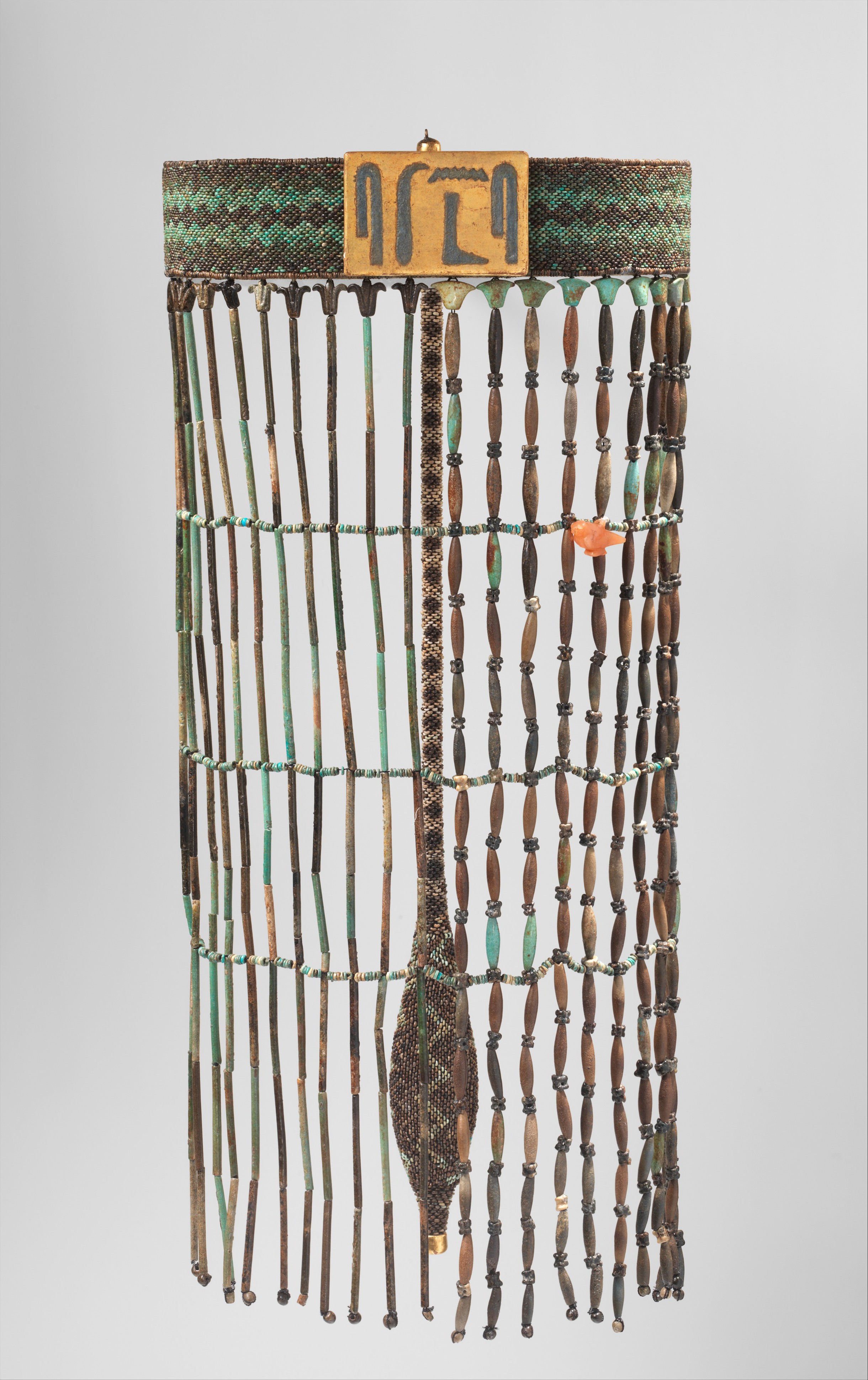
Executive Heritage Analysis: The Beadwork Apron of Senebtisi
The beadwork apron of Senebtisi, discovered within the Middle Kingdom burial assemblage at Dahshur, represents one of the most sophisticated examples of ancient Egyptian funerary adornment. Crafted from light and dark green, blue, and black faience with painted detailing, this ceremonial garment transcends mere decoration. For Katherine Fashion Lab, this artifact offers a strategic blueprint for integrating symbolic power, historical narrative, and spiritual depth into a 2026 luxury collection that speaks to discerning clients seeking meaning beyond aesthetics.
Symbolic Power and Material Semiotics
The chromatic selection of Senebtisi’s apron is not arbitrary; it is a coded language of cosmic authority. The deep blues and greens evoke the Nile’s regenerative waters and the verdant rebirth of vegetation, while the black accents reference the fertile alluvial soil of Kemet, the “Black Land.” In ancient Egyptian cosmology, these colors were not decorative but performative—they activated the wearer’s connection to Osiris, the god of resurrection. The faience itself, a sintered quartz composite, was called tjehenet, meaning “that which gleams,” and was believed to possess solar properties. When light struck the beads, the apron emitted a shimmering radiance that mirrored the sun’s daily rebirth, positioning Senebtisi as a living embodiment of cyclical renewal.
Strategically, this teaches luxury brands that color is not a passive choice but an active agent of storytelling. For 2026, Katherine Fashion Lab can deploy a similar palette—emerald, lapis, obsidian—not as trend-driven hues but as semiotic anchors. Each garment becomes a talisman, carrying the weight of historical resonance. The client is not purchasing fabric; they are acquiring a fragment of cosmic order, a wearable assertion of permanence in an ephemeral world.
Historical Adornment as Status Architecture
Senebtisi’s apron was more than an accessory; it was an architectural declaration of social hierarchy. The beadwork’s intricate netting technique, composed of thousands of individually strung faience cylinders, required extraordinary labor and material investment. This was not accessible craftsmanship—it was a marker of elite patronage, likely produced in royal workshops under the supervision of the priesthood. The apron’s placement over the mummy’s pelvic region, directly above the source of generation, further signified dynastic continuity and the preservation of lineage. In life, such adornment would have been reserved for ritual performances; in death, it ensured the deceased’s transformation into an akh, an effective spirit with enduring influence.
For a modern luxury house, this historical precedent underscores the value of scarcity and artisanal mastery. The 2026 strategy should pivot away from mass-produced “quiet luxury” toward what can be termed ritualized exclusivity. Each apron-inspired piece—whether a beaded belt, a camisole overlay, or a statement collar—should be limited to a single production run, numbered and certified. The labor intensity becomes a marketing narrative: hours of hand-beading, sourced faience-like glass, and a documented provenance of technique. The consumer is not buying a product but a lineage of craft, a tangible connection to a civilization that understood adornment as a form of immortality.
Spiritual Meaning and the Wearable Amulet
The spiritual dimension of Senebtisi’s apron cannot be overstated. In the Middle Kingdom, bead nets were explicitly amuletic, often accompanied by a heart scarab or inscribed with Chapter 159 of the Book of the Dead, which ensured the deceased’s ability to breathe in the afterlife. The apron’s grid-like structure was not coincidental; it replicated the menat necklace’s protective properties and the wesekh collar’s solar associations. Each bead was a micro-prayer, a repetitive devotion that created a field of sacred energy around the wearer. The painted details—likely representing feathers or petals—further invoked the goddess Nut, who sheltered the dead within her starry body.
In the context of 2026, where consumers increasingly seek wellness and metaphysical grounding, this spiritual layer offers a compelling positioning. Katherine Fashion Lab can introduce a sub-collection titled “The Senebtisi Code,” where each piece is accompanied by a digital or physical “blessing card” explaining the symbolic meaning of its bead pattern. This is not cultural appropriation but cultural appreciation, executed with scholarly rigor and respectful attribution. The garments become amulets for the modern age—protecting the wearer’s energy, grounding them in intentionality, and serving as a daily ritual of self-reverence. The luxury market’s pivot toward “meaningful consumption” finds its most potent expression here: a product that offers not just status but spiritual utility.
2026 High-End Luxury Strategy: Bridging Antiquity and Avant-Garde
The translation of Senebtisi’s apron into a 2026 luxury strategy requires a three-tiered approach: Heritage Line, Avant-Garde Extension, and Experiential Launch.
Heritage Line: The Museum Edition
This tier reproduces the apron’s geometry with contemporary materials—sustainable glass beads, recycled brass, and hand-painted enamel—while maintaining the original color ratios. Offered in a capsule of 50 pieces, each includes a certificate of authenticity co-signed by an Egyptologist and a fashion historian. The price point is deliberately high, reflecting not material cost but knowledge cost. This edition targets collectors who view fashion as an investment in cultural capital.
Avant-Garde Extension: Deconstructed Ritual
For the fashion-forward client, this tier deconstructs the apron’s form into modular elements: a beaded fringe that can be worn as a neckpiece, a waist-cincher with magnetic closures, or a translucent mesh overlay with embroidered faience-inspired motifs. The black and blue palette is retained, but the silhouette is aggressively contemporary—asymmetric, sculptural, and architectural. This line positions Katherine Fashion Lab as a house that respects tradition but refuses to be confined by it. The marketing narrative emphasizes “ancient technology, modern body,” appealing to clients who see themselves as pioneers.
Experiential Launch: The Ritual Presentation
The launch strategy should mirror the artifact’s funerary context, but inverted for life. Host an invite-only event in a dimly lit gallery, where models move slowly on a sand-covered runway, their beaded garments catching light in controlled beams. Guests receive a small vial of Nile-scented oil and a printed papyrus-style card explaining the apron’s spell. The event is not a fashion show but a ceremony—a moment of collective reverence that attendees will discuss for years. Post-event, a documentary short film featuring the artifact’s history plays on the brand’s digital channels, extending the narrative’s lifespan.
Conclusion: The Apron as Eternal Strategy
The beadwork apron of Senebtisi is not a relic; it is a strategic manifesto. It teaches that luxury is not volume but vibration—the resonance of color, the weight of history, and the intention of craft. For Katherine Fashion Lab, this artifact provides a template for a 2026 collection that is intellectually rigorous, emotionally resonant, and commercially astute. By honoring the symbolic power, historical adornment, and spiritual meaning of Senebtisi’s garment, the brand can offer its clients something increasingly rare in modern luxury: a piece that does not merely clothe the body but elevates the soul. In doing so, Katherine Fashion Lab does not imitate the past; it continues a conversation that began four thousand years ago—a dialogue between the wearer and the eternal.