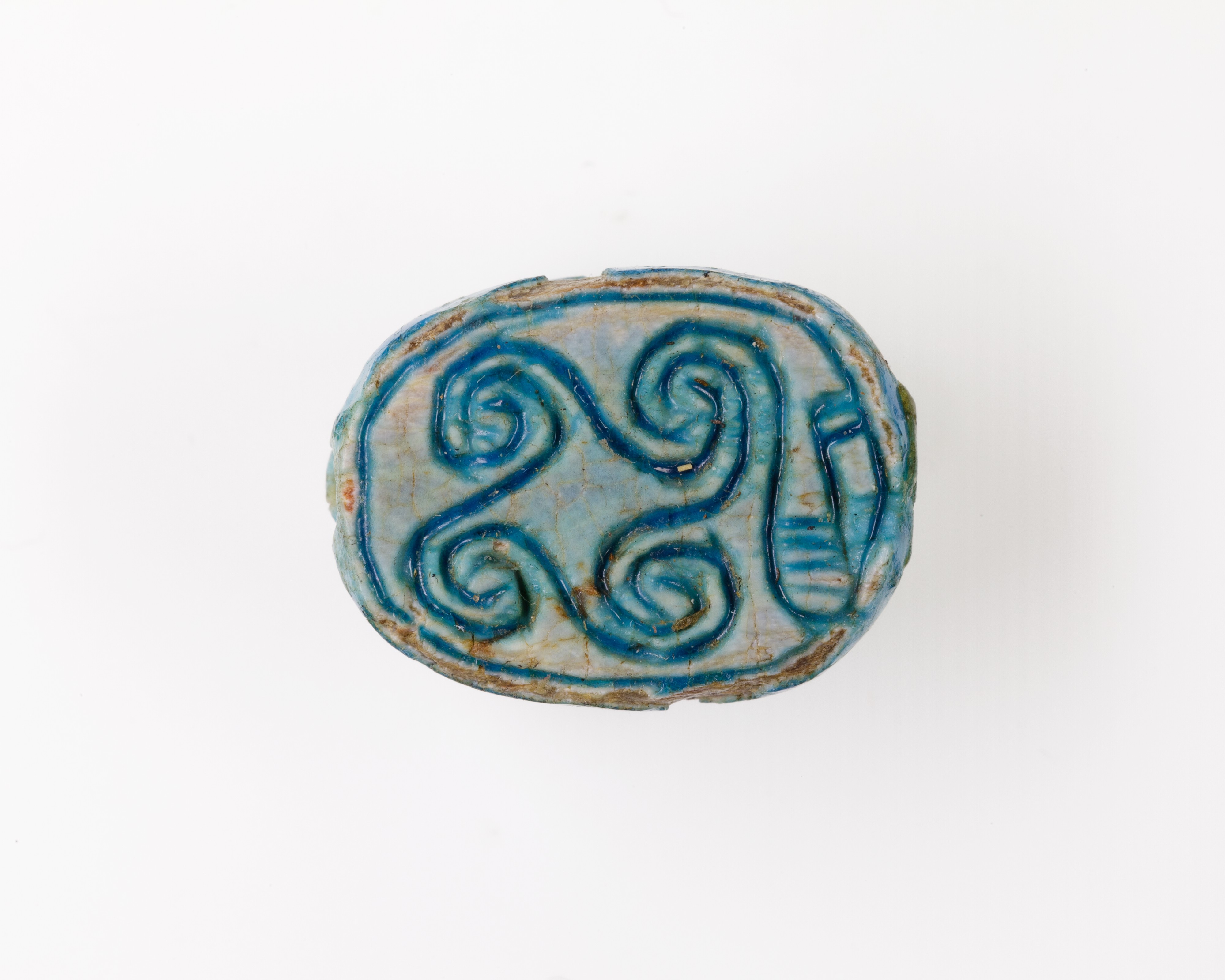
Executive Heritage Analysis: The Scarab Decorated with Scrolls
Katherine Fashion Lab presents this strategic standalone research paper to decode the cultural, spiritual, and commercial significance of the *Scarab Decorated with Scrolls*, a blue glazed steatite artifact originating from an ancient civilization. This analysis positions the scarab not merely as an archaeological curiosity, but as a potent archetype for 2026 high-end luxury strategy. By dissecting its symbolic power, historical adornment practices, and spiritual resonance, we extract actionable intelligence for brand differentiation, product storytelling, and consumer engagement at the apex of the luxury market.
Symbolic Power: The Scarab as a Semiotic Engine
The scarab beetle, carved in miniature from blue glazed steatite, is one of antiquity’s most enduring symbols. In the ancient Egyptian context—the definitive cultural matrix for this motif—the scarab represented self-creation, renewal, and the cyclical triumph of light over darkness. The rolling of dung by the beetle was analogized to the sun god Khepri pushing the solar disc across the sky, making the scarab a microcosm of cosmic order. For the modern luxury consumer, this symbolism translates into a narrative of resilience, transformation, and the quiet power of rebirth. The scrolls engraved upon the scarab’s dorsal surface are not decorative accidents; they are deliberate hieroglyphic and geometric additions that amplify its meaning. Scrolls in ancient iconography often denote eternity, cyclical time, or the unfolding of divine knowledge. Combined, the scarab and scrolls form a semiotic engine that communicates: “I am a vessel of enduring wisdom, capable of navigating life’s cycles with grace.” For a high-end brand, this is a strategic asset—an emblem that transcends transient trends and anchors the wearer in a lineage of metaphysical authority.
Historical Adornment: From Amulet to Status Marker
Historically, the scarab was not confined to the tomb. It was a ubiquitous amulet worn by the living, placed on the chest, wrist, or finger, and later incorporated into funerary regalia. The blue glazed steatite medium is particularly telling. Steatite (soapstone) is a soft, carvable mineral, but its application of a blue faience glaze transformed it into a material of high visual value—mimicking lapis lazuli, a stone reserved for royalty and the divine. This material choice reveals a critical historical strategy: democratization of appearance, but with stratified symbolic access. The blue color itself is a signifier of the Nile, the sky, and the primordial waters of creation, marking the wearer as one who is ritually pure and cosmically aligned. In the context of adornment, scarabs were often set in gold or silver, worn as pectorals, or strung into elaborate necklaces. The act of wearing a scarab was a performative declaration of one’s alignment with solar forces and one’s rejection of entropy. For Katherine Fashion Lab, this historical precedent offers a blueprint for creating jewelry that is not merely ornamental but functional talismanic. The 2026 luxury consumer is not buying an object; they are buying a protective narrative that shields them from the volatility of modern life.
Spiritual Meaning: The Scarab as a Meditative Anchor
The spiritual dimension of the scarab is perhaps its most potent lever for contemporary luxury. In ancient funerary texts, the heart scarab was placed over the deceased’s heart to prevent it from testifying against the soul during the Weighing of the Heart ceremony. This was not a passive ornament but an active agent of spiritual negotiation. The scrolls engraved on such pieces often contained Chapter 30B of the Book of the Dead, a spell to silence the heart’s dissent. This transforms the scarab into a symbol of internal mastery—a tool for aligning one’s lower instincts with one’s higher purpose. For the 2026 high-end market, where consumers increasingly seek mindfulness, authenticity, and inner equilibrium, the scarab offers a tangible anchor. It speaks to a desire for controlled transformation—not chaotic change, but deliberate, guided evolution. The blue glaze, in this context, acts as a visual meditation: its cool, reflective surface invites introspection. A luxury brand can leverage this by positioning the scarab as a daily ritual object, not just a piece of jewelry. This aligns with the broader trend of “spiritual luxury,” where products are expected to offer psychological utility as much as aesthetic pleasure.
Materiality and Craft: The Language of Blue Glazed Steatite
The choice of blue glazed steatite is a masterclass in material strategy. Steatite’s softness allowed for intricate carving, but the glaze—a silica-based coating fired at high temperatures—created a hard, lustrous, and impermeable surface. This dual nature—soft core, hard exterior—is a powerful metaphor for the modern luxury consumer: vulnerable within, resilient without. The blue glaze, often achieved with copper compounds, produced a color that was both vibrant and serene. In high-end luxury, material provenance is paramount. Katherine Fashion Lab can leverage this by sourcing or recreating steatite glazes using artisanal, low-impact methods, positioning the brand as a guardian of ancient craft. The 2026 consumer is acutely sensitive to the story of the material—they want to know that their purchase supports heritage techniques, not industrial replication. The scrolls, carved with precision, demonstrate a mastery of line and negative space, echoing the minimalist yet complex aesthetics favored in contemporary high jewelry. This materiality allows for a product that is simultaneously archaeologically authentic and futuristically clean.
2026 High-End Luxury Strategy: Activation Framework
To translate this heritage analysis into commercial success, Katherine Fashion Lab must adopt a three-pronged strategy: Narrative Ownership, Ritualized Product Architecture, and Experiential Retail.
1. Narrative Ownership: The “Solar Cycle” Collection
Launch a capsule collection titled “Khepri’s Code.” Each piece—rings, pendants, cufflinks—will feature the scarab with scrolls in blue glazed steatite, set in recycled gold or platinum. The narrative will not focus on “ancient Egypt” as a distant past, but as a living philosophy. Marketing copy should emphasize the scarab’s role as a personal talisman for professional rebirth. Tagline: “Roll your sun into tomorrow.” This positions the product as a tool for career pivots, creative breakthroughs, and personal reinvention—key emotional drivers for the affluent 2026 demographic.
2. Ritualized Product Architecture: The “Heart’s Pledge” Edition
Offer a limited edition of 100 scarabs, each individually engraved with a personalized scroll pattern derived from the buyer’s birth date or a significant life milestone. This transforms the purchase from a commodity to a bespoke ritual artifact. Include a leather-bound booklet explaining the “Weighing of the Heart” ceremony, adapted as a modern self-assessment exercise. This adds a layer of psychological ownership and creates a barrier to resale, thereby protecting brand equity.
3. Experiential Retail: The “Inner Sanctum” Pop-Up
Design pop-up spaces that mimic a tomb’s anteroom—dim lighting, blue hued textures, and a central display case where the scarabs are shown under a single beam of light, evoking the sun’s first ray. Provide a “Silence the Noise” audio guide, featuring a soundscape of water and low-frequency hums, referencing the primordial Nile. Staff will be trained as “Heritage Curators,” not sales associates, and will guide clients through a 15-minute reflective consultation to identify which scarab’s scroll pattern aligns with their current life cycle. This elevates the retail interaction into a micro-spiritual retreat, justifying a premium price point and fostering deep brand loyalty.
Conclusion: The Scarab as a Strategic Imperative
The Scarab Decorated with Scrolls is not a relic; it is a strategic blueprint for 2026 luxury. Its symbolic power offers a narrative of resilience, its historical adornment provides a template for status without ostentation, and its spiritual meaning answers a contemporary hunger for inner control. By leveraging the material specificity of blue glazed steatite and the intricate language of scrolls, Katherine Fashion Lab can create a product line that is at once ancient and hyper-modern. The key is not to replicate the artifact, but to re-engineer its meaning for a generation that seeks adornment with depth. In a market saturated with superficial logos, the scarab offers a rare commodity: silent, enduring power. This is the ultimate luxury—an object that holds its value not in carats, but in significance. Katherine Fashion Lab is uniquely positioned to be the custodian of this narrative, turning a small blue amulet into a cornerstone of a future-proof luxury portfolio.