A Cartography of Craft: Deconstructing the Title Page of Schön’s *newes Modelbuch*
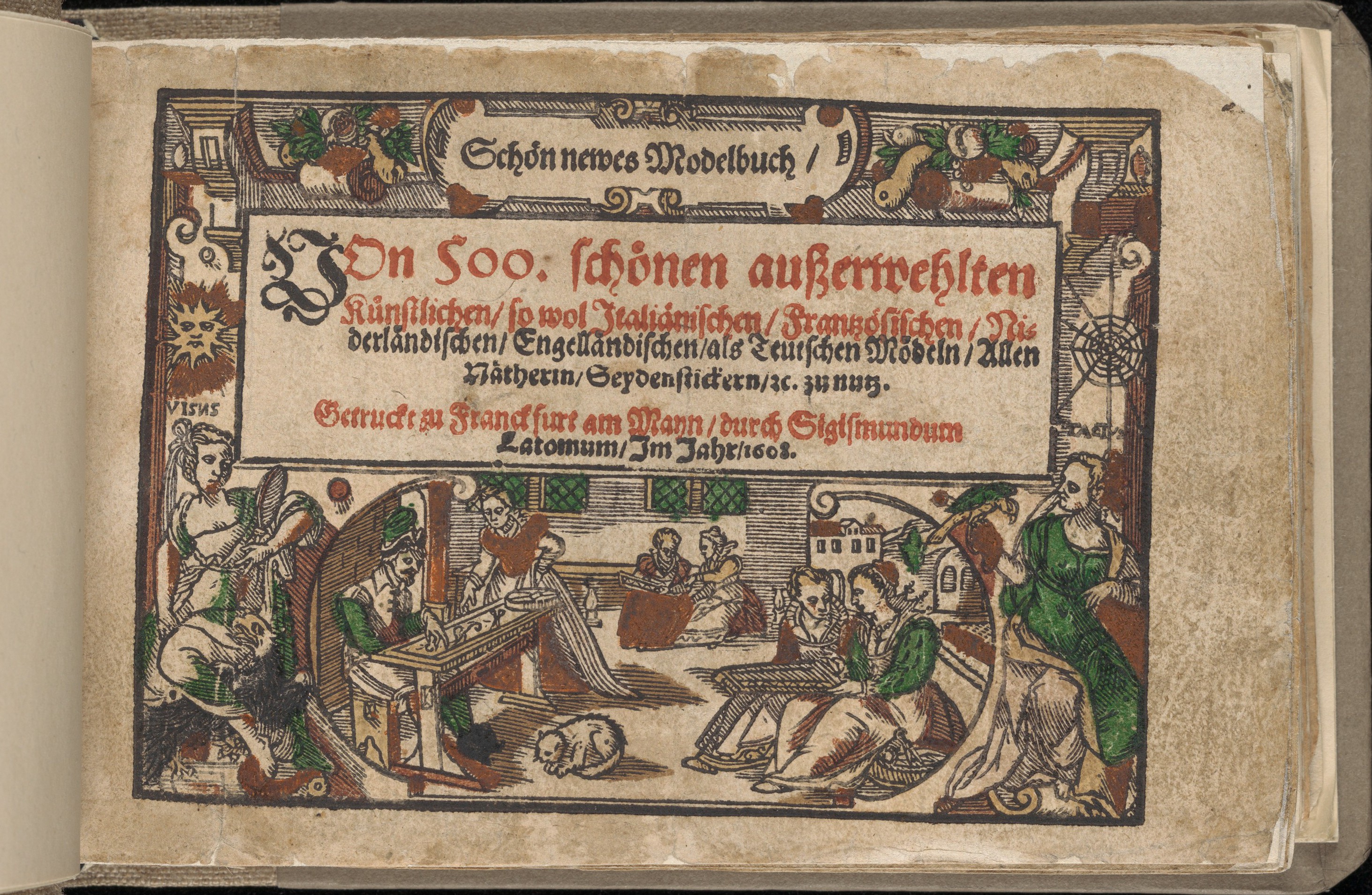
At first glance, a title page from a 16th-century German pattern book appears to be a utilitarian artifact—a bibliographic label, a precursor to the content within. Yet, in the hands of Katherine Fashion Lab, this woodcut from the *Schön newes Modelbuch* (Page 1r) transcends its functional role, emerging as a profound couture analysis in its own right. It is not merely a page; it is a compressed manifesto of early modern aesthetics, a coded system of production, and a silent dialogue between artisan and aristocrat. For the contemporary fashion scholar, this image is a Rosetta Stone, decoding the symbiotic relationship between technical reproducibility and sartorial aspiration that still underpins the luxury industry today.
The Semiotics of the Ornamental Frame
The most immediate visual impact of Page 1r is its architectural framing—a dense, intricate border of strapwork, grotesques, and botanical tendrils. In the context of couture, we must read this not as decoration but as structural engineering. The woodcut’s border functions as a metaphor for the tailoring skeleton of a garment: the boning, the interfacing, and the precise seam allowances that give a silhouette its authority. Just as a couture house’s atelier uses a rigid toile to shape fluid silk, Schön uses the heavy black line of the woodcut to contain and define the white space within. This is not accidental ornament; it is a deliberate exercise in negative space management, a principle that governs the drape of a bias-cut gown or the crisp lapel of a tailored jacket.
Furthermore, the grotesque motifs—hybrid creatures and mythical figures—are not whimsical. They represent the early modern fascination with transformation and hybridity. In fashion terms, this is the precursor to the modern concept of the "mash-up" or the fusion of disparate cultural codes. The title page is a global heritage artifact precisely because it synthesizes Italian Renaissance arabesques, German Gothic linearity, and a nascent Islamic influence in its geometric interlacing. This is a silent acknowledgment that fashion has never been pure; it is always a palimpsest of borrowed and recontextualized forms.
Typography as Textile: The Typographic Body
Moving beyond the frame, the typography itself demands a couture-level reading. The letterforms, set in a bold blackletter or Schwabacher typeface, are not merely read; they are worn. The thick vertical strokes and sharp angular terminals mimic the pleats and folds of contemporary fustian or velvet. The visual weight of the letters creates a rhythm that parallels the repeated motifs on a woven damask. In this sense, the title page is a paper textile. The printer, by controlling the density of ink, was performing an act of textural simulation. The glossy black of the woodcut ink against the rough, fibrous paper of the period evokes the contrast between polished metal thread and matte wool—a tactile duality that high fashion still exploits to create visual tension.
This typographic treatment also speaks to the hierarchy of information, a critical tool in any couture collection. The title, *Schön newes Modelbuch* (Beautiful New Pattern Book), is not presented as a whisper but as a proclamation. The size and weight of the letterforms dictate the viewer’s eye movement, just as a designer uses a bold primary color or an exaggerated shoulder pad to direct attention. The page teaches us that in fashion, as in print, authority is established through scale and contrast. The "newness" (newes) is not a subtle suggestion but a bold, marketable claim, foreshadowing the relentless cycle of seasonal novelty that drives the industry today.
The Woodcut as a Prototype of the Fashion Plate
Contextualized as a standalone study, this title page forces us to reconsider the genealogy of the fashion illustration. Before the advent of the hand-colored engraving or the photographic editorial, the woodcut was the primary vehicle for transmitting style. However, this page is unique because it does not depict a garment; it promises one. It is a meta-narrative of fashion, an advertisement for the very idea of pattern and replication. The woodcut’s inherent quality—its ability to be inked and pressed repeatedly—mirrors the logic of the pattern itself. Each impression is a copy, yet each copy carries a slight variation in ink pressure or paper tooth, making every "edition" an original. This paradox is the essence of couture: the handmade within the reproducible, the unique within the series.
In a contemporary context, Katherine Fashion Lab interprets this as the tension between the "drop" and the "archive." The title page is the original drop, the teaser campaign for the collection contained within. It establishes a brand identity—Schön—and a value proposition: beauty through systematic design. The fact that it is a standalone study allows us to isolate this branding mechanism, to see how a visual identity is constructed before the product is even revealed. This is a masterclass in restraint; the page does not scream with imagery of gowns, but rather seduces with the promise of intellectual and aesthetic rigor.
Global Heritage and the Economics of Desire
Finally, we must situate this object within the broader flows of global heritage. The *Modelbuch* was a commercial product, sold across Europe and beyond, feeding a nascent consumer culture. The title page is a tool of economic persuasion. Its intricate design signals the skill of the engraver, which in turn vouches for the quality of the patterns within. This is the same logic used by luxury houses when they invest millions in a flagship store's architecture—the container must exude as much craftsmanship as the product. The page is a democratizing force, allowing a middle-class seamstress in Augsburg to access the same design vocabulary as a noblewoman in Florence, albeit in a more simplified form. This is the early modern origin of "diffusion lines" and "bridge collections."
Moreover, the materiality of the woodcut—its durability and its ability to be stored and reused—speaks to the concept of sustainability in a pre-industrial age. This was not a disposable medium; it was a long-term asset. The block could be re-inked for decades, making it a valuable piece of intellectual property. In our era of fast fashion and digital disposability, the Schön title page is a stark reminder that true luxury is not ephemeral. It is built on systems, on reusable knowledge, and on a deep respect for the material and the manual.
In conclusion, the title page from Schön’s *newes Modelbuch* is far more than a bibliographic curiosity. For the discerning eye of Katherine Fashion Lab, it is a complete couture philosophy in miniature. It demonstrates that fashion is a language of structure, a negotiation between ornament and function, and a commercial enterprise built on the allure of the new. The woodcut’s stark black lines are the DNA of the modern runway, and its silent, static presence on the page holds the kinetic energy of a thousand future garments. To study it is to understand that the roots of haute couture lie not in the fabric, but in the initial, immutable sketch—or in this case, the carved line that gives form to desire.