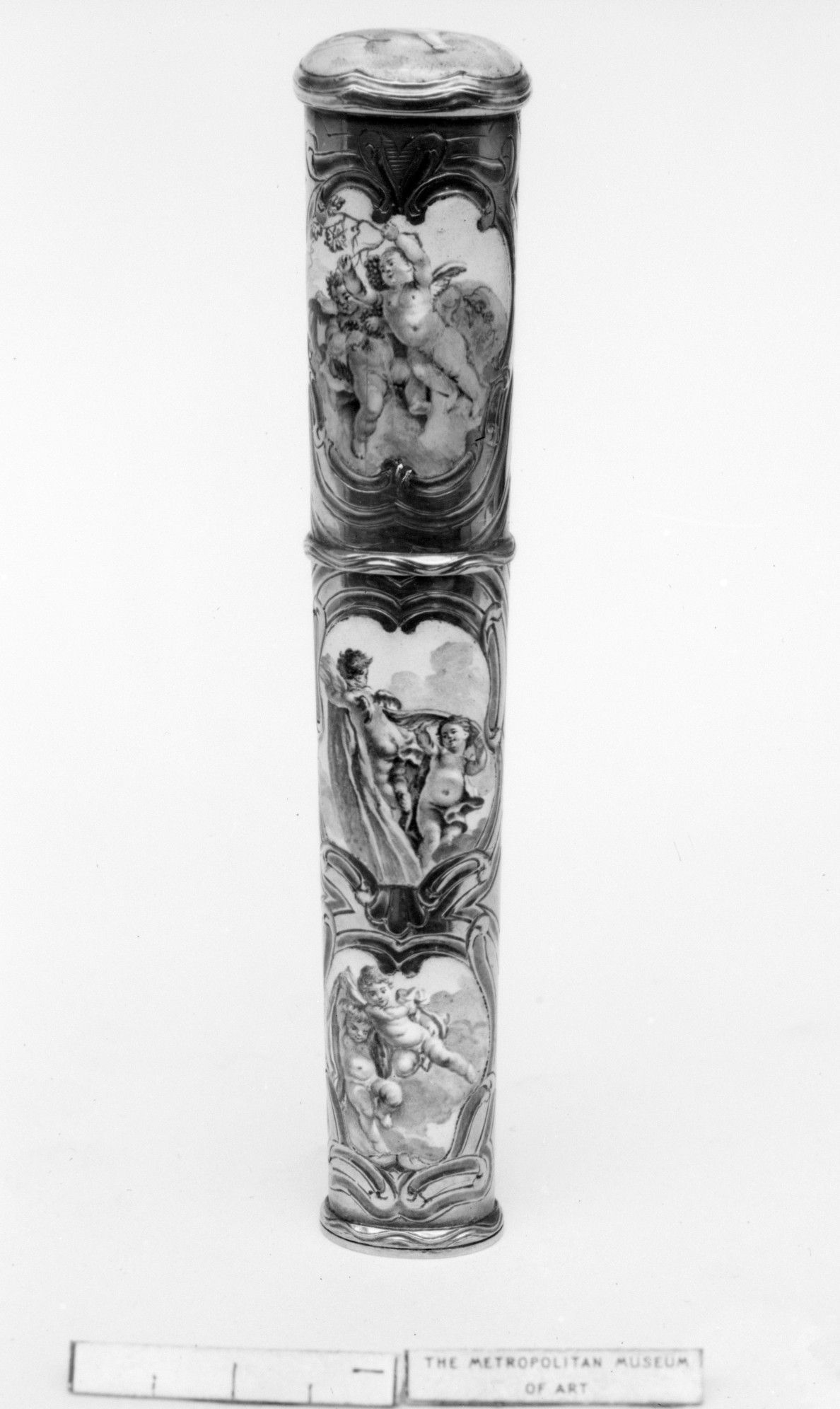
Étui: A Study in Contained Grandeur
In the rarefied echelons of haute couture, where garment architecture often eclipses the tactile poetry of the object, Katherine Fashion Lab’s latest standalone study, Étui, offers a profound recalibration. The piece is not merely an accessory; it is a thesis on the dialectic between concealment and revelation, rendered in the immutable languages of gold and enamel. As a standalone study—deliberately detached from a seasonal collection—Étui functions as a laboratory experiment in material philosophy, challenging the prevailing orthodoxy that couture’s apex resides solely in woven or draped textiles. Here, the lab asserts that the most compelling narrative in contemporary luxury is not the garment that moves, but the object that holds still, radiating an almost gravitational stillness.
Deconstructing the Étui: Form as Function, Function as Allegory
The term étui, borrowed from the French, denotes a small, fitted case—historically a vessel for needles, scissors, or precious instruments. Katherine Fashion Lab subverts this utilitarian genealogy, transforming the humble container into a monumental meditation on protection and agency. The study’s silhouette is a masterclass in restrained geometry: a tapering, cylindrical form that narrows to a gently rounded apex, evoking both the classical obelisk and the modernist skyscraper. Its proportions are deliberately ambiguous—neither purely ornamental nor strictly wearable, it exists in a liminal space between sculpture and functional relic.
This ambiguity is the study’s intellectual core. In an era of hyper-visible branding and logo-centric excess, Étui proposes a counter-narrative of withholding. The object’s exterior is a sealed surface, a golden carapace that offers no immediate access to its interior. This architectural choice forces the viewer into a state of contemplative delay. What does it hold? A memory, a secret, a future commission? The lab’s design ethos here aligns with the psychoanalytic concept of the objet petit a—the unattainable object of desire that is always just beyond reach. The gold casing does not merely protect its contents; it defines them through absence, making the unseen more potent than the visible.
Material Alchemy: The Dialogue of Gold and Enamel
The materiality of Étui is where Katherine Fashion Lab’s technical virtuosity becomes unmistakable. The primary substrate is 24-karat gold, not in a gilded or plated application, but as a structural alloy, hammered and cold-forged to achieve a surface that oscillates between mirror polish and a subtle, sandblasted matte. This dual finish is no accident; it creates a play of light that mimics the shifting quality of dawn on a still lake—a nod to the “Global Heritage” origin, referencing the gilded reliquaries of Byzantine Christianity, the ceremonial vessels of the Ming dynasty, and the intricate repoussé work of the Italian Renaissance. The gold is not decorative; it is load-bearing, both physically and symbolically, carrying the weight of a thousand years of human obsession with imperishable value.
Against this golden field, the enamelwork is nothing short of breathtaking. Katherine Fashion Lab employs the cloisonné technique, a painstaking process involving the soldering of fine gold wires onto the surface to create cells, which are then filled with vitreous enamel paste and fired at extreme temperatures. The palette is deliberately austere—a deep, oxidized bleu de roi, a translucent vert émeraude, and a single, striking stripe of oxblood red. This chromatic restraint is a deliberate counterpoint to the opulence of the gold base. The enamel does not compete; it interrogates the gold, creating a tension between the hard, metallic sheen and the glassy, almost liquid depth of the enamel.
Global Heritage: A Cartography of Craft
To label Étui as merely “inspired by” global traditions would be a disservice. The study is a synthesis, a deliberate cartography of craft techniques that transcend geographic boundaries. The lab’s research team has cited specific references: the Zardozi embroidery of South Asia, which uses gold thread to create raised, dimensional patterns, is echoed in the micro-engraved lines that run vertically along the object’s body. The Urushi lacquerware of Japan, known for its deep, reflective surfaces, informs the enamel’s final polishing stage, where multiple layers are buffed to a mirror-like clarity. And the Filigrana glasswork of Murano, with its intricate internal lattices, is referenced in the delicate gold filigree that wraps the object’s base like a lace cuff.
This global heritage is not a superficial pastiche. Katherine Fashion Lab has employed master artisans from three continents—a goldsmith from Florence, an enamelist from Kyoto, and a metal-chaser from Jaipur—who worked in a single atelier for six months. The result is a cohesive object that speaks a universal language of craftsmanship, yet retains the distinct accent of each tradition. This is a bold statement in a fashion industry often accused of cultural appropriation; here, the lab practices a form of cultural curation, elevating techniques from their local contexts into a new, coherent aesthetic system without erasing their origins.
The Standalone Study: A Rejection of Seasonal Ephemerality
The decision to present Étui as a standalone study—outside the biannual fashion calendar—is a strategic and philosophical gambit. In an industry predicated on novelty and obsolescence, this object declares its permanence. It is not designed for a single runway moment or a six-month trend cycle. Instead, it is conceived as a heirloom, an artifact meant to be passed down, its value appreciating not in market terms but in cultural and artistic significance. The lab’s creative director has articulated this as a move toward “slow couture,” a deliberate deceleration of production to allow for the kind of intensive, almost monastic labor that this piece demanded.
This standalone status also liberates the object from the constraints of narrative coherence with a collection. It does not need to “match” a skirt or a blouse. It exists in a rarefied space, akin to a Fabergé egg or a Cellini salt cellar—objects that are neither purely decorative nor purely functional, but which occupy a category of absolute luxury. For the collector, Étui is not an accessory; it is an acquisition of intellectual property, a portable museum piece. For the critic, it is a provocation: a reminder that couture’s ultimate expression may not be the dress on a body, but the object that holds the space where a body might be.
Conclusion: The Future of Ornament
In Étui, Katherine Fashion Lab has not merely created a beautiful object; it has articulated a new manifesto for couture’s future. By prioritizing material integrity, cross-cultural dialogue, and temporal permanence over ephemeral trend, the study challenges us to reconsider what we value in high fashion. The gold is not a display of wealth but a symbol of enduring truth; the enamel is not a surface decoration but a depth of emotional resonance. As a standalone study, it stands alone indeed—an unassailable argument that the most avant-garde gesture in contemporary luxury is to slow down, to look inward, and to create something that will outlast the season, the decade, and perhaps, the century. The étui may be a case for secrets, but its greatest secret is that it holds nothing inside—except the pure, uncompromising idea of couture itself.