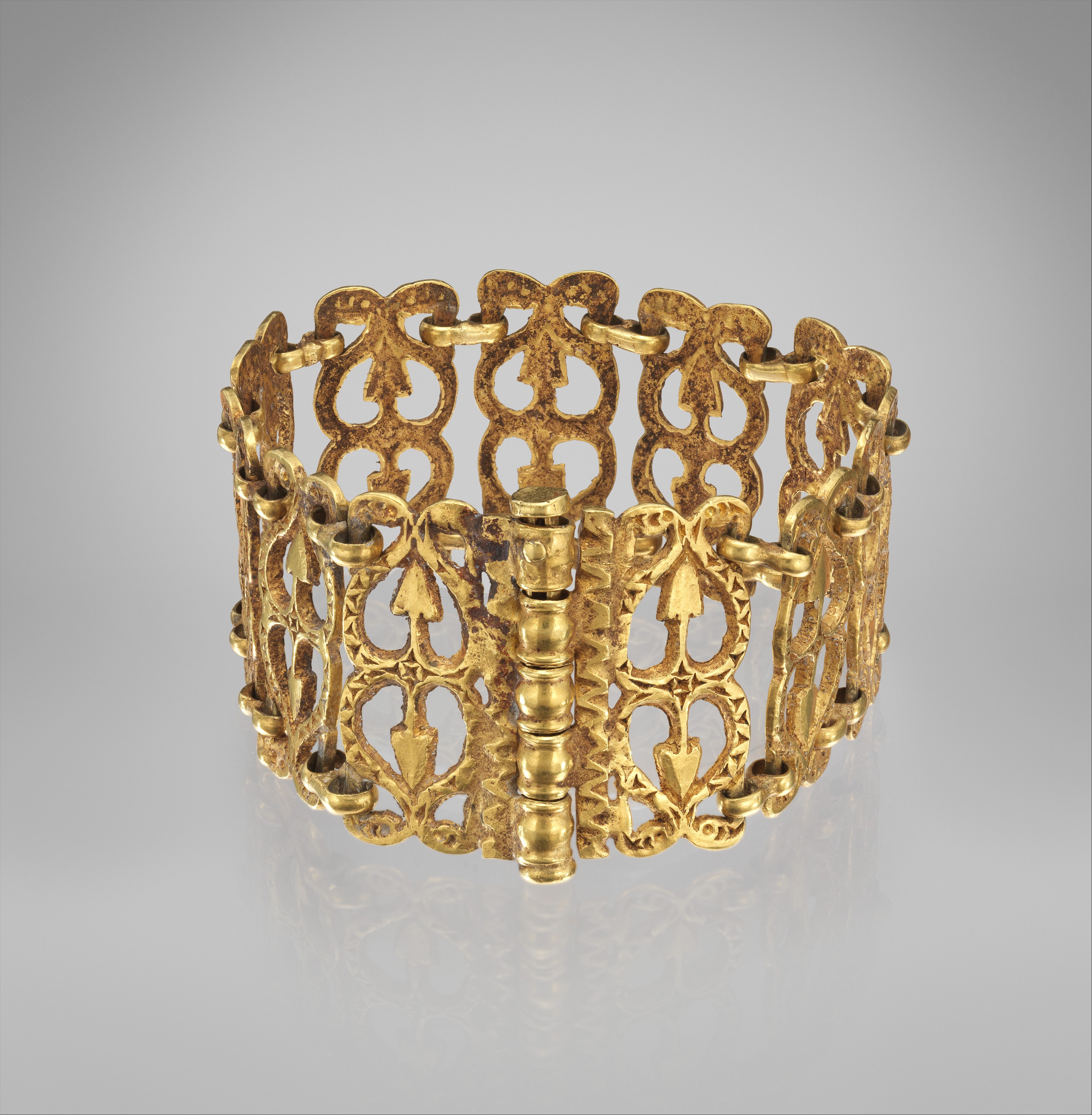
Heritage Analysis: The Byzantine Gold Bracelet and the Dialectics of Light and Legacy
At Katherine Fashion Lab, our research mandate extends beyond the mere cataloging of historical artifacts. We seek to decode the genetic memory embedded within adornment—the way metal, form, and iconography carry the psychological and spiritual DNA of a civilization. The Byzantine gold bracelet, a cylinder of hammered light and intricate repoussé, serves as a profound case study in this endeavor. Its resonance with our concurrent study of the Mirror with Split-Leaf—a dichotomy of polished silver reflecting the present and cold stone narrating the past—illuminates a core tension in luxury: the perpetual dialogue between ephemeral reflection and eternal inscription. This analysis will dissect the bracelet’s symbolic power, its role in historical adornment, its spiritual architecture, and translate these findings into a decisive 2026 high-end luxury strategy.
I. Symbolic Power: The Imperial Codification of Light
In the Byzantine court, gold was not merely a precious metal; it was a theological substance. The bracelet, often worn in pairs or as part of a broader armilla set, was a portable assertion of divine mandate. The Byzantine Emperor was considered God’s viceroy on Earth, and his body—when adorned—became a living icon. The gold bracelet encircling the wrist was a deliberate symbol of cosmic order, a closed loop representing eternity, the cyclical nature of Christ’s kingdom, and the unbroken succession of imperial power. Unlike the Roman signet ring, which denoted personal authority, the Byzantine bracelet was a collective declaration. Its weight was not a burden but an anchor, grounding the wearer in a lineage that predated and would outlast the mortal frame.
This symbolic power is distinctly different from the mirror in our parallel study. The silver mirror reflects the transient, mutable self—the face of the present moment. The gold bracelet, however, does not reflect; it absorbs and emits. It projects an idealized, fixed persona onto the world. Where the mirror is subjective, the bracelet is objective. It tells the observer, "Here stands a person of consequence, not because of what they see, but because of what they represent." For Katherine Fashion Lab, this translates into a luxury strategy that moves away from "self-expression" and toward "self-ascension." The 2026 client does not want to see themselves; they want to see who they are becoming.
II. Historical Adornment: The Architecture of the Body
Historically, the Byzantine gold bracelet was engineered with a specific spatial intelligence. It was not designed to dangle or draw attention through movement, as in later Baroque periods. Instead, it was a rigid, architectural band that disciplined the wrist and elongated the line of the arm. The use of opus interrasile (openwork) or heavy repoussé created a play of light and shadow that made the metal appear to breathe. This was a strategic choice: the bracelet was meant to be seen in the context of ceremonial stillness—during processions, liturgical rites, or imperial audiences. The flicker of candlelight across its surface was a calculated effect, turning the wearer into a lumen Christi, a bearer of holy light.
The contrast with the stone sarcophagus in our research is stark and instructive. The sarcophagus is the final, immobile architecture of death—a permanent house for the body. The bracelet is the mobile architecture of life—a temporary house for the soul’s authority. Both are "containers," but the bracelet is a dynamic container. It allows the wearer to move through the world while maintaining the gravitas of a monument. In our 2026 strategy, this informs a design philosophy of "wearable monumentality." We must craft pieces that give the wearer the psychological posture of a statue—grounded, unshakeable—without sacrificing ergonomic comfort. The bracelet should feel like a piece of a palace, not a piece of jewelry.
III. Spiritual Meaning: The Liturgy of Adornment
The spiritual dimension of the Byzantine bracelet cannot be overstated. It was often inscribed with prayers, Christian monograms (such as the Chi-Rho), or depictions of saints. This transformed the object from a secular status symbol into a devotional instrument. The bracelet served as a physical prayer wheel, a tactile reminder of one's covenant with God. The act of clasping it or feeling its weight against the pulse point was a form of kinetic meditation. It synchronized the wearer’s heartbeat with the rhythm of the divine liturgy. This is the pinnacle of "adornment as armor"—not against physical weapons, but against spiritual despair and moral decay.
This spiritual resonance aligns with our study's theme of the "life narrative told in relief." The cold stone sarcophagus tells the story of a life after death, in static, carved prose. The gold bracelet tells the story of a life before death, in dynamic, metallic verse. It is a pre-emptive celebration of one's own legacy. For the modern luxury consumer, this translates into a craving for objects of protection and intention. The 2026 market is saturated with mass-produced "wellness" accessories, but there is a distinct void for objects that carry sacramental weight. Katherine Fashion Lab must position its heritage pieces not as "jewelry" but as reliquaries for the self—vessels that hold the wearer’s personal creed, ambition, and spiritual fortitude.
IV. 2026 High-End Luxury Strategy: The Synthesis of Mirror and Stone
The strategic imperative for Katherine Fashion Lab is to synthesize the two opposing artifacts of our research—the silver mirror and the gold bracelet—into a cohesive brand narrative. The mirror represents the digital, ephemeral, and hyper-personalized luxury of the recent past. The bracelet represents the analog, eternal, and hierarchical luxury of the deep past. The 2026 consumer is fatigued by the former and intimidated by the latter. Our strategy must bridge this gap.
Strategic Pillar 1: The "Legacy Loop" Collection
We will launch a capsule collection of gold bracelets, each echoing Byzantine construction techniques but reimagined for modern ergonomics. The design will feature a dual-face concept: an exterior of polished, reflective gold (the "mirror" for the world) and an interior of matte, textured gold with engraved, personalized "life codes" (the "sarcophagus" for the self). This creates a literal DNA correlation: the exterior is the public narrative, the interior is the private truth. This is not jewelry; it is a portable biographical archive.
Strategic Pillar 2: The "Ritual of Investiture" Experience
Luxury in 2026 must be experiential and ceremonial. We will develop a private client ritual, wherein the purchase of a heritage bracelet is accompanied by a "Liturgy of Light" session. This involves a consultation where a curator inscribes the client’s personal "creed" onto the inner band—not a monogram, but a philosophical or aspirational phrase. The act of wearing the bracelet becomes a daily reaffirmation of this creed. This moves the product from commodity to sacrament, creating a moat of emotional loyalty that mass-market competitors cannot breach.
Strategic Pillar 3: Anti-Digital Positioning
While the mirror symbolizes the "selfie" culture, the bracelet symbolizes the "self-possession" culture. Our marketing will explicitly pivot away from social validation metrics. We will position the bracelet as an anti-influencer device—an object of quiet, imperial confidence that does not ask for attention but commands it through presence. This is a contrarian play, but it is precisely the contrarianism that the high-net-worth individual of 2026 will reward. They are seeking refuge from the noise, and the Byzantine bracelet, with its millennia of silent authority, is the perfect sanctuary.
Conclusion: The Golden Constant
The Byzantine gold bracelet is not a historical artifact; it is a philosophical constant. It teaches us that true luxury is not about reflecting the world but about projecting a world. It is about the weight of intention, the architecture of the body, and the liturgy of daily life. As Katherine Fashion Lab moves toward 2026, we must abandon the transient allure of the polished mirror and embrace the enduring gravity of the golden band. We will not sell bracelets; we will sell investitures of power. We will not adorn wrists; we will coronate them. This is the heritage we carry, and this is the future we forge.