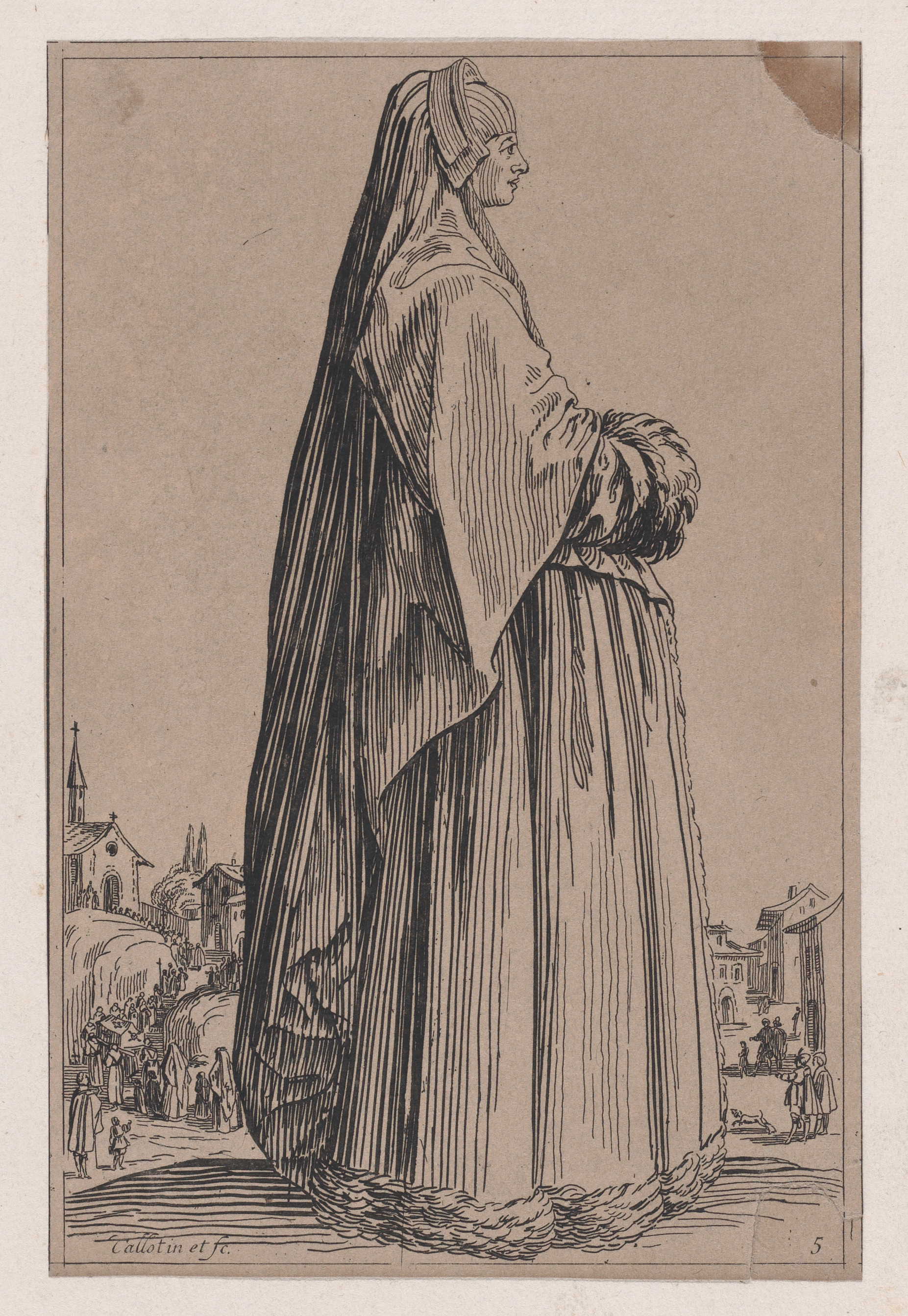
A Study in Restraint: Deconstructing the Couture of La Dame Coiffée d'un Grand Voile
In the rarefied atmosphere of haute couture, where novelty often masquerades as innovation, there exists a profound power in the archival. At Katherine Fashion Lab, our curatorial lens is trained not merely on the garment, but on the semiotics of dress—the silent language of silhouette, texture, and drape that speaks across centuries. The subject of this analysis, a standalone etching titled La Dame Coiffée d'un Grand Voile et a la Robe Bordée de Fourrures, from the series La Noblesse, is not a dress. It is a thesis. This 17th-century French engraving offers a masterclass in the architecture of aristocratic presence, distilling the essence of nobility into a single, static figure whose garments perform a complex choreography of power, piety, and patrician taste.
To the contemporary eye, accustomed to the relentless exposure of the body and the democratization of luxury, this image initially reads as austere. Yet, within its severe geometry lies the blueprint for a form of sartorial sovereignty that modern design frequently fails to replicate. The etching is not a faithful representation of a specific gown, but rather an idealized typology—a codified representation of status. It is a precursor to the fashion plate, a didactic tool that instructs the viewer on the visual grammar of rank. Our analysis will dissect this print into three primary couture components: the monolithic silhouette, the textural narrative of fur and fabric, and the subversive power of the veil.
The Monolithic Silhouette: Architecture as Identity
The most arresting feature of the etching is the overwhelming, almost architectural verticality of the figure. The lady’s form is subsumed beneath a robe that falls in unbroken, columnar folds from the shoulders to the floor. This is not the cinched, eroticized waist of later Rococo periods; nor is it the exaggerated panniers of the 18th century. Instead, we witness a deliberate erasure of the physical body in favor of a symbolic one. The gown functions as a mobile fortress, projecting an aura of unassailable dignity. In couture terms, this is the ultimate expression of the grande horizontale inverted—a vertical axis of power that elongates the figure into a near-spiritual monument.
For the modern atelier, this silhouette presents a radical departure from the body-conscious draping that dominates contemporary red carpets. The Katherine Fashion Lab interpretation of this study focuses on the engineering of volume without bulk. The etching reveals a fabric that is heavy, likely a wool or a rich silk velvet, yet it hangs with a mathematical precision. The folds are not random; they are deep, parallel channels that create a rhythm of light and shadow. This is the art of the plissé taken to a structural extreme. The garment’s hem, barely visible, suggests a train of considerable length, adding to the processional quality of the wearer’s implied movement. This is not clothing for action; it is clothing for presence, for the slow, deliberate procession through the halls of power.
Textural Juxtaposition: The Fur Trim as a Marker of Dominion
The title explicitly references a “Robe Bordée de Fourrures” (fur-lined robe), and it is this detail that elevates the garment from mere modesty to overt declaration of wealth. In the etching, the fur is not a fluffy, tactile appendage; it is rendered as a dense, dark border that traces the neckline and falls vertically down the center front of the gown. This is not trim in the decorative sense; it is a structural frame. The fur acts as a visual anchor, drawing the eye downward and reinforcing the verticality of the silhouette. It creates a stark chiaroscuro effect, contrasting the deep black of the fur with the lighter, hatched lines of the fabric, suggesting a play of textures that is both sensual and severe.
From a couture perspective, the use of fur here is a study in material hierarchy. It signals access to exotic trade routes and immense disposable income. But more importantly, it demonstrates a sophisticated understanding of tactile contrast. The smooth, sober surface of the robe is violently juxtaposed with the implied softness and density of the pelt. This is a lesson in restraint: the fur does not cover the body; it merely outlines it, creating a negative space that amplifies the wearer’s form. In our lab, we deconstruct this principle using modern, ethical materials—high-pile faux furs, sheared mink, or even sculpted leathers—to recreate that same tension between austerity and opulence. The key is not the material itself, but the discipline of placement. The trim must function as a line of demarcation, defining the boundaries of the garment and, by extension, the personal space of the wearer.
The Veil: A Study in Concealment and Revelation
Perhaps the most intellectually complex element of the etching is the grand voile (long veil). This is not a diaphanous, romantic wisp of fabric. The etching depicts it as a substantial, opaque cloth that completely covers the hair, falling down the back and merging with the robe. It is a garment of absolute concealment, yet paradoxically, it draws more attention to the wearer than any décolletage ever could. The veil erases individuality, replacing the specific identity of the woman with the universal archetype of the Noble Lady. It is a tool of anonymization, which, in the context of nobility, is the ultimate privilege—to be recognized not as a person, but as an institution.
In the context of contemporary fashion, the veil is often misread as a symbol of oppression. However, a couture analysis must consider its agency. This veil is a choice, a performance of modesty that is, in reality, a display of power. By shrouding her features, the lady creates a void that demands projection. She becomes a canvas for the viewer’s assumptions about her lineage, her piety, and her wealth. The veil is a barrier, but it is also a lure. It forces the observer to focus solely on the architecture of the garment, on the impeccable fall of the fabric, and the pristine line of the fur. The face is irrelevant; the dress is the identity.
For Katherine Fashion Lab, this translates into a design philosophy that prioritizes the sculptural over the anatomical. We explore veils and hoods not as religious artifacts, but as high-fashion statements of introversion and control. A modern interpretation might use a stiffened silk organza to create a veil that stands away from the head, creating a halo of negative space. The goal is to recreate that sense of majestic detachment—a visual quietude that screams louder than any print or embellishment.
Conclusion: The Enduring Relevance of the Ethereal
The etching of La Dame Coiffée d'un Grand Voile is a relic, yet its design principles are profoundly contemporary. It rejects the ephemeral in favor of the eternal. In an era of fast fashion and fleeting trends, this image serves as a corrective, reminding us that true couture is an exercise in deliberate editing. The garment is not an accessory to the body; it is the primary text, and the body is merely the vehicle for its display.
At Katherine Fashion Lab, we view this etching as a foundational document. It teaches us that luxury is not about exposure, but about curated concealment. It demonstrates that the most powerful statement a designer can make is to remove, to simplify, and to let the integrity of the material and the precision of the line carry the message. The Lady in the etching is not dressed for a ball or a banquet; she is dressed for eternity. By studying her, we learn to design not just for the client of today, but for the legacy of tomorrow. The fur, the veil, and the monolithic robe are not historical curiosities; they are eternal archetypes of sartorial gravitas, waiting to be re-engineered for the modern muse who understands that true power is worn, not spoken.