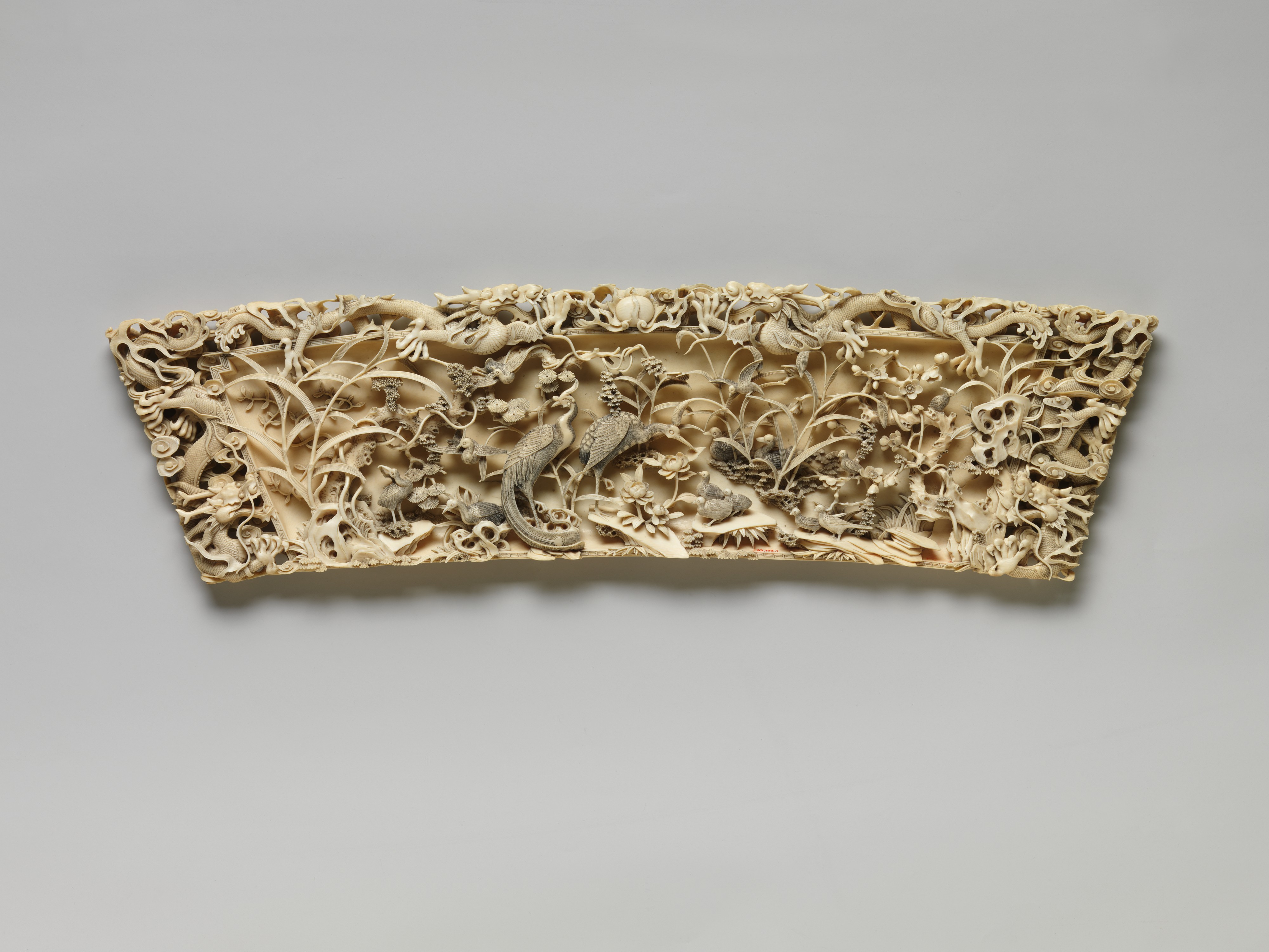
Heritage Analysis: The Imperial Avian Tableau
This ivory plaque, originating from Qing-dynasty China, is not merely an ornamental object but a condensed manifesto of imperial cosmology, social hierarchy, and spiritual aspiration. For Katherine Fashion Lab, this artifact serves as a strategic blueprint for a 2026 luxury collection that transcends aesthetic appropriation, offering a lexicon of power, protection, and precision. The composition—a dragon coiled amidst pheasant, quail, and other avian forms set against bamboo and plum blossom—is a sophisticated visual code that demands deep hermeneutic unpacking before translation into high-end wearable art.
Symbolic Power: The Hierarchical Grammar of Feather and Scale
The plaque operates within a strict Confucian semiotic system where each creature occupies a designated rank. The dragon, or long, is the paramount symbol of masculine imperial authority, representing the Emperor’s cosmic mandate and the dynamic, generative force of the yang principle. Its presence on the plaque is not decorative but declarative, asserting dominion over the natural and political order. In contrast, the pheasant (or zhiji) is the emblem of the Empress and the civil bureaucracy’s highest echelons, symbolizing literary refinement, beauty, and the sun’s light. The quail, a less prominent but equally significant motif, denotes courage and the protective instinct of the warrior class, while also carrying connotations of domestic harmony and the harvest. The inclusion of other birds—often including the egret, mandarin duck, or magpie—extends this taxonomy, each species mapping to specific virtues: fidelity, marital bliss, or auspicious news. For a luxury brand, this is a masterclass in stratified storytelling. The 2026 strategy must not flatten this hierarchy into a generic “bird-and-dragon” print; rather, it should employ a layered narrative where the placement of a motif on a garment—at the shoulder, hem, or collar—corresponds to a deliberate power dynamic, mirroring the Qing court’s use of rank badges.
Historical Adornment: The Evolution of a Courtly Code
Historically, such plaques were integral to the bufu (mandarin square), worn by civil and military officials during court audiences. The medium—ivory with pigment—is crucial. Ivory’s luminous, bone-white surface provided a pristine canvas for mineral-based pigments (cinnabar, azurite, malachite), creating a luminous, jewel-like effect that caught candlelight in the Forbidden City’s dim halls. The carving technique, typically relief or openwork, demonstrates an extraordinary mastery of negative space, where the bamboo stalks and plum branches act as structural scaffolding for the bird figures. This is not a casual decorative craft; it is a precision engineering of form and void, executed by artisans whose workshops were state-sanctioned. For Katherine Fashion Lab, this historical context offers a critical lesson in material integrity and provenance. In 2026, the brand must pivot away from synthetic approximations. The strategy should involve sourcing ethically certified, museum-grade alternative materials (e.g., Tagua nut, bone china, or bio-resin) that replicate ivory’s optical density, while explicitly honoring the artifact’s provenance through a digital heritage tag. The historical adornment is not about replication but about transubstantiation—translating the tactile gravity of carved ivory into the weight of a silk faille or the structural drape of a sculpted wool crepe.
Spiritual Meaning: The Daoist Resonance of Resilience
Beyond the political, the plaque is saturated with Daoist and Buddhist spiritual symbolism. The bamboo is the quintessential emblem of the junzi (the noble person), bending without breaking, signifying integrity, humility, and resilience. The plum blossom, blooming in late winter, represents the triumph of purity and hope over adversity, a metaphor for inner strength emerging from harsh conditions. Together, they form a visual mantra for sustainability—not in the environmental sense alone, but as a spiritual endurance. The dragon, despite its imperial ferocity, is also a water deity, a bringer of rain and fertility, connecting the celestial to the terrestrial. The birds, perched or in flight, bridge the earthly plane (bamboo) and the celestial (sky), acting as psychopomps for the soul’s ascent. For a 2026 luxury strategy, this spiritual layer is the emotional differentiator. The modern high-end consumer is not buying a garment; they are acquiring a talisman. The plaque’s spiritual meaning can be translated into a sensory experience: a cashmere coat with a woven bamboo lattice that stiffens at the shoulder (resilience), a silk gown with a plum blossom embroidery that appears only under UV light (hidden purity), or a jewelry capsule where the dragon is rendered as a subtle, protective clasp on a necklace. The brand must market this not as “Eastern mysticism” but as a universal philosophy of grace under pressure, aligning with contemporary wellness and mindfulness trends.
2026 High-End Luxury Strategy: From Artifact to Archetype
The strategic translation of this plaque for Katherine Fashion Lab’s 2026 line requires a three-pronged approach: Deconstruction, Recontextualization, and Scarcity Marketing.
Deconstruction: The Modular Motif System
Do not reproduce the plaque wholesale. Instead, deconstruct it into a modular design system. The dragon’s scale pattern becomes a micro-jacquard texture. The pheasant’s tail feathers are elongated into a dramatic train. The bamboo is abstracted into a geometric, architectural seam line. The plum blossom becomes a singular, oversized crystal brooch. This allows for versatile product categories—from a $2,000 silk scarf with a single quail feather print to a $45,000 bespoke evening gown with a hand-embroidered dragon in 18-karat gold thread. The hierarchy of motifs should be reflected in price architecture: the dragon is the apex, reserved for haute couture; the pheasant for ready-to-wear; the quail for accessories. This creates a purchasing ladder that gamifies collection, encouraging repeat patronage.
Recontextualization: The Modern Court
Position the collection as “The Modern Court,” where the wearer is the sovereign of their own domain. The marketing narrative should pivot from historical China to a global, futuristic aesthetic. Use AI-generated campaign visuals that place the motifs on abstract, metallic landscapes, not literal pagodas. The color palette should be pulled from the plaque’s pigments—cinnabar red, azurite blue, malachite green—but applied to technical fabrics like bonded neoprene or liquid satin. Collaborations with contemporary Chinese artists who reinterpret the bufu tradition in a digital-native style will generate cultural cachet and avoid accusations of static Orientalism. The brand must also engage in philanthro-capitalism: a percentage of proceeds funds the conservation of Qing-dynasty ivory carvings in museums, directly addressing the ethical concerns of the original medium.
Scarcity and Provenance
High-end luxury in 2026 will be defined by verifiable scarcity. Each garment will include a blockchain-based NFC chip that traces its design lineage to this specific plaque, complete with high-resolution scans and historical annotations. Production will be limited to 2026 pieces globally, mirroring the plaque’s original singular status. The brand should host private viewings in museum spaces, not retail stores, where the physical artifact is displayed alongside the new collection, creating a powerful aura of continuity. This is not a “capsule” but a permanent heritage pillar, refreshed annually with a new motif from the original plaque.
Conclusion: The Plaque as Strategic Compass
The plaque with dragon, pheasant, quail, and bamboo is a microcosm of Chinese imperial thought—a system where every element has a function, a rank, and a spiritual resonance. For Katherine Fashion Lab, its value lies not in its aesthetic surface but in its operational logic. By decoding its hierarchical grammar, honoring its material history, and translating its spiritual core into a contemporary ethos of resilience, the brand can create a 2026 collection that is intellectually rigorous, emotionally resonant, and commercially astute. The ultimate luxury is not ornamentation; it is the confidence to wear a story of cosmic order, adapted for the individual sovereign. This plaque is not a relic; it is a roadmap.