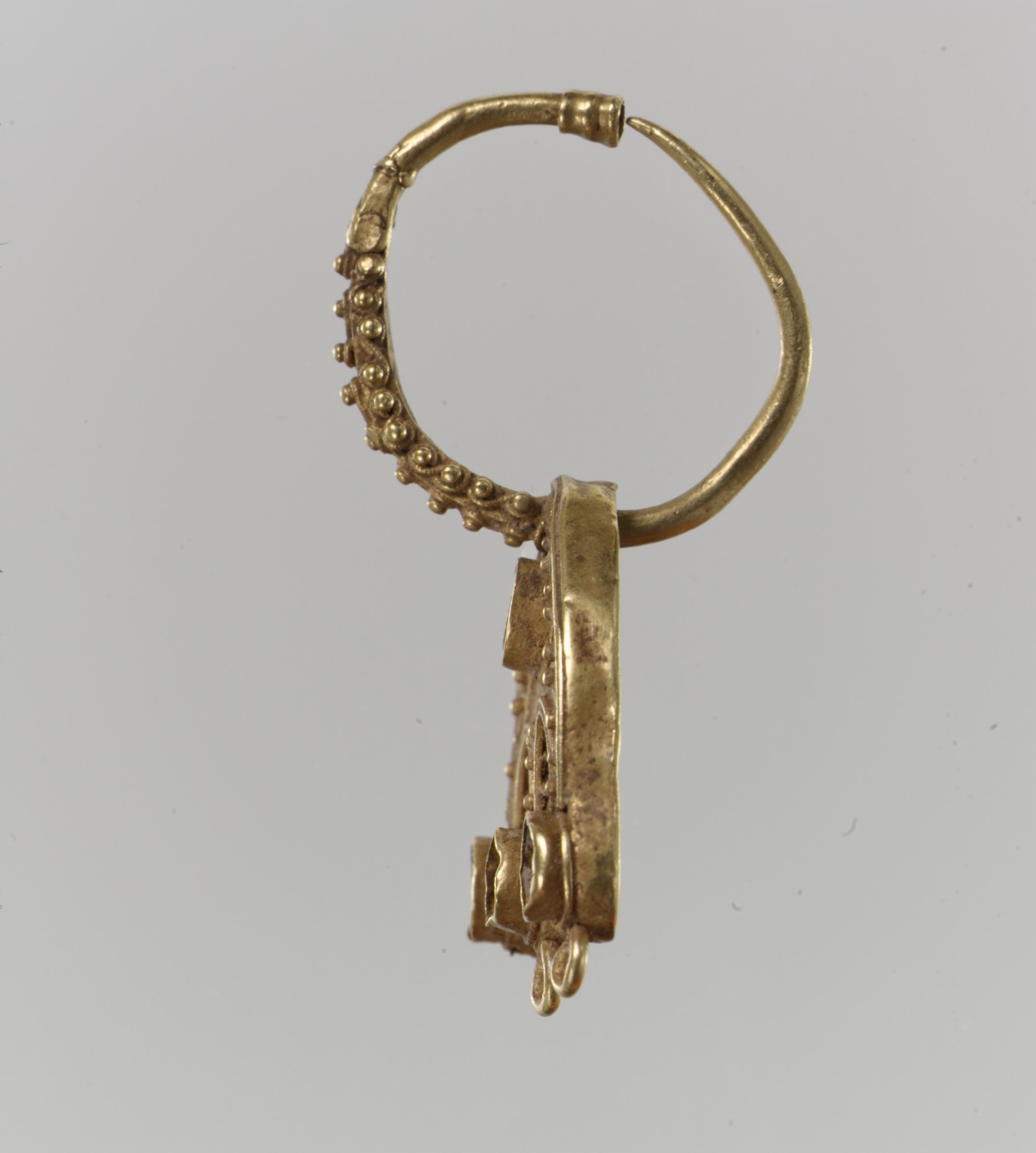
Earring: The Architectonics of Eternity
In the curated silence of the Katherine Fashion Lab archive, an object asserts its presence not through volume, but through density. It is an earring, a singular proposition in gold, whose lineage is deliberately dual: the structured opulence of Byzantium and the migratory, transformative energy of the Langobardic tradition. This is not a piece of jewelry; it is a portable monument, a compressed thesis on the dialogue between surface and depth, the ephemeral and the eternal. Its material, gold, is the constant—the divine metal that refuses corruption, the ultimate signifier of permanence across both civilizations. Yet, its true context is unlocked by its archival DNA: "一面是光洁银镜上以黄金镶嵌的纷繁棕叶纹,另一面是冰冷石棺板上以浮雕诉说的生命叙事" ("On one side, the intricate palmette motifs inlaid in gold on a smooth silver mirror; on the other, the narrative of life told in relief on a cold stone sarcophagus panel"). This dialectic between the mirror and the sarcophagus, the reflective adornment of life and the carved memory of death, forms the core of our analysis.
Byzantine Surface: The Theology of Light and Pattern
The Byzantine contribution to this earring’s DNA is one of cosmological order and radiant hierarchy. The "smooth silver mirror" referenced is the foundation: a perfect, unblemished plane representing the celestial firmament or the purified soul. Upon this, the "intricate palmette motifs inlaid in gold" are not mere decoration; they are a sacred grammar. The split-palmette, or anthemion, is a classical motif theologized by Byzantium. Its rhythmic, radiating fronds symbolize the eternal, unfolding life of paradise, a vegetative motif divorced from earthly decay and rendered in the incorruptible medium of gold.
In our earring, this translates to a front-facing, declarative architecture. Imagine a central axis, perhaps a vertical bar or a rounded form, serving as the "mirror." Upon it, gold is not simply applied but architectonically structured using techniques like opus interrasile (openwork piercing) or cloisonné, creating a lace-like effect of light and shadow. The pattern is symmetrical, hierarchical, and designed to catch and refract light in a controlled, dazzling display. This is adornment as a spiritual act: the wearer becomes a bearer of a microcosmic, ordered universe, her movement causing a kinetic play of light that mimics the divine energy (energeia) understood to permeate creation. The surface is everything—a complex, impenetrable, and glorious facade that communicates status and piety directly to the observer.
Langobardic Depth: The Narrative of Material and Journey
If Byzantium offers the theology of the surface, the Langobardic spirit injects the narrative of the depth and the journey. The "cold stone sarcophagus panel" evokes the Langobardic mastery of sculptural, narrative relief—a tradition less about abstract cosmic reflection and more about storytelling, memory, and interfacing with powerful materials. Langobardic goldsmithing, seen in grave goods and ceremonial cross-cultural objects, is tactile, textured, and often carries a narrative of transformation.
This influence manifests in the earring’s structural audacity and tactile materiality. The gold here is not just a sheet for patterning; it is wire twisted into intricate filigree cages, granules fused in complex clusters (granulation), or hammered into repoussé forms that push out from the back to create a low relief on the front. This is the "relief" narrative. The design may incorporate interlacing beasts or geometric knots—motifs that speak of migration, interconnection, and the binding of forces. The form might be more modular, less rigidly symmetrical, suggesting assembly and adaptability. Crucially, the piece has a pronounced three-dimensionality and weight; it is an object to be felt by the wearer, its presence a tangible reminder of lineage, journey, and the physical body it adorns. It acknowledges the sarcophagus—the end of the journey—by celebrating the intricate, woven path of life itself.
Synthesis: The Dialectic of the Adorned Self
The genius of this Katherine Fashion Lab piece lies in its non-resolution of these two heritages. It holds them in a fertile, tense synthesis. The earring presents a Janus-faced identity: one aspect, the polished, radiant, palmette-adorned face for the public gaze (the mirror); the other, a more textured, intricate, perhaps slightly more organic reverse, meant to be known intimately by the wearer and the divine (the sarcophagus panel facing the eternal).
This creates a profound statement on the adorned self. The wearer is simultaneously:
The Icon and the Chronicler: She presents a perfected, luminous image to the world (Byzantine iconicity), while carrying a personal, complex narrative of experience and origin (Langobardic historicity).
The Reflector and the Relic: The piece functions as a mirror, amplifying the wearer's social and spiritual light, while also possessing the enduring, artifact-like quality of a relic, meant to outlive the moment and speak across time.
The material execution would be a masterclass in contrast: flawless millgrain edges beside deliberately irregular granulation, mirror-polished gold curves against matte, chased textures. It would feel substantial, a deliberate weight that commands awareness—a memento mori in the guise of a luxury. In wearing it, one does not simply accessorize; one embodies a critical dialogue between the desire for eternal, radiant order and the acceptance of a beautiful, complex, and mortal journey.
Conclusion: Beyond Ornament, A Philosophical Object
This earring, as conceived through the lens of its archival DNA, transcends its category. It is a concisely rendered philosophical argument. The Byzantine and Langobardic strands are not blended but are placed in a deliberate, productive opposition, much like the mirror and the sarcophagus are two sides of the same human condition. The gold is the constant medium through which this dialogue is conducted—a material that signifies both temporal power and timeless value.
For Katherine Fashion Lab, this analysis posits that true couture is not merely about historical reference or material splendor. It is about vestimentary intelligence—the encoding of complex cultural and existential dialogues into a form that is worn on the body. This earring is a manifesto: beauty is found not in choosing between the mirror and the sarcophagus, between the surface pattern and the deep narrative, but in the courageous act of wearing both, thereby composing a more complete, resonant, and intellectually formidable vision of the self.