Executive Summary: Recontextualizing Ancient Adornment for Contemporary Luxury
This strategic standalone research paper, prepared for Katherine Fashion Lab, conducts a heritage analysis of the pendant and necklace form, tracing its origins to ancient civilizations. By deconstructing the symbolic, material, and spiritual codes embedded in artifacts of gold, enamel, and precious gemstones—rubies, diamonds, and emeralds—we establish a foundational lexicon for a 2026 high-end luxury strategy. The analysis posits that in an era defined by experiential value and narrative depth, the most potent luxury propositions are those that transcend mere ornamentation to become wearable archives of meaning. This document outlines how KFL can leverage this ancient heritage to create pendants and necklaces that function as strategic assets, commanding authority in the ultra-luxury segment through a synthesis of symbolic power, historical consciousness, and spiritual resonance.
Archaeology of Adornment: The Pendant as Primordial Power Object
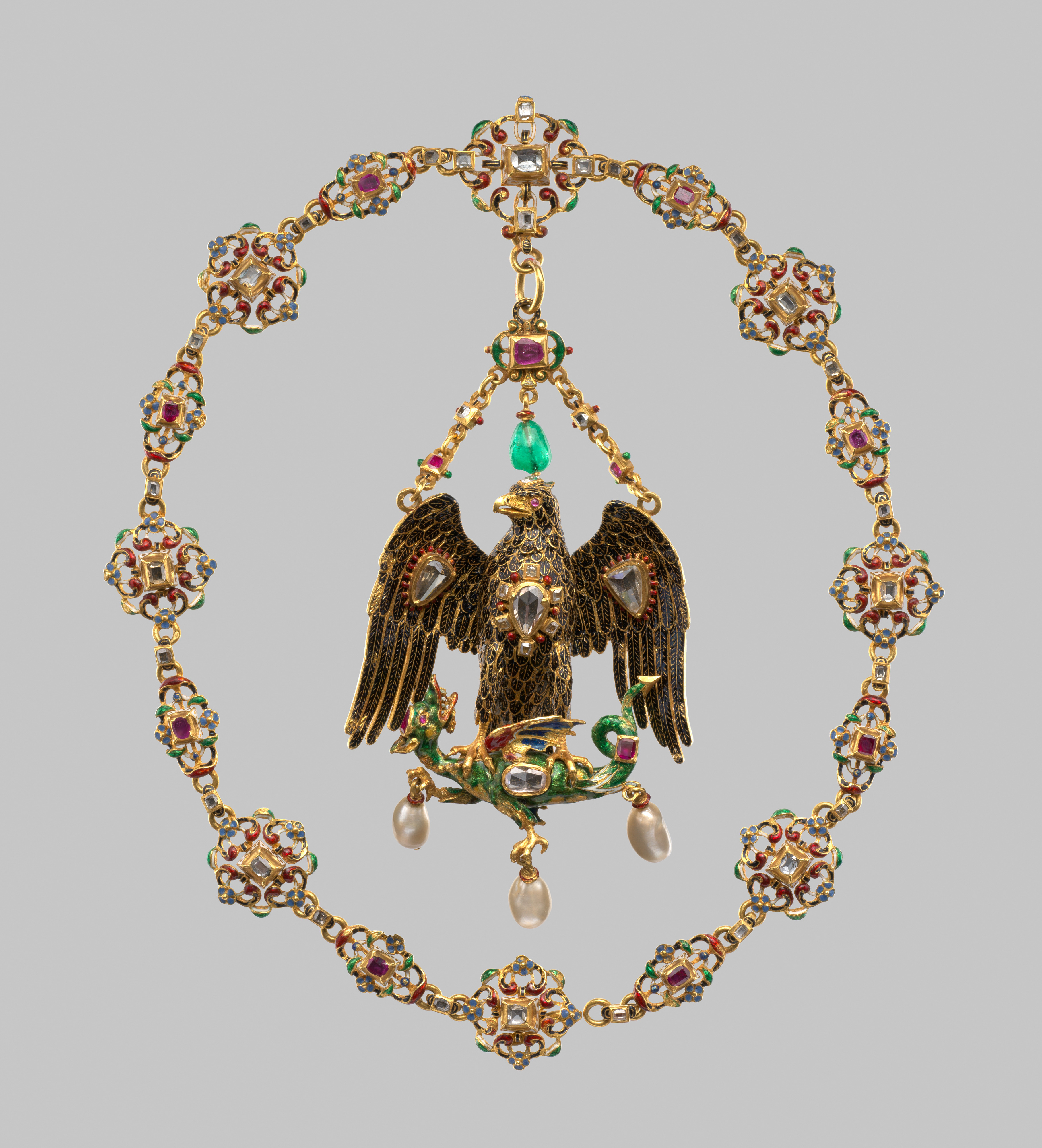
In the context of ancient civilizations, from Mesopotamia and Egypt to the Indus Valley and Mesoamerica, the pendant was rarely a simple decorative item. It was a concentrated nexus of power, a portable insignia of status, belief, and identity. Worn close to the heart and throat—centers of life and expression—it served as a personal talisman and a public declaration. The materials specified—gold, enamel, rubies, diamonds, and emerald—were not chosen for aesthetic appeal alone but for their intrinsic cosmological properties. Gold, incorruptible and solar, symbolized immortality and divine favor. Enamel, with its vitreous fusion of mineral and fire, represented transformation and the artistry of capturing light. This foundational understanding frames the pendant not as jewelry, but as a condensed universe, a principle upon which KFL's modern creations can be consciously built.
Decoding the Material Lexicon: Gold, Enamel, and the Sacred Triad of Gems
The material palette is a direct inheritance of royal and sacerdotal adornment. Gold functioned as the skin of the gods, a material so associated with permanence and celestial power that its use was often restricted by sumptuary laws. Its malleability allowed for the encapsulation of complex symbolism. Enamel, particularly in Byzantine and later European traditions, provided a chromatic language to illustrate narratives, heraldry, and sacred iconography upon the gold ground, adding layers of literal and figurative meaning.
The gemstone triad—ruby, diamond, emerald—forms a potent symbolic syntax. In ancient Indian and Persian traditions, the ruby (ratnaraj, king of gems) was the stone of life, blood, and sovereign power, believed to hold an inextinguishable inner flame. The diamond, revered in India long before its European popularity, was the ultimate symbol of invincibility, clarity, and enlightenment due to its unmatched hardness and refractive qualities. The emerald, deeply sacred to Egyptians (associated with fertility and rebirth) and later the Incas (where it was the stone of the goddess Umina), represented the eternal vitality of the natural world. Together, they map a spectrum of power: ruby (passion/dominance), diamond (purity/strength), emerald (renewal/wisdom).
The Strategic Pillars: From Ancient Symbolism to 2026 Luxury Codes
For Katherine Fashion Lab's 2026 strategy, this heritage is not a museum relic but a living strategic resource. The modern luxury consumer, particularly in the high-net-worth segment, seeks objects with gravitas, authenticity, and a story that resonates on a personal level. The ancient pendant provides the blueprint for this depth.
Symbolic Power & Modern Heraldry
Ancient pendants were wearable heraldry, denoting lineage, allegiance, and achievement. The 2026 opportunity lies in creating modern heraldry for a global elite. This moves beyond monogramming to embedding personalized symbolic narratives. A KFL pendant could integrate client-specific motifs—abstracted references to a personal milestone, a familial legacy, or a philosophical belief—rendered in the ancient language of enamel micro-painting or gemstone arrangement. The piece becomes a unique cipher, a badge of individual sovereignty rather than generic brand affiliation.
Spiritual Meaning & The Sanctuary Object
In a secular yet spiritually seeking age, luxury is increasingly framed around wellness, mindfulness, and personal sanctuary. The talismanic function of the ancient pendant is directly relevant. KFL can engineer pieces that serve as contemporary sanctum objects. This involves intentional design: perhaps a pendant that opens to reveal a miniature, serene enamel scene or a secret compartment for a meaningful inscription; the strategic setting of stones based on historical beliefs in their protective or clarifying energies (e.g., an emerald "heart," flanked by diamond "clarity" and ruby "vitality"). The narrative shifts from "owning a jewel" to "carrying a personal sanctuary."
Historical Adornment & The Artisanal Algorithm
The reverence for historical craftsmanship is paramount. KFL's strategy must visibly engage with, and innovate upon, ancient techniques. This means championing the artisanal algorithm—where advanced design tools are used to conceive forms impossible in antiquity, but executed with hyper-attenuated, historically referenced craftsmanship. Imagine a pendant featuring a micro-mosaic enamel pattern derived from a Mesopotamian cylinder seal, reconstructed via 3D modeling but laid by hand using millennia-old glass-fusing techniques. Or a diamond pavé set in a pattern that replicates the lost-wax casting texture of ancient Etruscan gold. This creates a tangible dialogue across time, justifying ultra-luxury price points through irreproducible knowledge and time.
2026 High-End Luxury Strategy: The Katherine Fashion Lab Protocol
To operationalize this heritage, KFL will implement a three-phase protocol for its pendant and necklace collection, positioning it as a standalone pillar of intellectual luxury.
Phase 1: The Archive & Abstraction. Establish an internal "Symbolic Archive" of motifs, material meanings, and forms from a curated set of ancient civilizations. Designers and client advisors will be trained in this symbolic language. New designs will begin as historical references, then abstracted into minimalist, architectural forms that carry the essence, not the literal replica, of the source.
Phase 2: The Bespoke Narrative Engine. Develop a confidential client journey for high-value commissions centered on "Narrative Mapping." Through curated conversations, a client’s personal story is translated into a symbolic brief—selecting relevant ancient motifs, a material palette with intentional symbolism, and a structural concept (e.g., a transforming pendant, a layered necklace telling a sequential story).
Phase 3: The Cultured Launch. Market launches will be partnered with cultural institutions (e.g., exhibitions on ancient jewelry at the Met or the British Museum). Each collection will be accompanied by a serious, white-paper-like monograph explaining its historical inspiration and symbolic research, targeting the "philosopher-consumer" who buys with both emotion and intellect.
Conclusion: The Pendant as Portable Legacy
For Katherine Fashion Lab, the ancient pendant is a strategic archetype. It teaches that the most powerful adornment operates on multiple planes: the aesthetic, the social, the spiritual, and the historical. By mastering and modernizing this complex language, KFL can create pieces for 2026 that are not merely purchased but decoded and inhabited. In a market saturated with fleeting trends, the offer of a wearable legacy—an object that connects the wearer to the deepest human traditions of meaning-making through materials of eternal significance—establishes a formidable and defensible position at the apex of the luxury landscape. The goal is to ensure that a KFL pendant is understood not as an accessory, but as an heirloom of the future, forged in the wisdom of the past.