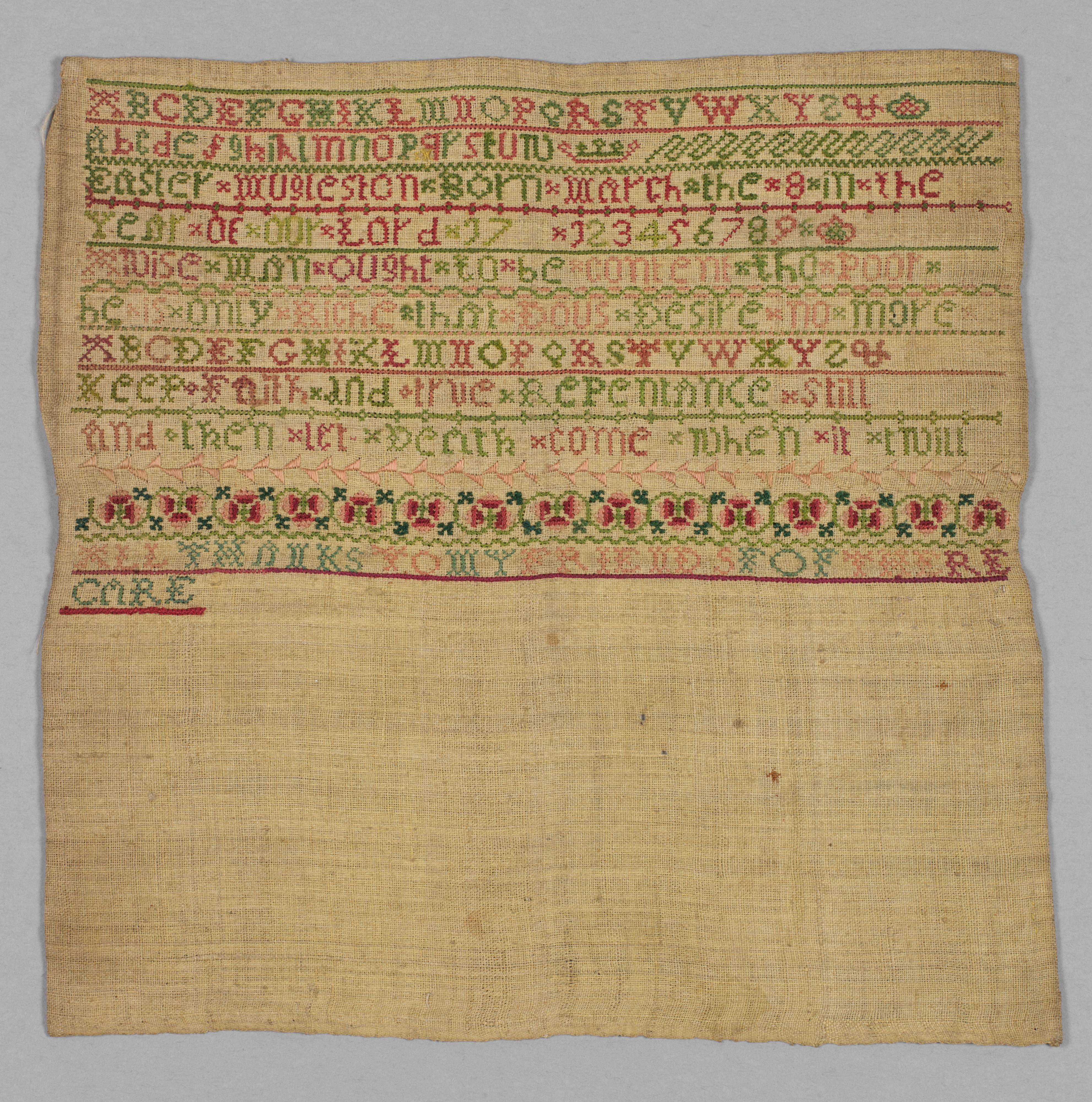
The Sampler: A Cartography of Stitch and Heritage
In the rarefied world of haute couture, where novelty is often mistaken for innovation, Katherine Fashion Lab’s latest standalone study, The Sampler, offers a profound recalibration. At first glance, the piece appears deceptively simple—a square of linen, densely worked in silk. Yet to dismiss it as mere textile craft would be to ignore a masterclass in material semiotics. The Sampler is not a garment; it is a thesis. It is a cartography of global heritage, mapped through the humble yet exacting language of the embroiderer’s needle.
This analysis dissects the work’s technical rigor, its cultural palimpsest, and its strategic positioning within the contemporary luxury landscape, arguing that Katherine Fashion Lab has transformed a pedagogical artifact of domesticity into a powerful statement on provenance, patience, and the economics of scarcity.
Deconstructing the Medium: Silk on Linen as a Dialect of Power
The choice of silk on linen is neither arbitrary nor purely aesthetic. It is a deliberate dialogue between two opposing material philosophies. Linen, derived from the flax plant, is a fiber of the earth—rugged, breathable, and historically associated with the working classes of Europe and the Levant. Silk, by contrast, is a filament of imperial luxury, spun from the cocoon of the Bombyx mori, a material that once defined the Silk Road’s economic and cultural exchanges. By marrying these two, the Lab creates a tensile friction: the sturdy, unbleached ground of the linen acts as a canvas of humility, while the silk threads—varying in sheen from matte to high-gloss—perform as calligraphic strokes of opulence.
In couture terms, this is a masterstroke of tactile hierarchy. The linen’s slubbed texture provides a visual and physical counterpoint to the silk’s fluid luminosity. The embroidery is not applied as a surface decoration but is integrated as a structural relief. The stitches—likely a combination of point de croix, chainette, and point de tige—are executed with a tension that suggests hours of obsessive calibration. Each motif is not merely drawn but sculpted, creating a topographical map of raised threads that catches light differently with every shift in viewing angle. This is not decoration; it is material storytelling.
Global Heritage: A Palimpsest of Motifs and Meanings
The true intellectual weight of The Sampler lies in its iconographic program. Unlike traditional samplers, which often served as alphabetic or numeric exercises for young women in 18th-century Europe, this piece draws from a global repository of folk symbols. One can discern the geometric diamond motifs of the Kelim weavers of Anatolia, the protective Nazar eye of the Mediterranean, the stepped pyramids of pre-Columbian Andean textiles, and the delicate floral sprigs reminiscent of Japanese Sashiko stitching. The composition is not chaotic but choreographed—a radial symmetry that anchors the eye while allowing peripheral motifs to whisper their regional origins.
This is a deliberate act of curatorial appropriation, but not in the pejorative sense. Katherine Fashion Lab does not merely borrow; it pays homage through technique. The Lab’s atelier, known for its rigorous archival research, has likely sourced stitch manuals from the V&A and the Musée du Quai Branly. The result is a lieu de mémoire—a site of memory—that collapses geographic and temporal distances. The sampler becomes a microcosm of the human impulse to adorn, to protect, and to communicate through fiber. In an era where "heritage" is often reduced to a logo or a monogram, The Sampler demands a slower, more literate form of consumption. It asks the viewer to decode, not merely to see.
Standalone Study: The Anti-Collection Statement
The context of this piece as a standalone study is critical to its commercial and artistic positioning. In the current fashion ecosystem, where the relentless pace of seasonal drops has led to what industry analysts call "collection fatigue," the standalone object offers a radical alternative. It is not a fragment of a larger narrative designed to sell multiple SKUs; it is a complete, self-contained argument. This positioning elevates the piece from product to objet d’art, a move that resonates with the growing market for "investment pieces" that transcend trend cycles.
Strategically, this allows Katherine Fashion Lab to bypass the conventional fashion calendar. The Sampler is not subject to the tyranny of Spring/Summer or Fall/Winter. It exists in a temporal vacuum, which paradoxically increases its timelessness. For the discerning collector—one who understands the difference between a luxury good and a luxury artifact—this standalone status is a powerful signifier. It signals that the Lab is confident enough in its craft to present a single work without the scaffolding of a collection. This is a bold, almost architectural approach to fashion economics, one that prioritizes depth over breadth.
The Economics of Patience and the New Scarcity
In a market saturated with mass-produced "artisanal" goods, The Sampler’s true luxury lies in its temporal cost. Conservatively, a piece of this density—assuming a stitch count of over 200,000—would require a minimum of 300 hours of handwork by a senior embroiderer. This is not a cost of materials; it is a cost of human attention. The Lab’s pricing strategy, therefore, is not based on the silk’s weight or the linen’s thread count, but on the opportunity cost of the artisan’s time. This is the new scarcity—not of resources, but of skill and patience.
Furthermore, the piece’s materiality speaks to a post-COVID, post-globalization consumer who is increasingly skeptical of opaque supply chains. By foregrounding linen (cultivated in Normandy or Flanders) and silk (sourced from ethical sericulture cooperatives in Jiangsu), the Lab offers a transparent provenance narrative. The Sampler is not just a beautiful object; it is a document of ethical labor. The buyer is not purchasing a textile; they are purchasing a piece of someone’s life, encoded in stitch. This shifts the value proposition from "what is it?" to "who made it, and how long did it take?"
Conclusion: A Quiet Revolution in Couture
The Sampler is a quiet revolution. It eschews the bombast of oversized silhouettes and the shock value of deconstruction. Instead, it finds its power in the millimeter—the precise placement of a silk thread, the tension of a knot, the rhythm of a repetitive pattern. Katherine Fashion Lab has successfully inverted the couture hierarchy, placing the embroiderer’s sampler—historically a practice piece, a learning tool—on the same pedestal as the haute couture gown. It is a feminist reclamation of a domestic craft, a globalist celebration of shared symbols, and a capitalist critique of disposability, all folded into one square of cloth.
For the MBA-minded observer, The Sampler is a case study in differentiation through craftsmanship. It proves that in a world of infinite digital reproduction, the hand-made, the slow, and the singular remain the ultimate markers of prestige. It is not merely a textile; it is a manifesto, stitched in silk, grounded in linen, and destined to be studied for generations.