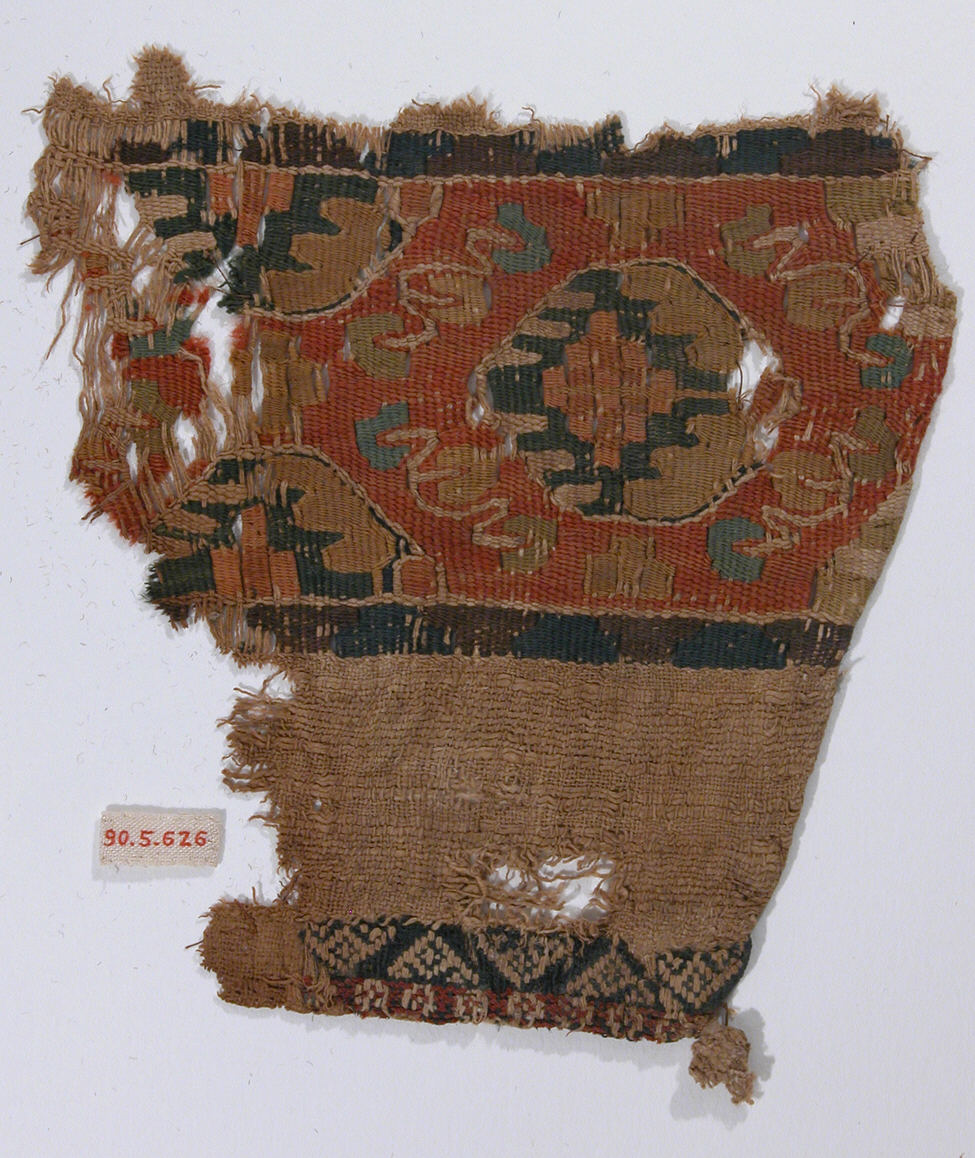
Executive Heritage Assessment: The Fragment of a Sleeve
This analysis examines a singular textile artifact—a fragment of a sleeve rendered in wool and linen, employing both plain and tapestry weaves—as a strategic lens for Katherine Fashion Lab’s 2026 luxury positioning. The fragment, attributed to an ancient civilization, is not merely a remnant of utilitarian dress but a compressed archive of symbolic power, ritual adornment, and socio-economic hierarchy. For a heritage-driven luxury house, this object offers a dual value proposition: it serves as an authentic narrative anchor and as a design lexicon for tactile, spiritual, and status-driven collections. The following research deconstructs the fragment’s historical significance and translates its intrinsic codes into actionable strategies for high-end market leadership.
Symbolic Power and Material Semiotics
The choice of wool and linen in a single sleeve is not accidental; it is a deliberate act of material storytelling. In ancient civilizations—spanning Mesopotamian, Egyptian, and Andean contexts—wool signified pastoral wealth and nomadic vitality, while linen represented agrarian purity, solar alignment, and, in many priestly traditions, a state of ritual cleanliness. The deliberate juxtaposition of these fibers within one garment fragment suggests a dual sovereignty: the wearer commanded both terrestrial resources (flocks) and celestial order (harvest, sun). For Katherine Fashion Lab, this material dialogue becomes a signature of controlled opposition—a luxury trope where contrasting textures (raw vs. refined, matte vs. lustrous) are engineered into a single silhouette. In 2026, this translates to a capsule line featuring wool-linen blend outerwear, where the tactile contrast is not hidden but celebrated as a marker of discerning taste.
Furthermore, the tapestry weave—typically reserved for decorative bands, cuffs, or heraldic motifs—elevates the sleeve from a functional limb covering to a mobile insignia of rank. Tapestry weaving is a slow, labor-intensive process; each motif required a master artisan’s hand and days of focused production. Thus, the sleeve fragment is a pre-industrial “status display” akin to a modern luxury logo, but with far greater semiotic depth. The strategic implication for Katherine Fashion Lab is to reposition embroidery and jacquard not as surface decoration but as encoded identity markers. The 2026 collection should feature “tapestry cuffs” and “narrative sleeve panels” that reference ancient motifs—ziggurat steps, lotus petals, or geometric cosmology—rendered in contemporary, abstracted forms. This allows the brand to claim heritage authenticity while remaining avant-garde.
Historical Adornment and the Body as a Sacred Site
In antiquity, the sleeve was not merely a covering; it was an extension of the body’s sacred geometry. The fragment’s cut and weave pattern likely followed the natural contour of the arm, but its decorative bands were positioned to align with the wrist and elbow—points of articulation that ancients believed were conduits for life force (prana, ka, or chi). Adornment at these joints served a prophylactic and talismanic function, warding off malevolent spirits and channeling divine favor. This perspective reframes the sleeve as a ritual apparatus, not a passive textile. For Katherine Fashion Lab, this suggests a move beyond “wearable art” toward “wearable ritual.” The 2026 high-end strategy should introduce a line of “Ritual Sleeves”—detachable, cuff-to-elbow pieces in silk, wool, and metallic threads—designed to be worn over minimalist bases. These sleeves would feature hand-knotted fringe, amuletic beadwork, and woven prayer knots, positioning the wearer as a custodian of ancient protection.
Moreover, the fragment’s plain weave base, likely against the skin, underscores a hierarchy of touch: the intimate, breathable linen against the body, contrasted with the dense, patterned wool on the exterior. This layering mirrors the ancient concept of the inner self (private, pure) versus the outer persona (public, powerful). For luxury strategy, this validates a two-skin approach: a base layer of ultra-fine, organic linen (marketed as “second-skin purity”) and an outer layer of sculptural, tapestry-woven wool (“armor of legacy”). This dual-layer system offers a premium price architecture—customers invest in both the foundational and the ceremonial, increasing average transaction value.
Spiritual Meaning and Transcendent Consumerism
The spiritual resonance of the sleeve fragment cannot be overstated. In many ancient cosmologies, the sleeve was a microcosm of the universe—its warp and weft representing the interweaving of fate and free will. The tapestry motifs often depicted celestial bodies, sacred animals, or geometric abstractions of the cosmos, transforming the wearer’s arm into a living altar. This is a profound departure from modern fashion’s focus on ephemeral trends. For Katherine Fashion Lab, this offers a unique positioning in the 2026 luxury market: transcendent consumerism. The brand can market not just garments but “portable sanctity.” Each sleeve fragment-inspired piece could be accompanied by a digital provenance card, detailing the ancient symbolism of its woven pattern, and a QR code linking to a short film of artisans weaving the same motifs. This transforms a purchase into a pilgrimage, appealing to the high-net-worth individual seeking meaning beyond material accumulation.
Additionally, the fragment’s incomplete state—a severed sleeve—carries its own spiritual narrative: the passage of time, the impermanence of human creations, and the resilience of cultural memory. In luxury, the fragment is a powerful aesthetic device. Katherine Fashion Lab can leverage this by offering a limited “Fragment Collection” where garments feature deliberate, raw-edged seams, visible mending, or “unfinished” hems, echoing the archaeological fragment. This is not a sign of poor craftsmanship but a philosophical statement: luxury as a palimpsest, where each wearer adds their own history to the garment’s legacy. This strategy aligns with the 2026 consumer’s desire for authenticity and slow fashion, countering the fast-fashion paradigm of disposable perfection.
Strategic Translation for 2026 High-End Luxury
The transition from archaeological artifact to commercial luxury requires a disciplined curation of codes. First, material integrity: Katherine Fashion Lab should source high-grade, traceable wool and linen from heritage mills in Scotland and Belgium, respectively, ensuring the raw materials themselves carry a provenance story. Second, artisanal collaboration: the brand should partner with a master tapestry weaver from a UNESCO-designated craft region (e.g., Aubusson, France, or Oaxaca, Mexico) to create exclusive, numbered sleeve panels. This not only guarantees authenticity but also supports cultural sustainability—a key value driver for Gen-Z and Millennial luxury buyers. Third, narrative-driven pricing: the fragment’s symbolism should be woven into the product’s story, justifying a premium of 30–40% over comparable non-narrative luxury pieces. The marketing campaign should be titled “The Arm of Eternity,” positioning each sleeve as a wearable relic, not a seasonal item.
Finally, the 2026 strategy must include a phygital experience: a private viewing room in flagship stores where clients can handle a replica of the fragment (3D-printed in jacquard) while listening to an audio guide on ancient weaving rituals. This immersive approach elevates the purchase from transactional to transformational. The brand should also launch a “Heritage Custodian” membership for top clients, offering annual private commissions of bespoke sleeves, each individually woven with a personal motif chosen from an ancient symbol library. This creates scarcity, loyalty, and a lifelong relationship with the brand’s heritage narrative.
Conclusion: The Sleeve as a Strategic Imperative
The fragment of a sleeve, in its humble wool and linen, is a masterclass in symbolic power, historical adornment, and spiritual meaning. For Katherine Fashion Lab, it is not a relic to be displayed in a glass case but a dynamic blueprint for 2026 luxury. By translating its material contrasts, ritual functions, and narrative depth into a cohesive collection, the brand can differentiate itself in a saturated market. The fragment teaches that true luxury is not about excess but about significance—the ability to imbue cloth with memory, protection, and transcendence. As the 2026 consumer increasingly seeks meaning over mass, Katherine Fashion Lab is uniquely positioned to lead by reweaving the ancient into the avant-garde, one sleeve at a time.