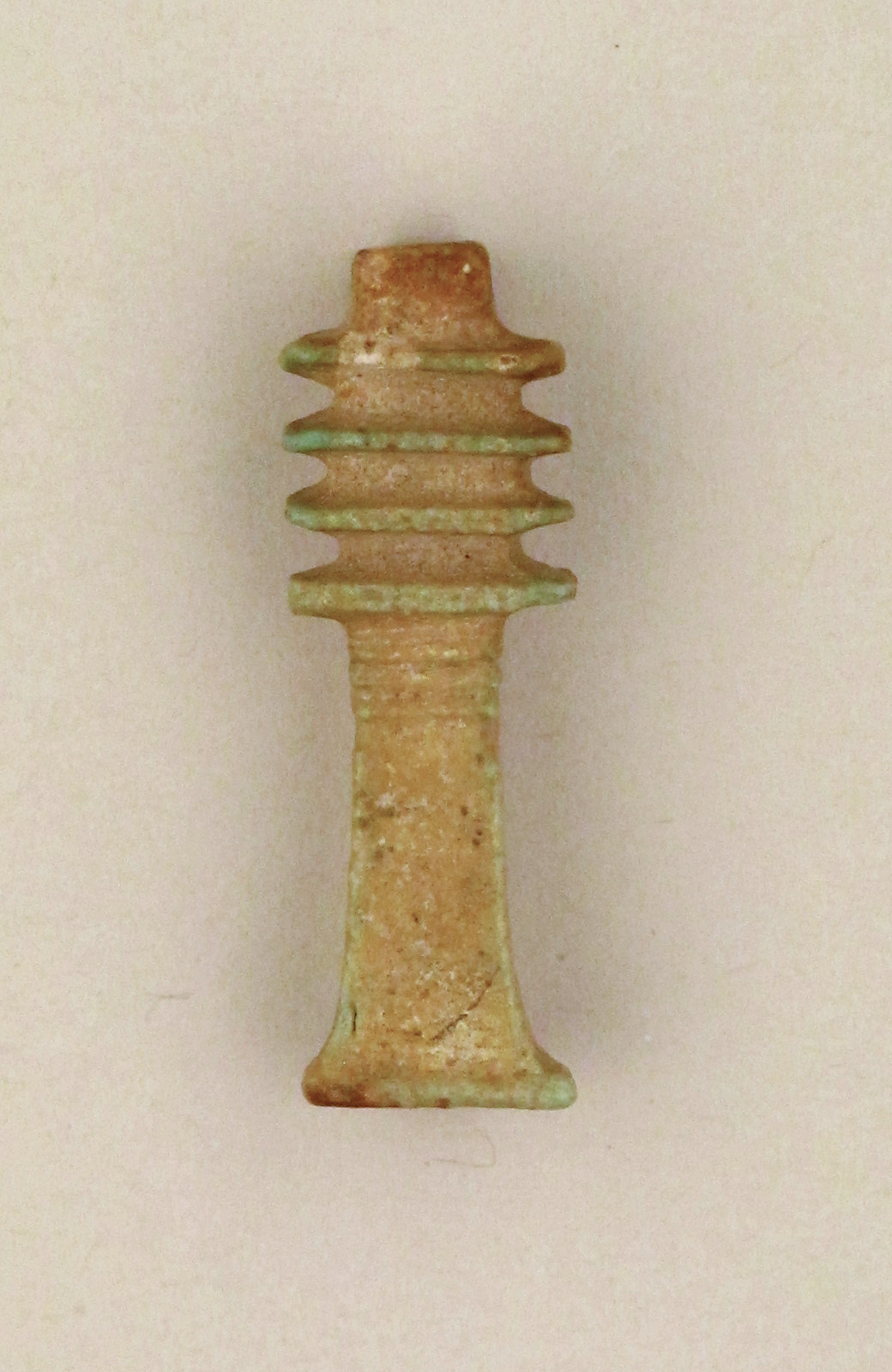
Executive Heritage Assessment: The Faience Djed-Pillar Amulet
This standalone research paper, commissioned by Katherine Fashion Lab, presents a comprehensive heritage analysis of the Egyptian faience djed-pillar amulet. The objective is twofold: to decode the artifact’s symbolic and spiritual lexicon for scholarly documentation, and to translate that lexicon into a viable 2026 high-end luxury strategy. The analysis proceeds from material culture to metaphysical resonance, concluding with actionable brand positioning frameworks.
Material and Craft: The Alchemy of Faience
The djed-pillar amulet in question is rendered in Egyptian faience, a sintered-quartz ceramic celebrated for its lustrous, vitreous surface. Technically, faience is not clay; it is a composite of crushed quartz or sand, alkaline salts, and a copper-based colorant. When fired, it produces a brilliant blue-green glaze, a hue the Egyptians called tjehenet, signifying brilliance and solar rebirth. For Katherine Fashion Lab, the material choice is not incidental. Faience represents one of humanity’s earliest engineered materials—a deliberate act of transformation from mundane silica to sacred luminosity. This aligns with luxury’s foundational ethos: the transmutation of raw matter into objects of enduring value.
From a heritage curatorial standpoint, the djed-pillar’s form is equally significant. The pillar, composed of stacked, horizontal bars atop a central vertical shaft, mimics a stylized tree trunk or a column of vertebrae. Its earliest iconographic appearances date to the Early Dynastic Period (c. 3000 BCE), where it was associated with the god Ptah of Memphis, then later with Osiris, lord of the underworld. The amulet’s compact size—typically 2 to 5 centimeters—belies its monumental metaphysical weight. It was worn on the body, often at the neck or chest, to confer stability and endurance upon the wearer.
Symbolic Power and Spiritual Semantics
The djed-pillar’s primary symbolic value is stability. The hieroglyphic sign djed translates literally as “enduring” or “stable,” and its visual grammar—a vertical axis with horizontal crossbars—suggests a structural spine. In mortuary contexts, the djed was raised as a ritual act to restore order after chaos, mirroring the resurrection of Osiris. For the living, wearing a djed amulet was an act of prophylactic magic: it anchored the wearer’s physical and spiritual integrity against the vicissitudes of existence.
Historical Adornment and Amuletic Function
Historically, amulets were not passive ornaments. They were activated by incantation and placement, often positioned over the heart or throat. The djed specifically was believed to ensure the deceased’s ability to stand upright in the afterlife, a metaphor for moral and physical incorruptibility. In daily life, it functioned as a portable talisman for vitality and resilience. The material—faience—amplified this function through its solar symbolism. The blue-green glaze evoked the Nile’s life-giving waters and the sky’s regenerative power, creating a dual resonance of fertility and eternity.
For high-end luxury, this historical context offers a profound departure from contemporary ornamentation. Modern jewelry often prioritizes surface aesthetics or investment value. The djed-pillar, by contrast, is a wearable technology of the soul. Its power lies not in carat weight but in semiotic density. This distinction is critical for Katherine Fashion Lab’s strategic positioning: the brand can offer not merely objects, but instruments of personal sovereignty.
From Artifact to Aesthetic: Translating Heritage for 2026
As we project toward the 2026 luxury landscape, several macro-trends converge to make the djed-pillar a uniquely resonant motif. First, the post-pandemic consumer has shifted from ostentatious display to meaningful minimalism. Clients seek pieces that communicate inner strength rather than external wealth. Second, there is a growing appetite for cultural intelligence—consumers who value provenance and symbolic literacy over generic bling. Third, the wellness economy has infiltrated luxury, with clients treating jewelry as energetic tools for grounding and clarity.
Strategic Product Architecture
Katherine Fashion Lab should develop a capsule collection titled “The Djed Protocol”, structured around three tiers. The first tier is Heritage Replica: museum-grade reproductions in faience or high-fire porcelain, glazed in the original turquoise, set in 18-karat gold or recycled sterling silver. This tier targets collectors and institutional clients, priced at the $5,000–$15,000 range. The second tier is Contemporary Talisman: a reinterpretation using modern materials—black onyx, lapis lazuli, or titanium—where the djed form is abstracted into a sleek, architectural silhouette. This tier, priced at $2,500–$8,000, appeals to the fashion-forward executive seeking a discreet emblem of endurance. The third tier is Bespoke Ritual Object: a made-to-order commission where the client’s name is inscribed in hieroglyphs on the reverse, accompanied by a personalized “stability invocation” crafted by an Egyptologist. This tier commands a premium of $25,000+, leveraging scarcity and narrative exclusivity.
Brand Narrative and Experiential Retail
The 2026 strategy must extend beyond the product. Katherine Fashion Lab should invest in an immersive retail experience—a “Chamber of Stability”—where clients participate in a sensory ritual. The space would feature dimmed lighting, the scent of myrrh and cedar, and a soundscape of ancient Egyptian temple chants. Upon selection, the client receives the amulet in a bespoke cedar box lined with linen, accompanied by a papyrus scroll explaining the djed’s history. This transforms a purchase into a rite of passage, aligning with luxury’s shift toward experiential ownership.
Furthermore, the brand should position the djed-pillar as a counter-signifier to fragility. In a world of geopolitical volatility and digital impermanence, the djed offers a tangible anchor. Marketing copy should avoid overt religiosity but emphasize universal themes: resilience, alignment, and continuity. The tagline, “Wear Your Spine,” could serve as a dual entendre—referring both to the pillar’s form and to the wearer’s inner resolve.
Conclusion: Strategic Imperatives for Katherine Fashion Lab
The faience djed-pillar amulet is not merely an ancient artifact; it is a blueprint for timeless luxury. Its material alchemy, symbolic stability, and amuletic function provide a rich foundation for a 2026 collection that is both historically literate and commercially avant-garde. To execute this strategy, Katherine Fashion Lab must prioritize three imperatives: authenticity (rigorous scholarly collaboration to ensure accurate iconography), material excellence (investing in faience artisanship or high-end ceramic engineering), and narrative depth (training sales staff as heritage docents, not merely retailers). By doing so, the brand will not only sell jewelry but also offer a modern talisman for an age of uncertainty—an enduring pillar in a transient world.