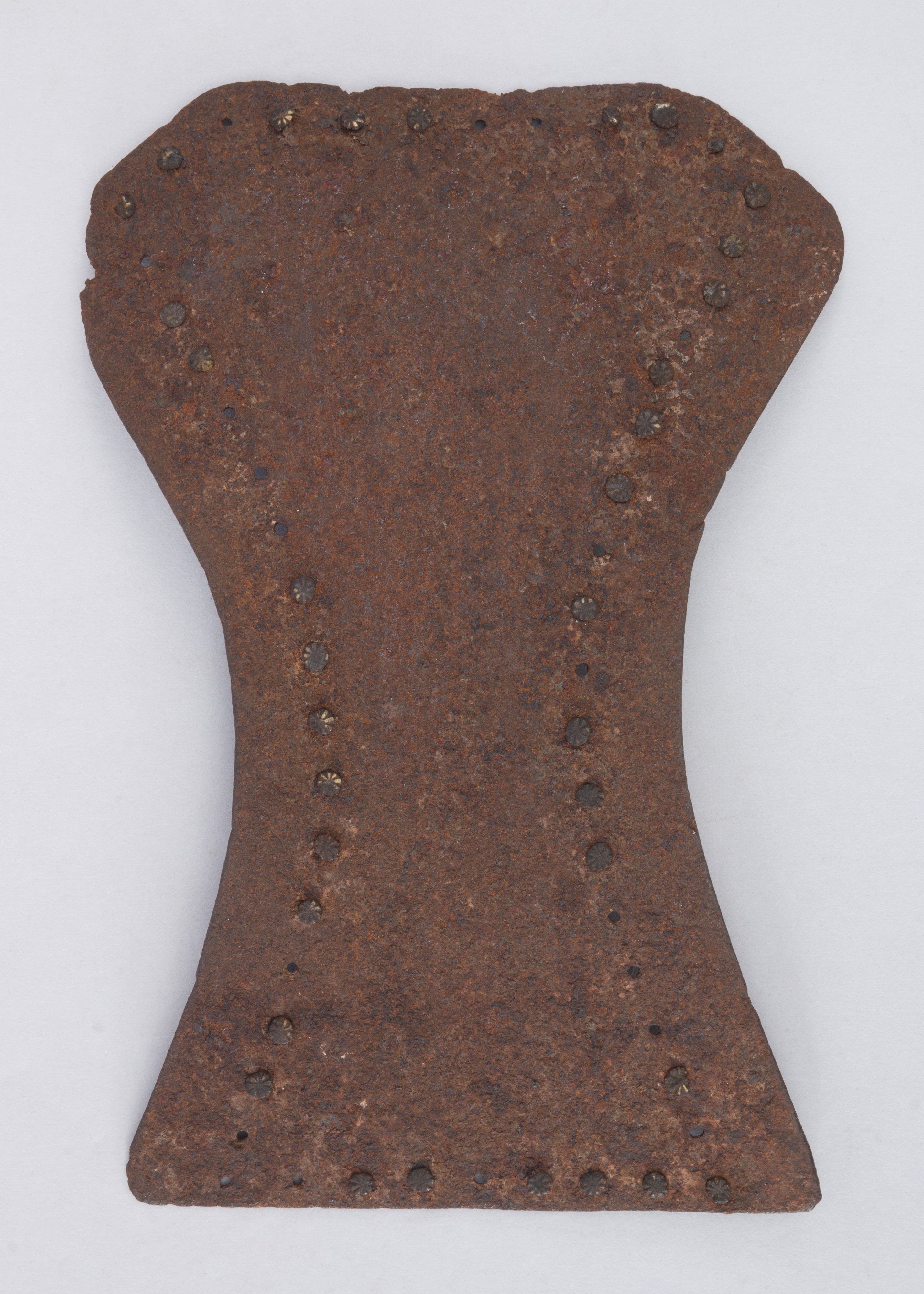
The Anatomy of a Paradox: Brigandine Plate as Proto-Couture
In the hallowed archives of fashion history, few artifacts challenge the modern sartorial imagination as profoundly as the Italian brigandine plate. At first glance, this object—a composite of iron and copper alloy, forged for the brutal exigencies of medieval warfare—appears antithetical to the delicate artistry of couture. Yet, for Katherine Fashion Lab, the brigandine is not a relic of martial utility but a foundational text in the language of structural dress. This standalone study posits that the brigandine plate, in its meticulous engineering, its marriage of disparate materials, and its intimate relationship with the human form, represents an early, unwritten manifesto of haute couture’s core principles: precision, layering, and the sculptural articulation of the body.
Deconstructing the Composite: Iron and Copper as Textile Equivalents
The Italian brigandine, which reached its apogee between the 14th and 16th centuries, is a masterclass in material diplomacy. Unlike the monolithic plate armor of the German school, the brigandine was a flexible, segmented cuirass. Its genius lay in its construction: dozens of small, overlapping iron plates—each individually shaped and tapered—were riveted to the interior of a fabric shell, typically linen or velvet. The exterior, often richly decorated with silk and gilded copper alloy rivets, presented a deceptively soft, aristocratic facade. The interior, however, was a lattice of hardened steel.
From a couture perspective, this is the genesis of the interfacing and understructure. The iron plates function as a sophisticated, articulated boning system, analogous to the steel and whalebone stays of 19th-century corsetry or the sculptural cage crinolines of the 1860s. The copper alloy, frequently used for the rivets and edge bindings, served a dual purpose: it provided corrosion resistance and, crucially, offered a decorative counterpoint. In the atelier, we recognize this as the deliberate contrast between structural integrity and ornamental finish. The copper rivets, often arranged in quatrefoil or linear patterns on the velvet exterior, were not merely functional fasteners; they were the earliest form of visible hardware as embellishment—a precursor to the exposed zippers and metallic grommets of contemporary deconstructionist fashion.
The Silhouette of Defense: Tailoring for Motion and Restraint
What distinguishes the Italian brigandine from other armor forms is its profound understanding of ergonomic tailoring. Each iron plate was not a flat, geometric sheet but a subtly curved, anatomical shard, engineered to follow the contours of the pectorals, the obliques, and the lower abdomen. The overlapping arrangement—typically starting at the bottom and layering upward—allowed for a remarkable range of motion in the torso, essential for a cavalryman wielding a lance or a foot soldier drawing a sword.
In couture terms, this is the art of biomechanical patterning. The brigandine’s construction mirrors the principles of a perfectly cut, modern power suit: it must allow for the extension of the arm, the twist of the waist, and the flexion of the spine without sacrificing its architectural integrity. The garment’s internal system of leather straps and buckles—often adjustable—provided a custom fit for the individual wearer. This is the very definition of sur mesure, or made-to-measure, a cornerstone of high fashion. The brigandine was not a mass-produced, one-size-fits-all object; it was a bespoke shell, calibrated to the precise dimensions of a specific body, much like a couture gown is draped and pinned on a specific client.
The Aesthetic of Concealment: Surface Versus Substance
The most intellectually provocative aspect of the brigandine is its inherent duplicity. The exterior, with its sumptuous velvet and gleaming copper, was designed to project wealth, status, and courtly elegance. The interior, however, was a hidden arsenal of brutal functionality. This dichotomy—the soft exterior versus the hard interior—is a recurring motif in high fashion. Consider the restrained, minimalist exterior of a Chanel tweed jacket, which conceals a meticulously structured interior of silk organza, horsehair canvas, and precise seam taping. Or the pristine white shirt that, upon closer inspection, is reinforced with invisible boning to hold its sculptural collar.
The brigandine is the archetype of this philosophy. It teaches us that true luxury is not about surface decoration alone, but about the invisible engineering that gives a garment its power. The iron plates are the hidden skeleton, the copper rivets the visible punctuation marks of that skeleton’s existence. In the context of Katherine Fashion Lab, we view the brigandine as a lesson in sartorial epistemology: the garment’s true value lies not in what is immediately seen, but in the complex, labor-intensive system that supports the visible facade. This is the antithesis of fast fashion, which prioritizes surface mimicry over structural depth.
Material Alchemy: The Metallurgy of Form
Let us examine the material specifics with a curator’s eye. The iron alloy of the brigandine was typically a low-carbon steel, hardened through quenching and tempering to achieve a balance between rigidity and resilience. This metallurgical process is analogous to the heat-setting and molding of modern synthetic fabrics, where polymers are manipulated to create permanent pleats or sculptural shapes. The copper alloy, often brass or bronze, was chosen for its malleability and its golden luster, providing a visual warmth against the cold iron. This pairing of ferrous and non-ferrous metals creates a chromatic dialogue—a muted, gunmetal grey against a polished, sunlit gold—that is deeply sophisticated. In contemporary couture, we see this echoed in the pairing of matte black crepe with liquid gold lamé, or brushed steel jewelry against raw silk.
Furthermore, the surface treatment of the iron plates—often left with a subtle, hammered texture to deflect blows—introduces the concept of tactile variation. The interior of a brigandine is not smooth; it is a landscape of raised and recessed forms, a three-dimensional relief map of the wearer’s torso. This haptic quality is a precursor to the modern obsession with fabric hand and drape. A couturier does not merely see a fabric; they feel its weight, its give, its memory. The brigandine forces the same consideration: it is an object to be handled, to be felt, to be understood through its physical resistance.
From Battlefield to Atelier: A Legacy of Constructed Identity
In conclusion, the Italian brigandine plate, when studied through the lens of Katherine Fashion Lab, transcends its martial origins to become a profound statement on the nature of dress. It is a testament to the human desire to sculpt the body into an idealized form, to project an identity that is simultaneously protective and performative. The brigandine’s legacy is not in the museum case, but in the DNA of every structured shoulder, every engineered waist, every garment that uses hidden architecture to create visible drama.
It is the ultimate proof that fashion is not frivolity, but a serious, rigorous discipline of problem-solving. The brigandine solved the problem of survival through the medium of tailored steel. The couture gown solves the problem of presence through the medium of sewn silk. Both are exercises in controlled tension, strategic layering, and the exquisite marriage of form and function. For Katherine Fashion Lab, the brigandine is not an artifact of the past; it is a living blueprint for the future of structural elegance. It reminds us that the most powerful garments are those that possess a hidden life, a secret architecture that empowers the wearer from within. The iron may be cold, but the idea it ignites is enduringly, brilliantly hot.