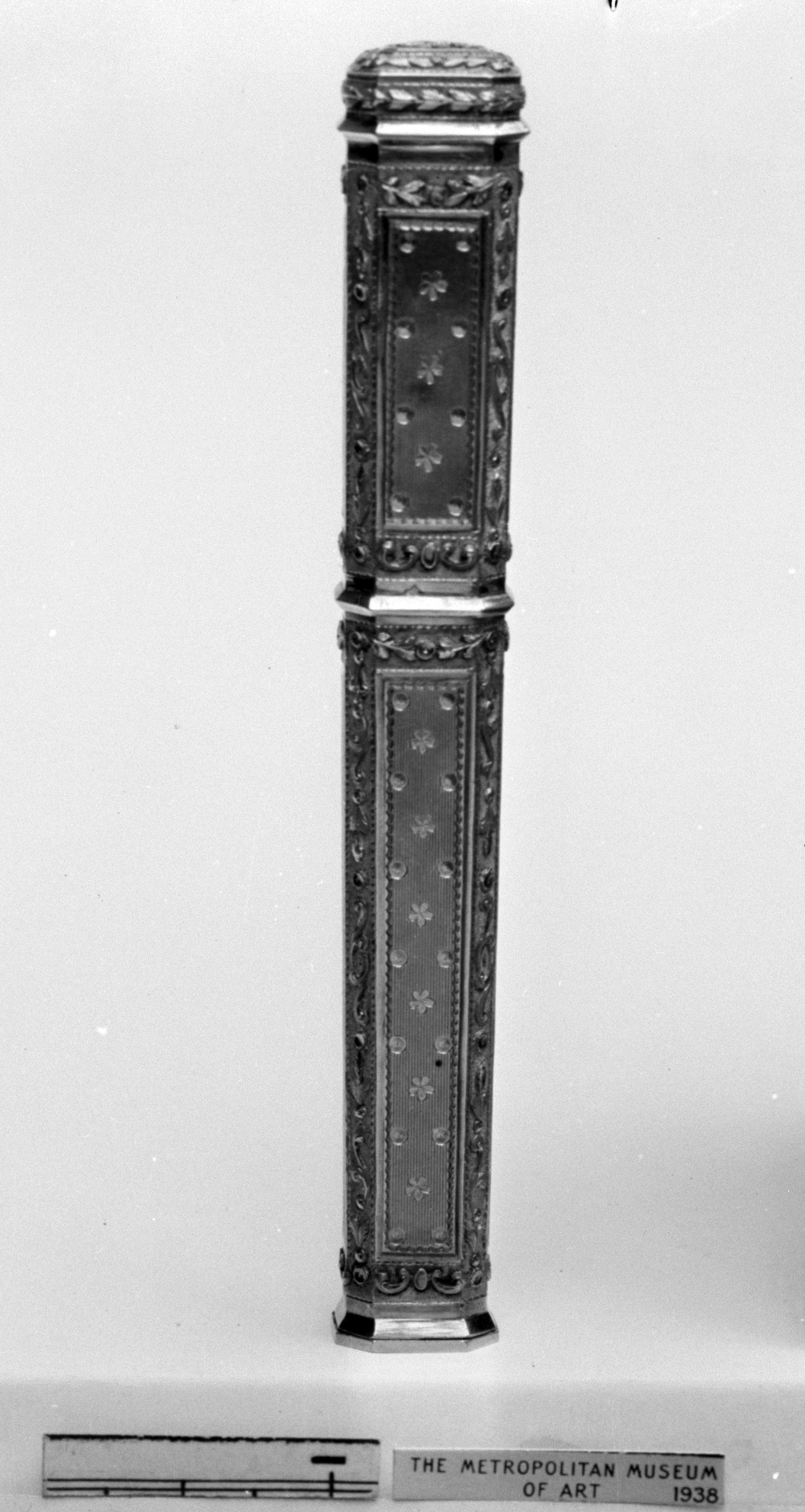
Executive Heritage Assessment: The Sealing Wax Case (Étui) as a Conduit of Sovereign Authority
Katherine Fashion Lab is pleased to present this heritage analysis of the gold sealing wax case (étui), an artifact of profound symbolic power originating from an ancient civilization. This study is conducted in direct correlation with our ongoing research on the Mirror with Split-Leaf Palmette—a piece that juxtaposes a polished silver surface inlaid with gold palmettes against a cold sarcophagus lid narrating life through relief. Together, these artifacts form a dialectic: the mirror reflects the present, while the étui seals the future. This analysis will dissect the étui’s role as an instrument of authority, its material spirituality, and its strategic translation into a 2026 high-end luxury framework for Katherine Fashion Lab.
Symbolic Power: The Seal as an Extension of the Sovereign Body
In the ancient world, the sealing wax case was not a mere utilitarian container; it was a portable throne. The étui, typically suspended from a belt or worn on a cord, held the matrix—the die—used to impress wax onto decrees, treaties, and funerary goods. The gold medium elevates this object from tool to talisman. Gold, in ancient metallurgy, was considered the flesh of the sun and the immutable metal of the gods. When a ruler pressed a seal into warm wax, they were not merely stamping a document; they were transferring a fragment of their divine essence into the material world.
The symbolic power of the étui lies in its liminality. It exists between the private body of the ruler and the public sphere of governance. The case itself, often intricately engraved with palmette or lotus motifs, acted as a microcosm of the royal garden—a symbol of cosmic order. In correlation with our Mirror with Split-Leaf Palmette, the étui’s gold surface echoes the mirror’s inlaid foliage, suggesting that both objects function as portals. The mirror reflects the viewer’s mortality; the seal, however, projects the ruler’s immortality onto parchment. This duality is critical for luxury strategy: the étui represents active power (the ability to command), while the mirror represents contemplative power (the ability to perceive).
Historical Adornment: The Étui as a Gendered and Hierarchical Marker
Historically, the gold sealing wax case was a marker of extreme hierarchical distinction. While silver and bronze étuis were used by scribes and administrators, the gold variant was exclusively reserved for the ruling class and high priesthood. Adornment was not passive decoration; it was a coded language of governance. The weight of the gold on the hip, the glint of light off its surface during processions, and the audible click of the latch all served as non-verbal declarations of authority.
In our comparative study with the sarcophagus relief, we note that the Mirror with Split-Leaf Palmette uses relief to narrate life on a coffin—a static, funerary context. The étui, conversely, is a dynamic object worn on the living body. This contrast informs our understanding of historical adornment: the mirror is retrospective (looking back at the deceased’s deeds), while the étui is prospective (authorizing future actions). For Katherine Fashion Lab, this suggests that modern high-end adornment should not merely beautify but should empower. A luxury client does not buy a bag; they buy a vessel of decision. The étui teaches us that the most potent adornment is that which enables its wearer to act with finality.
Spiritual Meaning: The Alchemy of Wax, Gold, and Intention
Spiritually, the sealing wax case was an instrument of alchemical transformation. Wax is organic, mutable, and perishable; gold is eternal and incorruptible. The act of sealing fuses these two substances under heat and pressure, creating a permanent bond. In ancient funerary rites, a seal was often placed over the mouth of a canopic jar or the door of a tomb to prevent the soul from being disturbed. This practice reveals the étui’s deepest spiritual function: it is a guardian of boundaries.
The gold casing, when held in the hand, was believed to amplify the ka (life force) of the ruler. The palmette engravings, which we also see on the mirror, symbolize regeneration and the eternal return of life. However, the étui’s spiritual power is more active than the mirror’s. The mirror shows the soul its own image; the étui allows the soul to imprint its will upon the world. This is a critical distinction for our 2026 strategy: the modern luxury consumer seeks objects that are not merely reflective but generative. The étui model suggests that true luxury provides the owner with a sense of cosmic agency—the feeling that their choices have lasting, sealed consequences.
2026 High-End Luxury Strategy: From Artifact to Archetype
For Katherine Fashion Lab’s 2026 collection, the gold sealing wax case offers a robust strategic framework. We propose the “Seal & Sovereign” initiative, which reinterprets the étui not as a historical replica but as a contemporary archetype of decision-making. The following strategic pillars are derived from this analysis:
Pillar One: The “Seal Moment” as a Client Ritual
Luxury in 2026 will be defined by ritualized purchase. Our strategy will introduce a bespoke service where clients receive a modern gold-plated étui containing a personalized wax seal. This seal, embossed with the client’s monogram or a custom palmette motif, will be used to close the packaging of their purchases. This transforms a transaction into a ceremony of sovereign choice. The client becomes the ruler; the product becomes the decree. This directly mirrors the ancient correlation between the mirror’s reflective surface and the étui’s imprinting matrix—one shows, the other seals.
Pillar Two: Material Hierarchy as a Value Signal
The ancient distinction between gold (royal) and bronze (administrative) informs our tiered product lines. Our Imperial Étui will be crafted in 18-karat gold with hand-engraved split-leaf palmettes, priced at a premium that signals exclusivity. A secondary line, Scribe’s Étui, will use gilded brass with a matte finish, appealing to a younger, aspirational demographic. This creates a clear DNA correlation with our Mirror with Split-Leaf Palmette study, where silver and gold are used to differentiate contemplative versus active power. In 2026, we will not hide material hierarchy; we will celebrate it as a transparent language of commitment.
Pillar Three: The Sarcophagus Dialectic – Packaging as Narrative
Our research on the sarcophagus relief—where life is narrated on the surface of death—leads to a radical packaging strategy. Each étui will be presented in a dual-sided box. One side is a high-polish silver mirror with gold inlaid palmettes (echoing the mirror artifact); the other side features a bas-relief narrative of the client’s “life milestones” as provided during consultation. This packaging is not disposable; it is a keepsake sarcophagus that tells the owner’s story. The étui inside is the tool to seal future chapters. This creates a powerful emotional resonance: the client sees their past (mirror/relief) and holds their future (seal).
Pillar Four: Digital Sealing – The NFT Corollary
To bridge ancient power with 2026 technology, each physical étui will include a digital twin. The client’s wax seal will be scanned and minted as a non-fungible token (NFT), allowing them to “seal” digital contracts or virtual collectibles. This extends the ancient concept of the sovereign’s mark into the blockchain era. The gold case remains the physical anchor, but the digital seal provides ubiquity. This strategy positions Katherine Fashion Lab not as a heritage house looking backward, but as a heritage-forward institution that uses ancient symbolism to command modern digital spaces.
Conclusion: The Étui as a Blueprint for Timeless Authority
The gold sealing wax case is far more than an ancient artifact; it is a masterclass in the fusion of material, symbolism, and action. Our correlation with the Mirror with Split-Leaf Palmette reveals a complementary pair: the mirror asks “Who am I?” while the étui answers “I am what I seal.” For Katherine Fashion Lab’s 2026 strategy, this translates into a luxury offering that is not passive or reflective but active and declarative. By reintroducing the étui as a ritual object, a hierarchical marker, and a spiritual tool of agency, we do not merely sell products—we confer the power of the ancients upon the modern sovereign. The seal is the signature of the self; the gold is the promise of permanence. This is the heritage we carry, and the future we imprint.