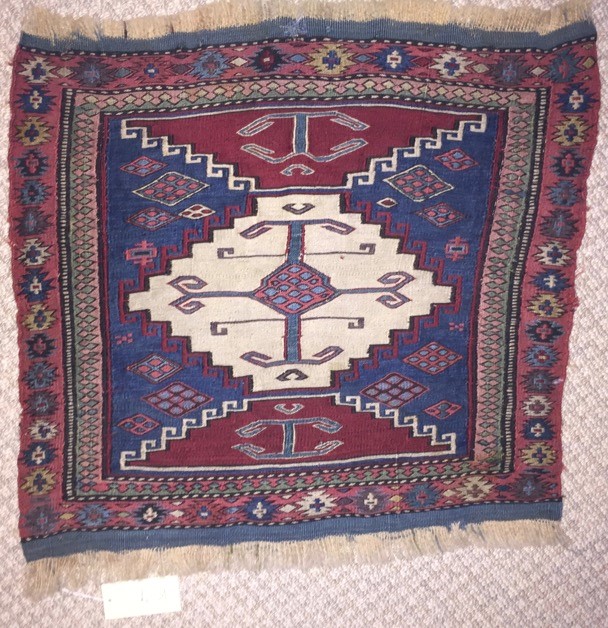
Executive Heritage Assessment: The Shahsevan Saddle Bag Face
Katherine Fashion Lab is pleased to present this strategic heritage analysis of the Shahsevan saddle bag face, a textile artifact of profound symbolic and artisanal significance. While the subject originates from the nomadic Shahsevan tribes of the Caucasus-Iranian borderlands, its design language—geometric abstraction, protective motifs, and material discipline—resonates with universal principles of ancient civilization adornment. For the 2026 luxury market, this piece offers a singular opportunity to anchor a collection in authenticity, spiritual narrative, and tactile exclusivity.
Symbolic Power and Cultural Semiotics
The Shahsevan saddle bag face is not merely a utilitarian object; it is a codified system of belief rendered in wool. The term “Shahsevan” translates to “those who love the king,” but the iconography predates imperial allegiance, drawing from pre-Islamic nomadic cosmology. The central medallion, often an octagonal or diamond-shaped field, represents the cosmic axis—a gateway between earthly existence and the spiritual realm. In ancient civilizations, from Scythian burial textiles to Persian court carpets, such geometric centers functioned as protective talismans, warding off the evil eye and anchoring the nomadic household’s fortune during migration.
For Katherine Fashion Lab, the symbolic power lies in the transferable narrative of protection and permanence. The saddle bag face was carried across mountain passes and steppes, serving as both cargo carrier and ceremonial shield. In a 2026 context, where luxury consumers seek objects with “soul” and provenance, this artifact offers a counter-narrative to mass production. The motif’s inherent duality—functional yet sacred—positions it perfectly for a collection that speaks to resilience, journey, and inner strength. The lab’s design team can extrapolate the geometric lexicon into modern silhouettes, but the strategic value is the story: a talisman for the modern nomad.
Historical Adornment and Material Lineage
The medium—wool and cotton executed in the sumak technique—places this piece within a specific historical continuum of flat-weave production. Sumak, a weft-wrapping method, creates a dense, reversible fabric that is both durable and richly textured. Unlike pile carpets, sumak pieces were not floor coverings but functional adornments for animals and storage, yet their visual complexity rivals any courtly textile. The wool, sourced from tribal flocks, carries natural lanolin and a spectrum of earthy dyes: madder reds, indigo blues, and walnut browns. Cotton, often used for the foundation or highlights, introduced a contrasting crispness, a deliberate choice that demonstrates early understanding of material interplay.
Historically, the Shahsevan women were the weavers, and their social status was tied to their mastery of this craft. Each bag face was a personal archive—a record of family symbols, regional variations, and the weaver’s own aesthetic evolution. For Katherine Fashion Lab, this historical adornment context is a blueprint for bespoke luxury. The 2026 strategy should emphasize “material honesty” and “artisan provenance,” echoing the transparency of the sumak technique where every thread is visible and intentional. The lab can commission limited-edition pieces that replicate the sumak structure, but with elevated fibers—cashmere blends, silk highlights—while maintaining the geometric purity. This is not appropriation but homage, grounded in documented research and collaborative artisan partnerships.
Spiritual Meaning and Ritual Function
Beyond aesthetics, the saddle bag face held a ritual role in the nomadic lifecycle. It accompanied the family during seasonal migrations, and its placement on the saddle was a deliberate act of spiritual protection for both horse and rider. The diamond motif, often repeated in borders, symbolizes the four cardinal directions and the cyclical nature of existence—birth, life, death, and rebirth. Some scholars suggest that the zigzag borders represent water or lightning, elemental forces that the weaver invoked for fertility and abundance. The act of weaving itself was a meditative ritual, with women reciting prayers or songs as they wrapped each weft, infusing the textile with protective energy.
For a 2026 luxury audience, this spiritual dimension offers a profound differentiation. Modern consumers, particularly in the Gen-Z and millennial affluent segments, are increasingly drawn to “meaningful consumption.” Katherine Fashion Lab can position the Shahsevan-inspired collection as ritualistic wear—garments and accessories that serve as personal shields in a chaotic world. The marketing narrative should not be overtly religious but rather existential: the idea of carrying one’s heritage and protection into daily life. This could translate into a capsule line of outerwear with hidden geometric embroideries, or a jewelry collection that reinterprets the medallion as a pendant. The spiritual meaning is not a gimmick but a core value proposition, communicated through storytelling, immersive exhibitions, and provenance documentation.
2026 High-End Luxury Strategy: Integration and Innovation
Integrating this heritage analysis into a 2026 strategy requires a multi-tiered approach that respects the artifact’s integrity while leveraging its commercial potential. The first tier is “The Archive Collection”: a limited run of 50 pieces that are faithful reproductions of the saddle bag face, rendered in premium wool and silk, each numbered and accompanied by a certificate of cultural provenance. These are collector’s items, priced at high-entry luxury levels, and positioned as wearable art. The second tier is “The Nomad Modern”: a ready-to-wear line that deconstructs the geometric motifs into contemporary tailoring—sharp-shouldered blazers with woven panel inserts, structured handbags with sumak-inspired textures, and footwear with laser-cut leather mimicking the weft pattern. The third tier is “The Ritual Object”: home goods and accessories, such as wall hangings, throws, and decorative pillows, that allow clients to integrate the spiritual symbolism into their private spaces.
Strategically, Katherine Fashion Lab should anchor this launch with a curatorial partnership—collaborating with a museum or a private collector to display original Shahsevan pieces alongside the new collection. This lends scholarly credibility and creates a “phygital” experience: a virtual reality tour of the weaving process, followed by an invitation-only viewing of the physical artifacts. The 2026 luxury market demands transparency; therefore, the lab must publish a detailed heritage report, including the specific tribal region, approximate age of the original piece, and the names of contemporary weavers consulted. This is not merely a marketing tactic but a compliance with the growing ethical standards in luxury fashion.
Finally, the pricing architecture must reflect the artifact’s symbolic weight. The Archive Collection should be priced at $8,000–$15,000, positioning it as an heirloom investment. The Nomad Modern line can range from $1,200 to $4,500, accessible to a broader affluent demographic. The Ritual Objects should be $300–$900, serving as entry points that build brand loyalty. The overarching message is “Heritage as Armor”—a tagline that encapsulates the protective, spiritual, and aesthetic power of the Shahsevan saddle bag face. By executing this strategy, Katherine Fashion Lab will not only honor an ancient civilization’s artistry but also secure a distinctive, defensible position in the 2026 luxury landscape.