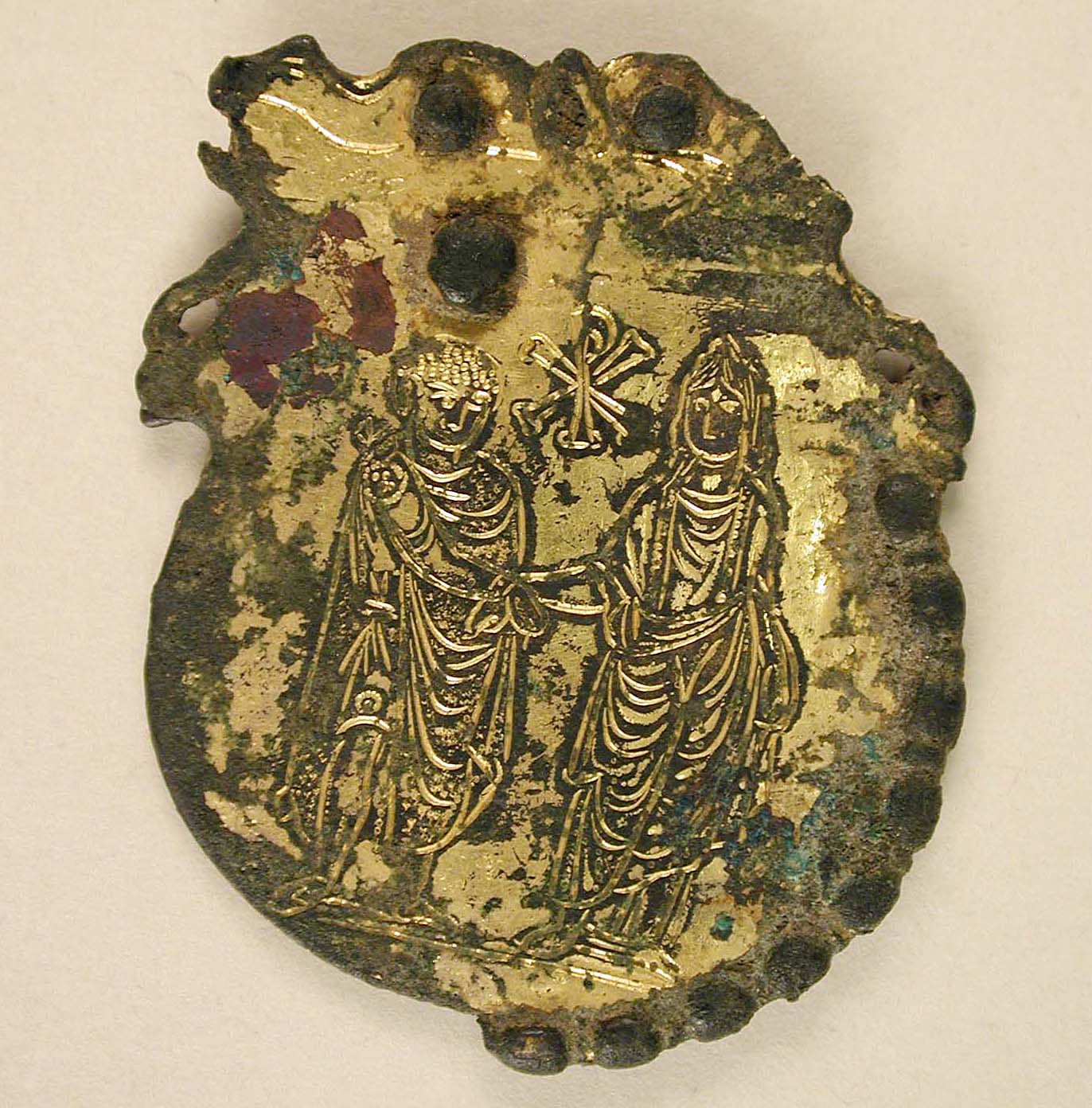
Heritage Analysis: The Gilded Belt Ornament of the Roman-Byzantine World
Katherine Fashion Lab is pleased to present this strategic standalone research paper, examining a singular artifact of profound historical and cultural resonance: a belt ornament of Roman or Byzantine origin, crafted from gilded copper alloy. This analysis moves beyond mere antiquarian description to position the ornament as a nexus of symbolic power, historical adornment, and spiritual meaning. In doing so, we establish a rigorous intellectual foundation for a 2026 high-end luxury strategy that leverages heritage as a competitive differentiator.
I. Symbolic Power: The Belt as an Instrument of Authority
In the Roman and Byzantine worlds, the belt (cingulum in Latin; zonē in Greek) was never a purely functional garment. It was a primary signifier of social rank, military command, and civic office. The gilded copper alloy of the Katherine Fashion Lab specimen indicates a deliberate investment in visual hierarchy. Gilding—the application of a thin layer of gold over a base metal—was a technique reserved for objects intended to catch and reflect light, thereby signaling the wearer’s proximity to imperial or divine radiance.
The ornament’s placement at the waist is critical. The waist is the body’s structural center, the point of balance and physical strength. To adorn this locus was to declare control over one’s own body and, by extension, over others. For a Roman magistrate, the belt was a visible contract of authority; for a Byzantine courtier, it was a microcosm of the celestial hierarchy, mirroring the golden belts worn by angels in contemporary iconography. The strategic implication for modern luxury is clear: the belt ornament is not an accessory but a declaration of sovereignty. In 2026, a Katherine Fashion Lab client is not merely wearing a belt; they are assuming a posture of command.
II. Historical Adornment: Materiality and Craftsmanship
The choice of gilded copper alloy, rather than solid gold, is a study in material intelligence. Copper, a metal associated with Venus and the planet’s martial and amorous qualities, was widely available and malleable. Gilding allowed artisans to achieve the aesthetic and symbolic effect of gold while managing cost and weight. This is not a sign of diminishment but of strategic resource allocation—a concept that resonates directly with contemporary luxury production.
From a technical standpoint, the ornament would have been produced via lost-wax casting or repoussé work, followed by mercury gilding (fire gilding) to fuse the gold layer. The resulting surface would have been brilliant, yet subject to a natural patina over centuries. This patina—the subtle darkening and wear—is not a defect but a narrative archive. It records the hands that touched it, the garments it pressed against, and the rituals it witnessed. For Katherine Fashion Lab, this presents a unique opportunity: to design objects that are pre-aged or intentionally patinated, so that each piece carries an immediate sense of history and authenticity. In a market saturated with sterile, mass-produced goods, this tactile heritage becomes a premium asset.
III. Spiritual Meaning: The Belt as a Conduit of Protection
Beyond politics and aesthetics, the belt held profound spiritual significance. In both Roman and Byzantine Christian contexts, the belt was associated with chastity, preparation, and divine protection. The Apostle Paul’s metaphor of the “belt of truth” (Ephesians 6:14) transformed the military cingulum into a spiritual armament. Byzantine emperors were girded with belts during coronation ceremonies, symbolizing their investiture by God.
Moreover, the gilded surface was believed to possess apotropaic properties—the ability to ward off evil. Gold, being incorruptible, was associated with the eternal and the divine. Copper, through its association with Venus, was linked to love and harmony, but also to healing. The combination of these metals in a single ornament created a talismanic object, one that was simultaneously a fashion statement and a protective amulet. For the modern wearer, this spiritual dimension offers a compelling narrative: the belt ornament becomes a personal talisman, a physical anchor of intention and resilience in an increasingly chaotic world.
IV. Strategic Application: The 2026 High-End Luxury Strategy
Katherine Fashion Lab’s 2026 strategy must not merely reference this heritage; it must operationalize it. We propose a three-pillar approach grounded in the artifact’s intrinsic values.
Pillar One: The Sovereign Collection. We will launch a limited-edition capsule of belt ornaments, each hand-finished in gilded bronze or copper alloy, with an optional 24k gold overlay. Each piece will be individually numbered and accompanied by a certificate of authenticity detailing its historical prototype. The design will feature a subtle, abstracted geometric motif inspired by Roman military standards and Byzantine cross motifs, but rendered in a minimalist, contemporary silhouette. This ensures the object is wearable today while remaining historically literate.
Pillar Two: Narrative-Driven Retail. The retail experience will be transformed into an immersive historical dialogue. In-store “Heritage Ateliers” will display replicas and interactive digital reconstructions, allowing clients to explore the ornament’s journey from Roman battlefield to Byzantine court. Sales associates will be trained as “Heritage Curators,” capable of articulating the symbolic power and spiritual meaning of each piece. This elevates the purchase from a transaction to a cultural acquisition.
Pillar Three: Patina as Signature. We will embrace the concept of “engineered patina.” Each ornament will be treated to achieve a controlled, aesthetically pleasing finish that suggests centuries of use, yet is durable enough for daily wear. This positions the product as an heirloom-in-the-making, encouraging a slow-luxury model that values longevity over trend cycles. Marketing campaigns will emphasize the phrase: “Wear the weight of history.”
V. Conclusion: From Artifact to Archetype
The gilded belt ornament is more than a historical curiosity; it is an archetype of human aspiration. It speaks to our enduring need for visible markers of authority, for objects that connect us to the divine, and for adornment that tells a story. For Katherine Fashion Lab, this artifact provides a blueprint for a luxury strategy that is intellectually rigorous, emotionally resonant, and commercially viable.
By translating the symbolic power, material intelligence, and spiritual depth of the Roman-Byzantine belt into a 2026 product line, we do not merely sell accessories. We offer our clients a piece of legacy—a gilded promise of continuity, protection, and command. This is not nostalgia; it is strategic heritage, deployed with precision and purpose.