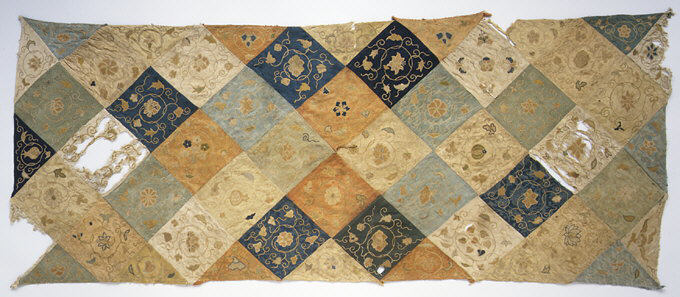
The Embroidered Patchwork Panel: A Study in Material Hierarchy and Temporal Resonance
In the rarefied echelons of couture analysis, the object of study often transcends mere garment construction to become a treatise on material culture, technical virtuosity, and the silent language of provenance. The Embroidered Patchwork Panel, a standalone study piece from Katherine Fashion Lab, offers precisely such a discourse. Originating from China and composed of a startlingly complex amalgam of silk needle-loop embroidery over gilt paper, mounted upon a substrate of simple gauze silk, silk damask, silk satin, and plain weave silk, this panel is not a fragment of a garment but a complete, autonomous artifact. It demands to be read not as a preparatory sketch, but as a finished manifesto on the dialectic between opulence and restraint, between the artisan’s hand and the weaver’s loom.
Deconstructing the Palimpsest: A Layered Material Vocabulary
The immediate visual and tactile impact of the panel is one of orchestrated density. At its core lies the embroidered patchwork—a deliberate, non-random assemblage of disparate silk textiles, each selected for its distinct weave structure and optical behavior. The silk damask provides a ground of figured opulence, its reversible patterns creating a subtle, shifting play of light that catches the eye before the embroidery claims dominance. In counterpoint, the silk satin offers a lustrous, unbroken surface, a field of high-gloss reflection that serves as a foil to the matte, absorbent quality of the plain weave silk. This juxtaposition is not accidental; it is a calculated exercise in textural counterpoint, where the eye moves from the deep, liquid glow of satin to the crisp, understated grid of plain weave, finding rest in the intricate topography of the needlework.
Yet, the panel’s most intellectually provocative element is the gilt paper underlying the needle-loop embroidery. This is not a precious metal thread, but paper—a humble, ephemeral material—gilded and elevated to a position of structural importance. The choice is deeply resonant. In Chinese material culture, paper is the vehicle of scholarship, calligraphy, and ritual offering. By placing gilt paper beneath silk thread, the artisan performs a quiet subversion of material hierarchy. The paper is not hidden; rather, its subtle crackle and slight unevenness beneath the loops of silk create a micro-topography that catches ambient light, producing a shimmer that is less assertive than metallic thread, yet more intimate. It is a whisper of gold, not a shout.
The Needle-Loop Technique: Sculpture in Silk
The needle-loop embroidery (often associated with techniques like Peking knot or forbidden stitch, though here executed in a looped, pile-like formation) elevates the panel from a two-dimensional surface to a low-relief sculpture. Each loop is a discrete, deliberate act of tension and release. The thread is pulled through the substrate, formed into a loop, and secured, creating a dense, carpet-like pile that stands in stark contrast to the flat, woven grounds beneath. This technique requires an extraordinary level of manual dexterity and a profound understanding of thread torsion; a single miscalculation in tension would result in a deformed loop, disrupting the entire field.
From a couture perspective, this is the antithesis of speed. It is a meditation on slowness, a commitment to the haptic intelligence of the hand. The looped pile does not merely decorate; it absorbs and diffuses light, creating a velvet-like depth that is unique to this technique. Where the satin reflects and the damask patterns, the needle-loop embroidery captures light, holding it within the tiny cavities of each loop. This creates a tripartite visual rhythm: reflection, refraction, and absorption. The viewer is not simply looking at a textile; they are observing a controlled experiment in photonic interaction.
Patchwork as Narrative: The Grammar of Assemblage
The term “patchwork” often connotes frugality or utilitarian recycling. However, in this panel, patchwork is a curatorial act. The selection and placement of each silk fragment—the damask, the satin, the plain weave—is a formal decision, akin to a painter choosing pigments. The patches are not random remnants; they are deliberately sized and oriented to create a rhythmic alternation of texture. This is a study in positive and negative space, where the embroidered loops act as the unifying agent, overlaying the disparate patches and binding them into a cohesive visual field.
This approach offers a profound lesson for contemporary couture. In an era of mass production and digital printing, the panel asserts the primacy of material honesty. The silk is not printed to imitate another fabric; it is used for what it is. The damask’s weave, the satin’s sheen, the gauze’s transparency—each is allowed to speak in its own register. The embroidery does not conceal these differences; it amplifies them, drawing attention to the joints and seams where one fabric meets another. This is a celebration of construction, a refusal to hide the artifice of assembly. In this sense, the panel is a proto-deconstructivist artifact, anticipating the work of later designers who exposed seams and celebrated the internal logic of tailoring.
Provenance and the Gilt Paper Paradox
To contextualize this piece within its Chinese origin is to understand the cultural weight of its materials. Silk, of course, is the quintessential Chinese luxury export, a fiber historically reserved for imperial courts and aristocratic elites. The gilt paper, however, introduces a more complex narrative. Paper was invented in China, and its use in textile arts—particularly in the creation of gold leaf for embroidery—has a long, storied history. Yet, the application here is unusual. Rather than using gold-wrapped thread (a common technique), the artisan has chosen to lay down a ground of gilt paper and then embroider over it.
This is a deliberate act of material subjugation. The paper, despite its gilded surface, is structurally fragile. It cannot bear the weight of a heavy metallic thread; it requires the gentle, looping pressure of silk. The result is a hybrid object—neither purely textile nor purely papercraft. It occupies a liminal space, challenging the taxonomy of traditional Chinese textile classification. This liminality is its greatest strength. It forces the observer to question assumptions about durability, value, and the hierarchy of materials. Is the paper merely a support, or is it an active participant in the visual effect? The answer is unequivocally the latter.
Conclusion: A Study in Autonomy
As a standalone study, this Embroidered Patchwork Panel is not subordinate to a larger garment. It is an end in itself. It functions as a technical specimen, a cultural document, and an aesthetic object in equal measure. For the couturier or the design scholar, it is a masterclass in the integration of disparate elements—a lesson in how to achieve unity without uniformity, and richness without excess. The panel demonstrates that true luxury lies not in the cost of the raw material alone, but in the intelligence of its application. By pairing the humble gauze with the opulent damask, and by elevating gilt paper to a position of structural significance, the artisan has created a work that is simultaneously ancient and modern, traditional and radical.
Katherine Fashion Lab’s decision to present this as a standalone study is a curatorial statement in itself. It removes the utilitarian context of the garment and forces a direct, unmediated engagement with the material. The viewer is invited to consider the time, labor, and cultural memory embedded in every loop and every seam. In a world of fleeting trends, this panel stands as a monument to permanence—a quiet, shimmering testament to the enduring power of the hand and the inexhaustible potential of silk. It is not merely an embroidered patchwork; it is a philosophy of making, rendered in thread and gilt.