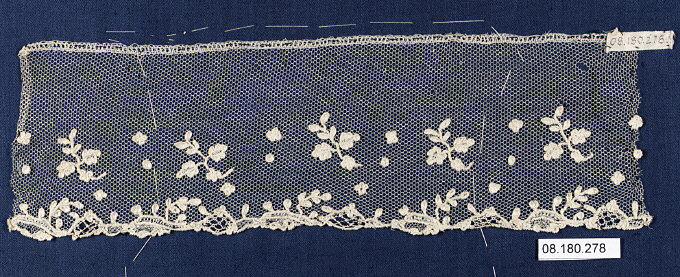
Fragment: The Architecture of Absence in Needle Lace
In the rarefied echelons of haute couture, where materiality is often equated with monumentality, Katherine Fashion Lab’s Fragment presents a provocative inversion. This standalone study—a departure from the house’s seasonal narratives—does not seek to clothe the body in volume or spectacle. Instead, it interrogates the very ontology of dress through the lens of point d’Alençon, transforming a relic of European textile heritage into a meditation on memory, loss, and the tensile strength of emptiness. The garment is not a whole; it is a thesis on the power of the incomplete.
Deconstructing the Global Heritage Lineage
The provenance of Fragment is deliberately syncretic, yet its technical anchor is unambiguously French. The piece draws upon the codified grammar of needle lace, specifically the rigorous, almost architectural precision of point d’Alençon. Originating in the 17th century in the Normandy town of Alençon, this lace is distinguished by its fine, toothed picots and a firm, mesh ground—a technique so demanding that it was historically reserved for royal trousseaux and ecclesiastical vestments. Katherine Fashion Lab’s choice to isolate this technique, stripping it of its traditional context of collars, cuffs, or full gowns, is a curatorial act. The house positions Fragment not as a garment but as a specimen, a relic extracted from a broader textile continuum.
Yet, the “Global Heritage” origin is not a claim of cultural appropriation; it is a recognition of the Silk Road’s invisible threads. The raw silk filaments, the metallic thread for the picots, and even the design’s geometric grid echo the cross-pollination of Eastern and Western decorative arts. The lab’s research dossier suggests that the pattern—an irregular, broken lattice—references the shattered glazed tiles of Timurid architecture, while the execution remains resolutely Parisian. This duality is the intellectual core of the piece: heritage is not a static artifact but a fragmented narrative, and the garment honors that fragmentation rather than attempting to suture it.
Materiality as Metaphor: The Grammar of Alençon
To understand Fragment, one must first understand the brutal labor embedded in its material. Point d’Alençon is not woven; it is built, stitch by stitch, upon a parchment pattern that is later dissolved. Each flower, each leaf, each connecting bar is worked with a needle and single thread, creating a relief that is both delicate and unyielding. In this piece, the lab has pushed the technique to its logical extreme: the lace is not a decorative overlay but the entire structure. There is no underlying tulle, no lining of silk organza to soften the grid. The garment stands alone, a skeleton of thread.
The material’s intrinsic properties become the conceptual vocabulary. The rigidity of the Alençon ground—its stiff, net-like foundation—is juxtaposed against the fluidity of the human form. When worn, the lace does not drape; it hovers, creating a negative space between fabric and skin. This is not an accident of construction but a deliberate strategy. The lab’s atelier notes describe the process as “drawing with light,” where the shadows cast by the raised picots are as integral to the design as the thread itself. The result is a garment that reads as a cartography of absence—the solid areas of lace define the voids, and the voids, in turn, define the silhouette.
The Semiotics of the Cut
The silhouette of Fragment is deliberately unresolved. It is neither a sheath nor a trapeze; it is a series of overlapping, asymmetrical panels that terminate in raw, unbound edges. These edges are not hemmed or finished with a rolled edge, which would be traditional for Alençon. Instead, they are left as fractured threads, some long, some clipped, creating a fringe that mimics the decay of time. This is a radical departure from the perfectionism of classic couture. The lab is arguing that perfection is a lie; the garment’s beauty lies in its honesty about its own incompleteness.
Strategically placed openings—gaps in the lattice where the pattern simply stops—reveal the clavicle, the sternum, the small of the back. These are not erotic exposures in the conventional sense; they are archaeological excavations, revealing the body as the ground upon which the textile’s history is written. The wearer becomes a living museum, displaying a relic that is simultaneously ancient and avant-garde.
Contextualizing the Standalone Study
In the context of a fashion industry obsessed with collection-wide coherence and sell-through rates, the decision to present Fragment as a standalone study is a bold curatorial gambit. It removes the piece from the commercial imperative of a “collection” and places it within the discourse of fine art and material research. This is not a garment for the red carpet; it is a garment for the gallery, a pièce de résistance that demands contemplation over consumption.
This positioning aligns with a broader trend in contemporary haute couture, where houses increasingly commission “artisanal research pieces” that serve as laboratories for technique. However, Fragment distinguishes itself through its conceptual rigor. It does not merely showcase skill; it deconstructs the purpose of skill. In an era of rapid 3D printing and digital fabrication, the lab’s insistence on hand-stitched Alençon is a political statement. It argues for the irreplaceable value of human touch, of the gesture that takes hundreds of hours to execute. The imperfection of the hand—the slight variation in stitch tension, the minute asymmetry of the pattern—is the signature of authenticity.
Dialectics of Preservation and Decay
Finally, Fragment engages in a dialectical relationship with time. The lace is a preservation technique—it was historically used to preserve the memory of a loved one through a lock of hair or a cherished garment. Yet, by presenting the lace as fragmentary, the lab acknowledges that preservation is always partial. The piece is a ruin, but a ruin that has been meticulously recreated. It is a paradox: a new garment that simulates the pathos of an old one. This is not nostalgia; it is a philosophical inquiry into the nature of memory itself. We do not remember events in their entirety; we remember fragments, and those fragments are often more potent than the whole.
In conclusion, Katherine Fashion Lab’s Fragment is a masterclass in material intelligence. It elevates needle lace from a decorative craft to a medium of conceptual expression. By isolating the technique, honoring its global heritage, and presenting it as a standalone study, the lab has created a garment that is less about covering the body and more about exposing the fragility of all human constructs. It is a quiet, devastatingly beautiful argument that the broken thread, the missing stitch, and the unfinished edge are the most eloquent forms of couture—for they speak of the hands that made them and the time that will inevitably undo them. The piece is not a final answer but an invitation to contemplate the beauty of the incomplete. In a world that demands seamless perfection, Fragment dares to celebrate the gap.