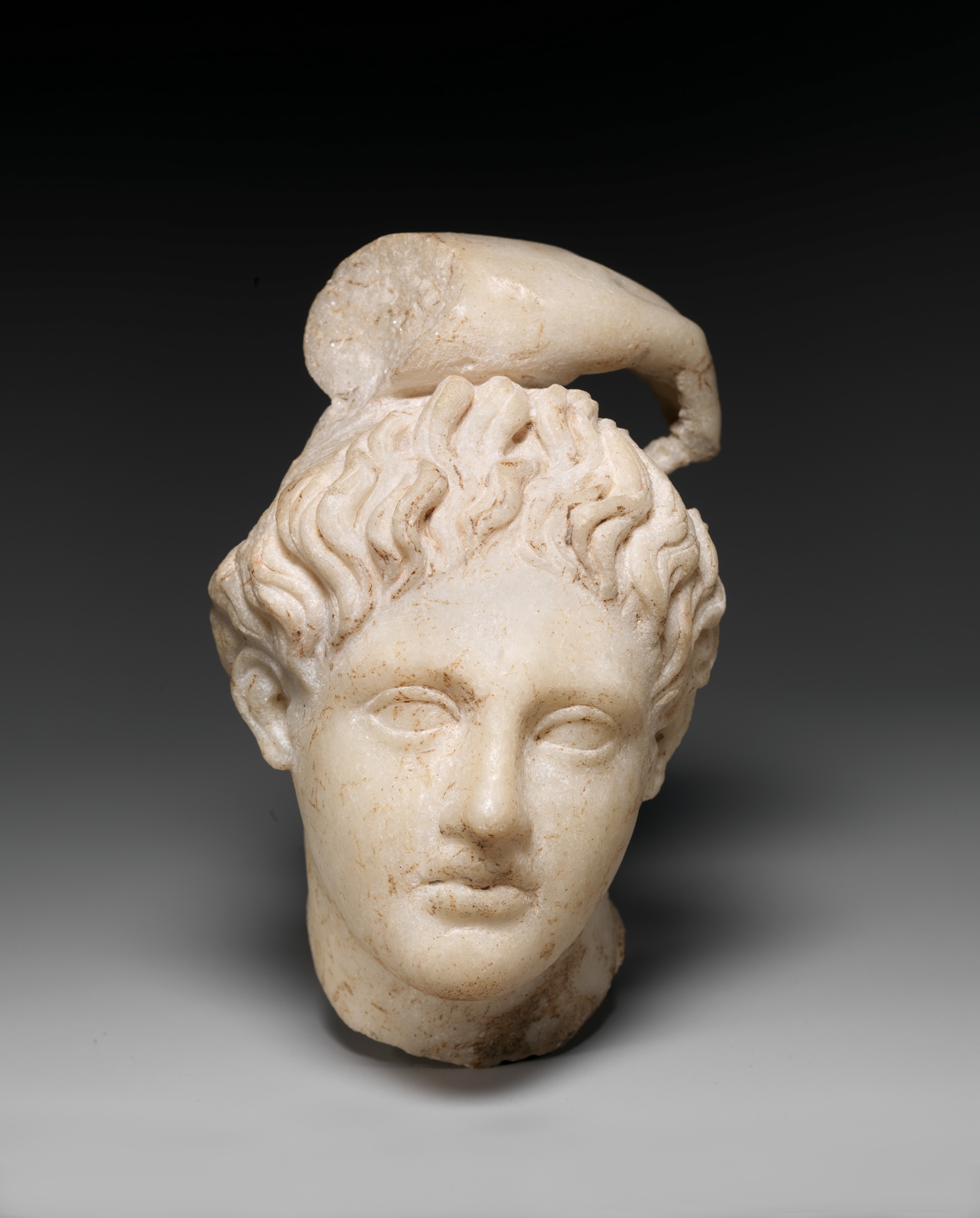
Executive Heritage Summary: The Marble Apollo as a Blueprint for Transcendent Luxury
This strategic analysis examines the Roman marble head of Apollo, accompanied by a fragment of his hand, as a foundational artifact for Katherine Fashion Lab’s 2026 high-end luxury positioning. The sculpture is not merely a relic of classical antiquity; it is a codified system of symbolic power, historical adornment, and spiritual meaning. For a luxury house seeking to move beyond transient trends, Apollo offers a permanent lexicon of authority, beauty, and divine proportion. This paper deconstructs the artifact’s layered heritage and translates its core principles into a concrete, actionable strategy for the upcoming fiscal year, focusing on narrative ownership, material storytelling, and client experience architecture.
Symbolic Power: The Anatomy of Divine Authority
The fragmentary nature of the head and hand is not a loss but a strategic asset. In Roman culture, the head (caput) was the seat of rational authority and civic identity, while the hand (manus) signified agency, creation, and benefaction. Together, they form a synecdoche for Apollo’s dual role as god of light (truth) and god of art (craft).
For Katherine Fashion Lab, this duality maps directly onto the luxury value proposition. The head represents the house’s intellectual rigor—its curatorial vision, its commitment to historical accuracy, and its refusal to dilute its DNA. The hand represents the atelier’s physical mastery—the precision of a seam, the weight of a drape, the finishing of a bespoke garment. In 2026, the luxury consumer is no longer buying a product; they are buying provenance and potency. Apollo’s head and hand, even in ruin, project an unbroken lineage of control. The lab’s strategy must therefore position every garment not as an item of clothing but as an instrument of the wearer’s own authority. The brand should adopt a visual motif of the fragmented hand—perhaps as a bespoke clasp or an embroidered interior label—to signify that each piece is a fragment of a larger, divine whole, accessible only to the initiated.
Historical Adornment: The Grammar of Classical Beauty
Apollo’s portrayal in Roman marble is a study in idealized symmetry, yet it is not sterile. The curls, carved with deep undercutting, create a play of light and shadow that mimics gilded laurel—the ultimate symbol of victory. The smooth, unblemished skin of the face is a testament to the Roman ideal of virtus (masculine excellence) achieved through restraint, not excess.
From an adornment perspective, the sculpture teaches a critical lesson: ornamentation is a function of structure, not addition. The laurel wreath, though absent in marble, is implied by the hair’s texture. For Katherine Fashion Lab’s 2026 collection, this translates to a design philosophy of architectural minimalism. Instead of literal Greek key prints or column motifs, the lab should employ subtle optical illusions—for instance, a bias-cut gown that mimics the fluting of a column, or a tailored jacket with a shoulder seam that recalls the contrapposto stance. Adornment should be an internal logic: hidden boning that creates a silhouette of Apollonian calm, or a single, perfectly placed crystal that catches light like a dewdrop on marble. The hand fragment suggests a focus on manual gestures—long gloves, articulated cuffs, or rings designed to draw the eye to the wearer’s own hand, thereby transferring the divine agency to the client.
Spiritual Meaning: Light, Healing, and the Luxury of Clarity
Apollo is not merely an artist; he is the healer and the purifier. His epithets include Paean (healer) and Phoebus (radiant). In the Roman world, his image was invoked for protection against plague and moral decay. This spiritual dimension is the most potent, yet most delicate, asset for a modern luxury house.
The 2026 luxury market is saturated with narratives of escapism and hedonism. Katherine Fashion Lab can differentiate by leveraging Apollo’s spiritual core: clarity as a form of healing. In a fragmented, digitally chaotic world, the marble head’s serene, unblinking gaze offers a form of visual meditation. The lab’s strategy should create a ritual of dressing that mirrors a purification rite. This can be achieved through a dedicated Apollonian Atelier experience, where clients are invited to a space of white marble, soft natural light, and silence. Here, the consultation is framed as a diagnosis of the client’s lifestyle, and the resulting garment is prescribed as a corrective to imbalance. The spiritual meaning is not religious; it is therapeutic and aspirational. The brand should adopt a fragrance or textile treatment infused with laurel and bay leaf—sacred to Apollo—to engage the olfactory sense, creating an invisible aura of purity and victory.
2026 High-End Luxury Strategy: The Apollo Protocol
Translating this heritage into a commercial strategy requires a three-pillar approach: Narrative Ownership, Material Theology, and Scarcity of Access.
Pillar One: Narrative Ownership
Katherine Fashion Lab must claim the exclusive narrative of the “Fragmented Divine.” This is not a trend; it is a permanent brand philosophy. The lab should publish a limited-edition heritage folio—a leather-bound tome featuring macro-photography of the marble’s surface, highlighting the chisel marks and the subtle veins of the stone. This folio is not for sale; it is gifted only to top-tier clients, establishing the brand as a custodian of classical knowledge. The language should shift from “collection” to “fragments of a new canon.”
Pillar Two: Material Theology
Materiality is the medium through which the spiritual meaning is transmitted. In 2026, the lab will introduce a signature textile called Marmor—a proprietary blend of virgin wool, silk, and a subtle metallic thread that mimics the cool, dense weight and subtle sheen of polished marble. This fabric will be used for a capsule line of “Statue Drapes”—garments that, when worn, create the illusion of a classical toga but with modern, engineered construction. The hand fragment is interpreted in hardware: all zippers, buttons, and clasps will be cast in oxidized silver with a hand-hammered texture, reminiscent of a sculptor’s unfinished work. This tactile imperfection in an otherwise perfect garment is the signature of authenticity.
Pillar Three: Scarcity of Access
Apollo’s power lies in his distance. The 2026 strategy will implement a “By Consultation Only” model for the Apollonian Collection. This is not a rejection of commerce but a curation of it. Clients must be referred by existing patrons or have a documented history with the lab. Each commission is limited to one piece per client per season, mirroring the uniqueness of a carved statue. The final garment is delivered in a marble-textured, weighted box with a certificate of authenticity that includes the specific provenance of the marble fragment that inspired it. This scarcity creates a psychological premium; the garment is not purchased, but bestowed.
Conclusion: The Eternal Present
The Roman marble head of Apollo is a masterclass in enduring relevance. It survived centuries not because it was static, but because its core principles—authority, proportion, and clarity—are universally aspirational. For Katherine Fashion Lab, this artifact is not a historical footnote but a strategic compass. By adopting the Apollo Protocol, the lab will not merely sell clothing; it will offer a fragment of timelessness in a disposable world. The hand may be broken, but the gesture of creation remains eternal—and that is the ultimate luxury.